Full Body Stretches
The lift in my building was out of order last Tuesday. Four floors to climb before my first cup of tea. By the second landing my calves were tight, my lower back was complaining, and my shoulders — eight hours hunched over a laptop, every day — felt like they belonged to someone else entirely. I got to my front door. Sat down on the step. And realised something simple. It wasn’t the stairs. I just hadn’t stretched properly in weeks.
That’s how full-body stiffness works. It doesn’t arrive all at once. One small area at a time. A stiff neck on Monday. Tight hips by Thursday. Until one ordinary thing — a broken lift, a long drive — adds them all up and hands you the bill. A short daily routine won’t undo years of sitting. It won’t fix a real injury either. But ten, twelve minutes, slow and regular, keeps the whole body moving the way it’s supposed to. That’s the whole promise here. Nothing more. Nothing less.
One thing first, and it matters more than any stretch below. Recent injury, a diagnosed joint or spine condition, numbness, pain shooting down an arm or leg — check with your doctor or physiotherapist before starting. This routine is for everyday stiffness. The sitting kind. The bad-sleep kind. The getting-older kind. Not for a body that needs medical attention. One rule through the whole thing: stop if it hurts. A stretch should feel like a gentle pull, never a sharp pain. This article is general wellness information only — not medical advice.
Why Stretch the Whole Body, Not Just the Sore Bit
The mistake most of us make? Neck hurts, stretch the neck. Lower back aches, stretch the lower back. Helps — for about an hour. Then the ache comes back. Because the tightness was never only in one place.
Your body works as a chain. Tight calves change how you walk. That loads the knees differently. That tightens the hips. That pulls on the lower back. That hunches the shoulders. Stretch only the sore link and the rest of the chain keeps dragging it back out of place. Stretch the whole chain — even the parts that feel fine — and everything gets a little more room. That’s why, in my experience, a short full-body routine beats a long session aimed at one spot. Ten minutes covering everything does more than twenty spent on a single ache.
The other thing a whole-body routine gives you is a daily check-in. You notice things. Left hip tighter than the right today. Right shoulder doesn’t lift as far as last week. That kind of noticing is useful. It tells you where to go gently, when to back off — long before a small stiffness turns into a proper problem. I check my left shoulder every morning now, without thinking about it — if it lifts fine, the day goes fine, and if it doesn’t, I go slower on the twist and the side bend.
Once a day. Ideally the same time. First thing in the morning works well — stiffness is at its worst then, so you feel the difference most. Late evening works too, especially after a day of sitting. The regularity matters, not the hour. Seven stretches. About twelve minutes. A mat or a rug, a bit of floor space. That’s it.
The Routine: 7 Full Body Stretches
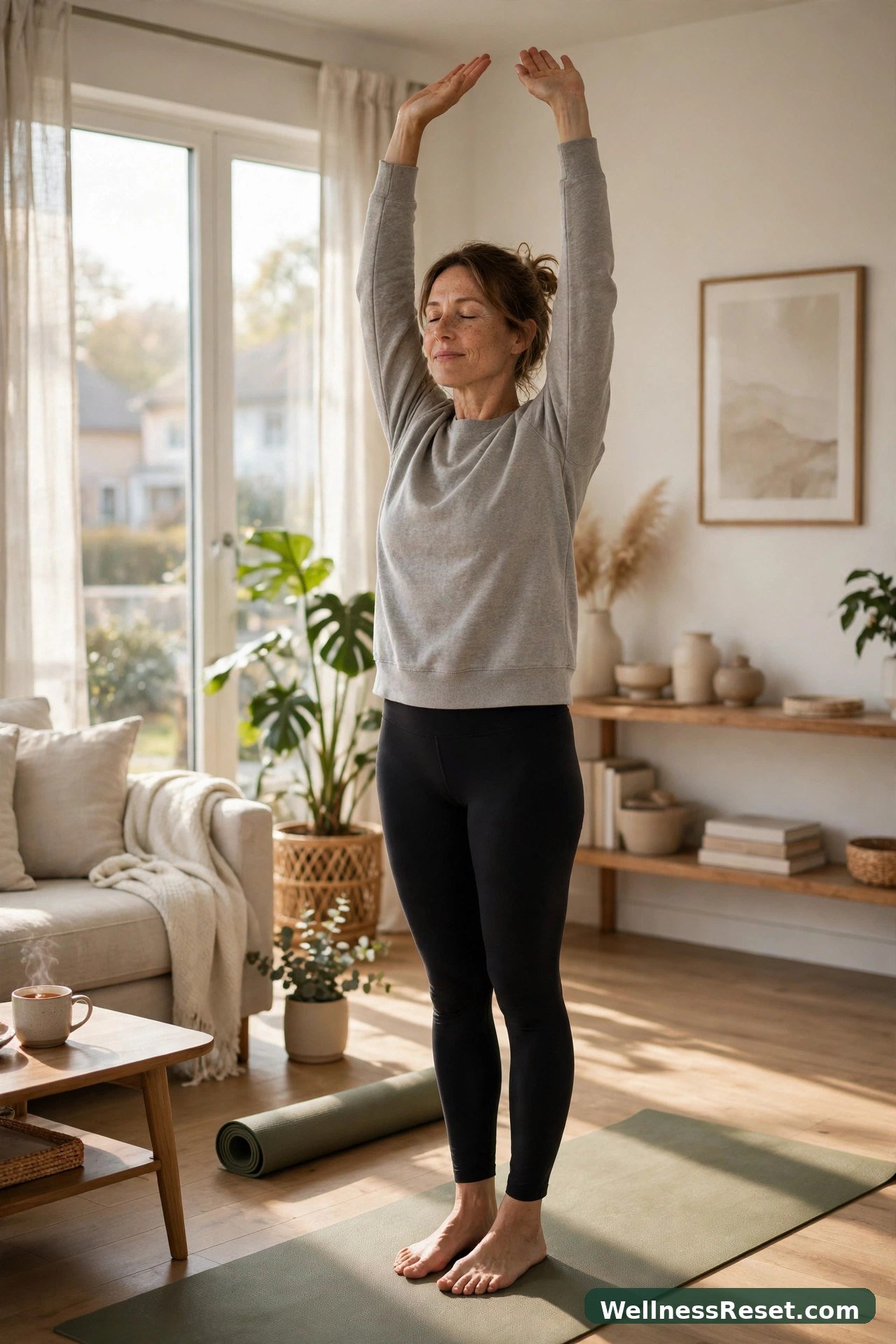
1. Overhead Reach
Best for: a stiff spine and shoulders, first thing in the morning.
Stand tall, feet hip-width apart, knees soft. Lace your fingers together and reach both arms up overhead, palms facing the ceiling. Stretch tall, as if you are trying to touch the ceiling, and take three slow breaths. Then lean gently to the right for two breaths, come back to centre, and lean left for two breaths. That is one round. Do two rounds. Keep your ribs down — the stretch should be in the sides of your body, not in your lower back arching.
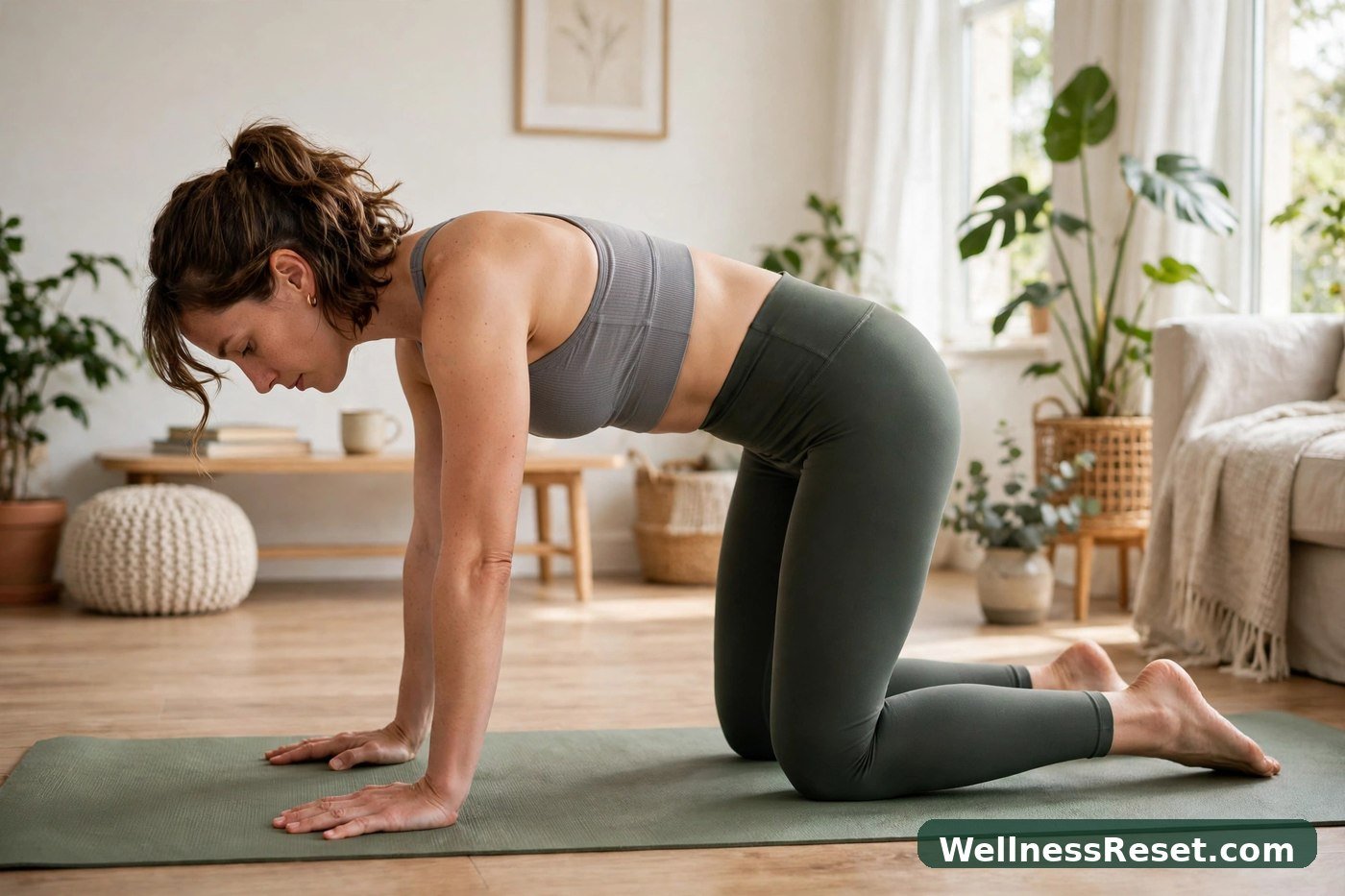
2. Cat-Cow
Best for: a lower back that feels rusty after sleep.
Come onto all fours, hands under your shoulders, knees under your hips. Breathe in, let your belly drop toward the floor and lift your head slightly — that is the cow. Breathe out, round your spine up toward the ceiling and tuck your chin — that is the cat. Move slowly, one full breath per position. 8 rounds. This is the gentlest move in the set, and the one I would keep if I could only keep one.
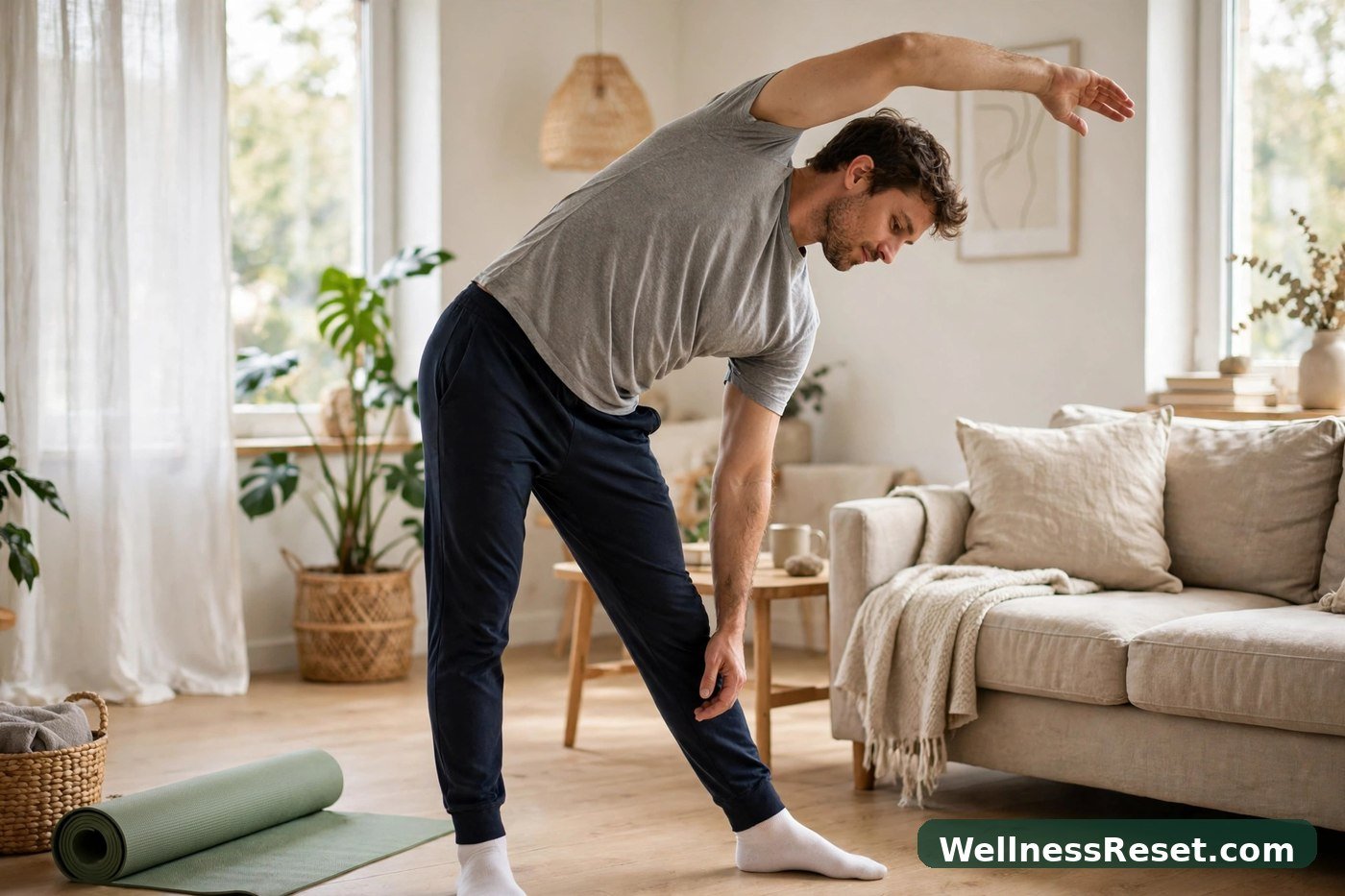
3. Standing Side Bend
Best for: the sides of the waist. And shoulders that hunch forward at a desk.
Stand with your feet a little wider than your hips. Reach your right arm overhead and lean slowly to the left, feeling the stretch run down your right side. Hold for 20 seconds, breathing normally. Come back up and switch sides. Two rounds per side. If your balance feels wobbly, stand next to a wall and rest your free hand on it. The stretch should feel like a long, even pull — if you feel a pinch in your lower back, you have leaned too far.
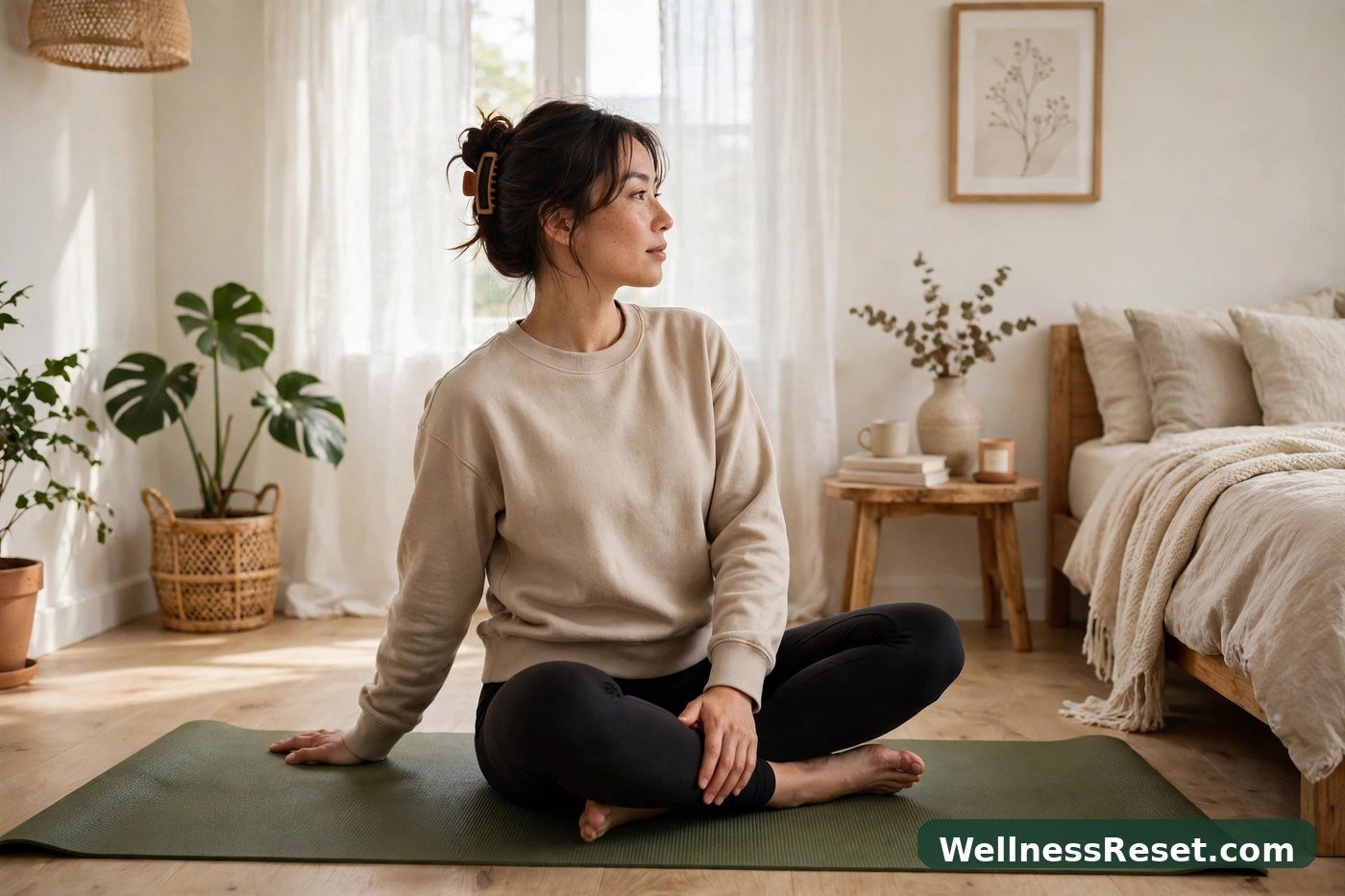
4. Seated Spinal Twist
Best for: a stiff mid-back. Hips that feel locked after sitting all day.
Sit on your mat with your legs crossed, or on a chair if the floor is hard to get to. Sit tall. Put your right hand on your left knee and your left hand on the floor behind you. Twist gently to the left, looking over your left shoulder, and hold for 20 to 30 seconds. Come back to centre slowly and twist the other way. Two rounds per side. Keep both sitting bones on the floor — the moment one lifts, the twist stops being useful and starts being a wobble.
5. Standing Forward Fold
Best for: tight hamstrings and calves. The whole back of the body, which sitting shortens.
Stand with your feet hip-width apart. Soften your knees — a small bend, not a squat — and fold forward from your hips, letting your arms hang toward the floor. Let your head hang heavy. Hold for 30 seconds, breathing slowly. If your hands don’t reach the floor, that is completely fine; rest them on your shins or on a chair seat in front of you. Never bounce to get further down. Two rounds. Come back up slowly, one vertebra at a time, so you don’t feel dizzy.
6. Chest Opener Against a Wall
Best for: rounded shoulders. A chest that tightens after hours at a keyboard.
Stand sideways next to a wall, about an arm’s length away. Put the palm of your near hand flat on the wall behind you, at shoulder height, fingers pointing back. Turn your body slowly away from the wall until you feel a gentle stretch across the front of your chest and shoulder. Hold 20 to 30 seconds, then switch sides. Two rounds per side. This one surprises people. The chest is often the tightest part of the whole body — and the part we almost never stretch.
7. Lying Knee-to-Chest
Best for: finishing up — lower back and hips, fully relaxed.
Lie on your back on the mat, knees bent, feet flat. Bring one knee slowly toward your chest, holding behind the thigh — not on top of the knee. Hold 20 to 30 seconds, then lower it and switch legs. Then, if it feels comfortable, bring both knees up together and hold for 30 seconds, rocking gently from side to side. Three rounds per leg. This is the closing move. Don’t rush it.
If your knees or lower back need their own focused work on other days, our Knee Stretches routine covers the joint in more depth, and our Lower Back Stretches go slower on the area most people feel first. The routine here is the whole-body version — use the others on alternate days if one area needs extra attention.
Step by Step: Your 12-Minute Session
Minutes 1–2: warm up. Walk around the room for a minute. 5 slow shoulder rolls each way, 5 gentle neck half-circles. Cold muscles stretch badly. Two minutes of easy movement makes the rest of the session work better — and stops the first stretch feeling like a shock.
Minutes 2–5: standing stretches. Overhead reach (2 rounds). Standing side bend (2 rounds per side). Standing forward fold (2 rounds). Slow. Breathing normally. This is where your body starts to feel longer.
Minutes 5–8: floor stretches. Cat-cow (8 rounds). Seated spinal twist (2 rounds per side). Stay on the mat. If getting down to the floor is hard, do the twist sitting on a chair instead. The routine still works.
Minutes 8–10: chest and finish. Chest opener against the wall (2 rounds per side). Lying knee-to-chest (3 rounds per leg). Slow down on purpose here. The last two minutes are for letting the body settle — not for squeezing in one more stretch.
Minutes 10–12: lie still. On your back, arms at your sides, five slow breaths. Notice how your body feels compared to twelve minutes ago. Most days the difference is small but real. Shoulders a little lower. First steps a little less creaky. That is the point. Small. Daily. Honest. Sometimes I stay there longer. Nobody’s timing you.
Troubleshooting
| Problem | Quick fix |
|---|---|
| A stretch feels sharp, not gentle | Ease off immediately — go half as far and hold half as long |
| You feel dizzy in the forward fold | Come up slowly and sit down; bend your knees more next time |
| One side is much tighter than the other | Give the tight side an extra round, but never force it to match |
| Lower back aches during the twist | Sit taller and twist less far — keep both sitting bones down |
| Shoulders creep up toward your ears | Drop them deliberately before every stretch; tension hides there |
| You feel worse the morning after | You pushed too far — halve every hold time for a week |
| No change after two weeks | Check your form against the steps above, and mention it at your next doctor visit |
Common Mistakes
Bouncing. The old “bounce into the stretch” habit. Worst thing you can do to stiff muscles. Bouncing triggers the stretch reflex, and the muscle tightens. Slow and still, every time. Catch yourself bouncing? You’ve gone too far. Back off until you can hold still.
Holding your breath. The moment a stretch gets interesting, people stop breathing. Catch yourself doing it, ease off until you can breathe normally again. The breath tells you whether you’re in the right range. Sounds too simple to matter. It matters more than the stretch itself.
Chasing the deepest stretch. The goal isn’t touching your toes or twisting like a pretzel. It’s a gentle pull, held 20 to 30 seconds. Depth comes on its own, over weeks. Force it and you buy yourself a sore body tomorrow — and a sore body skips the next session.
Stretching only the sore spot. Like I said earlier — the sore spot is usually the end of a chain, not the cause. Give the whole body its turn, even the parts that feel fine today. The parts that feel fine are the ones keeping the sore part working.
Doing it once and deciding it does nothing. One session loosens you for an hour. Twenty sessions change how your mornings feel. Give it three weeks before you judge it. And if the same movement keeps hurting after three weeks of gentle practice, get it checked rather than pushing through. That’s what doctors are for. No article should try to recieve that job.
Final Words
Four floors. No lift. One sore body. That was my reminder — it doesn’t need to be yours. Twelve minutes, a mat, a bit of patience. That’s all this routine asks. It’s not exciting. That’s the point. It’s the quiet daily habit that keeps stairs from getting longer and mornings from starting stiff.
Start tomorrow morning, before the day gets busy. Stand up. Lace your fingers together. Reach for the ceiling. That’s the first stretch. The rest is just doing it again tomorrow.
FAQ
How often should I do full body stretches?
Once a day. Twelve minutes, same time each day, so it becomes a habit. Twice a day is fine too if you’re very stiff — just keep each session gentle. Daily beats one long session a week.
Can full body stretches help with back pain?
They can ease the stiffness around a sore back and help you keep the movement you have. They can’t cure the cause of back pain, and they’re not a substitute for medical care. Sharp pain, pain shooting down a leg, numbness — see a doctor first.
Is it better to stretch in the morning or evening?
Whichever time you’ll actually do it. Morning suits stiffness best — that’s when the body is at its tightest. Evening suits people who want to unwind after sitting all day. Pick one. Keep it.
Should I stretch before or after exercise?
Gentle stretching like this is a good warm-up on its own. Before harder exercise, do a few minutes of easy movement first — walking, marching in place — then stretch. After exercise, slow stretching helps the muscles settle.
What if I can’t do all seven stretches?
Do the ones you can. Skip the rest, no guilt. Four stretches done daily beat seven done once. If getting to the floor is the problem, the standing stretches and the wall chest opener alone still make a useful five-minute routine. Start with the two standing ones and the wall chest opener.