
Text Neck: 6 Stretches for a Neck Sore From Phone Use
Your head weighs about 5 kilograms. Tilted forward at the angle most people hold their phones — roughly 45 degrees — the effective load on your neck jumps to over 20 kilograms. Hold that for the 3–4 hours a day the average person spends on their phone, and you have the recipe for “text neck”: the stiff, achy neck, tight shoulders, and tension headaches of the smartphone era.
The stretches below undo exactly what the phone posture does — they reverse the forward-head position, open the chest, and wake up the deep neck muscles that go quiet when you hunch. Do them once a day; the whole set takes about 10 minutes.
Why the Phone Posture Hurts
Three things happen when your head drifts forward over a screen:
The deep neck flexors weaken. These small muscles at the front of the neck hold your head balanced over your spine. When the head juts forward, they switch off and the big surface muscles take over — badly.
The chest shortens. Rounded shoulders pull the pecs tight, which pulls the shoulders further forward. A loop.
The upper traps overwork. The muscles from neck to shoulder end up carrying that 20-kilo effective head weight all day. They were not designed for that shift.
Stretching alone helps, but the permanent fix includes one strengthening move (number 6 below) and one habit change (at the end). Stretching without those two is mopping while the tap runs.
The 6 Stretches
1. Chin Tucks (the foundation)
Sit or stand tall. Without tilting your head up or down, glide your chin straight back — like making a double chin on purpose. Hold 5 seconds, release. Repeat 10 times. This directly reverses forward-head posture and reactivates the deep neck flexors. It looks like nothing. It is the most important exercise on this list. Best for: forward-head posture, the “head jutting” look.
2. Upper Trapezius Stretch
Sit tall. Drop your right ear toward your right shoulder. Place your right hand gently on the left side of your head — the weight of the hand only, no pulling. Hold 30 seconds. Switch sides. You should feel it from the neck down into the top of the shoulder. Best for: the tight band between neck and shoulder.
3. Levator Scapulae Stretch
This one targets the muscle that runs from the neck to the shoulder blade — the classic “crick in the neck” muscle. Turn your head 45 degrees to the right (look toward your right armpit direction), then tuck your chin down toward your chest. Place your right hand on the back of your head and let its weight increase the stretch. Hold 30 seconds each side. Best for: sharp stiffness when turning your head.

4. Doorway Chest Opener
Stand in a doorway. Place your forearms on the doorframe, elbows at shoulder height. Step one foot through the doorway and lean gently forward until you feel the stretch across your chest and the fronts of your shoulders. Hold 30–45 seconds. This undoes hours of rounded-shoulder phone posture in under a minute. Best for: rounded shoulders, tight chest.

5. Prone Cobra (floor)
Lie face down, arms at your sides, forehead on the floor. Squeeze your shoulder blades together and lift your chest a few inches — head stays in line with the spine, do not crank the neck back. Hold 5 seconds, lower. Repeat 8–10 times. This strengthens the exact back muscles that the phone posture lets go slack. Best for: weak upper back, postural endurance.
6. Deep Neck Flexor Strengthening (lying chin tucks)
Lie on your back, no pillow. Tuck your chin (same motion as stretch 1) and lift your head about an inch off the floor, holding the tuck. Hold 10 seconds, lower. Repeat 5–8 times. If 10 seconds is too much, start with 5. These small muscles are the long-term fix — stretching opens things up, but only strength keeps your head where it belongs. Best for: lasting posture correction.

The Habit Change That Matters More Than Stretching
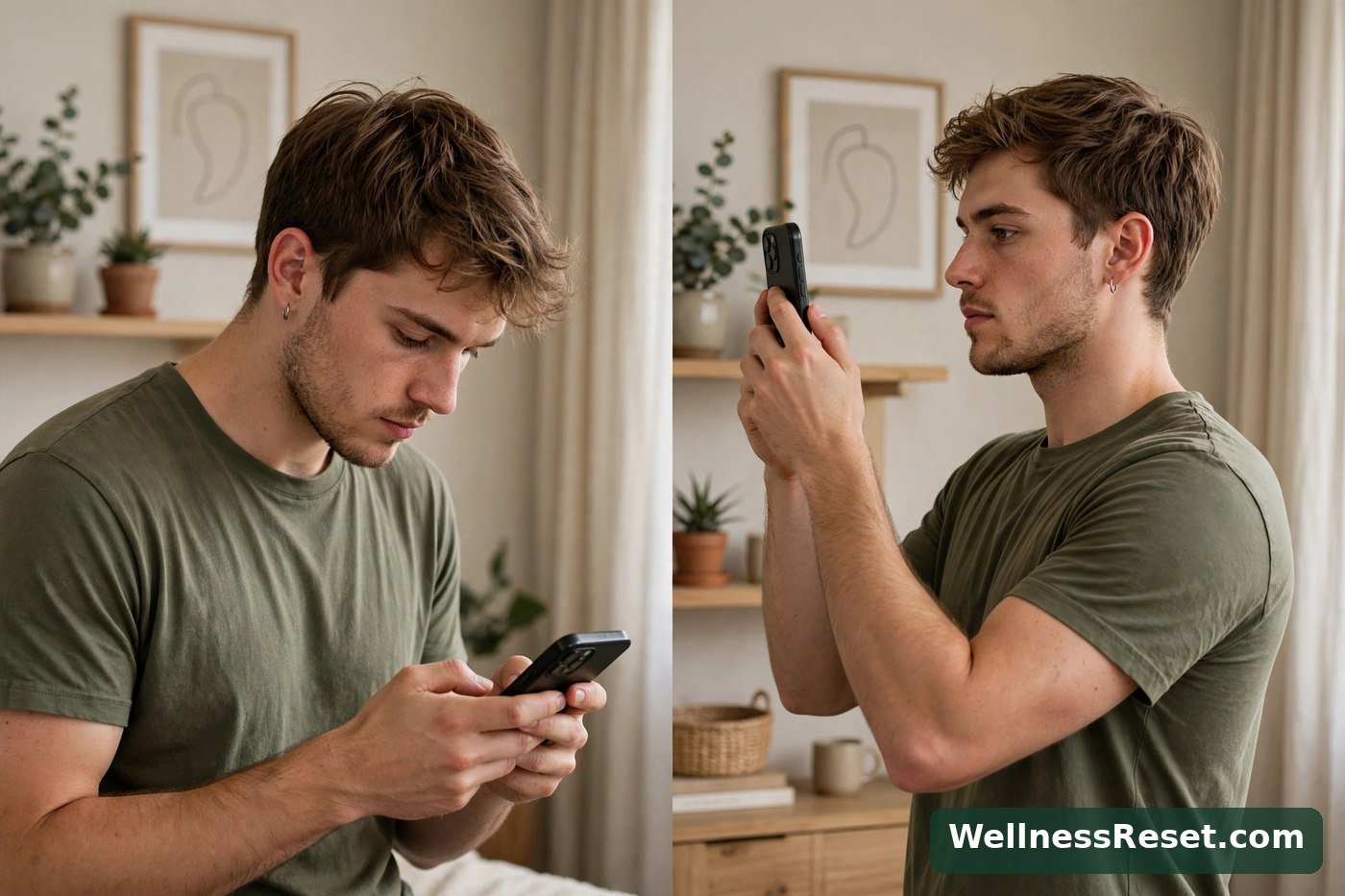
Raise the phone. That is it. Hold your phone at eye level instead of in your lap — bend your elbows, not your neck. It feels awkward for two days and then becomes automatic. Every stretch above is fighting your posture; this change stops creating the problem in the first place.
Two more micro-habits:
- The 20-minute check: set a reminder — every 20 minutes of phone time, do 5 chin tucks. Takes 30 seconds.
- No phone in bed on your side: side-lying scrolling twists the neck sideways for an hour. Sit up or skip it.
Problem → Quick Fix
| Problem | Quick fix |
|---|---|
| Chin tucks feel like nothing is happening | Place a finger on your chin — you should feel it glide backward, not down; the motion is horizontal |
| Stretch 3 gives a sharp pinch | Reduce the head turn to 30 degrees and do not add hand weight — sharp means back off |
| Doorway stretch hurts the shoulder joint | Lower the elbows below shoulder height; pain in the joint (not the muscle) means stop |
| Headaches after stretching | You are probably pressing too hard — all stretches here use gentle pressure only, never force |
| Neck cracks loudly during stretches | Painless cracking is harmless; painful cracking is a stop sign — see a professional if pain persists |

Common Mistakes
Only stretching, never strengthening. Stretching the front and sides feels good immediately, which is why everyone does it and stops there. But without the deep neck flexor work (moves 1 and 6), the head drifts forward again within hours. Stretch opens, strength holds.
Aggressive neck circles. Full head-rolling grinds the neck joints through their end ranges under load. The half-circle version (ear to shoulder, chin to chest, other ear) is safer and hits the same muscles.
Stretching once and expecting a cure. Text neck took years to build. Ten minutes daily for 2–3 weeks is when people typically report the “my neck feels normal again” moment.
Final Words
Text neck is not a mysterious condition — it is a straightforward mechanical problem with a straightforward fix: reverse the posture, open the chest, strengthen the deep neck muscles, and raise the phone. Six moves, ten minutes, one habit change. Your neck did not ask for the smartphone era; this is how you negotiate peace with it.
For the broader desk-posture picture, Fix Your Posture at Your Desk covers the full workstation setup, and the Chair Yoga for Neck Pain routine gives you a gentle movement sequence for screen-stiff necks.
FAQs
What exactly is text neck?
The informal name for neck pain, stiffness, and headaches caused by prolonged forward-head posture — most commonly from looking down at phones. It is a descriptive term, not a medical diagnosis.
How long does it take to fix text neck?
With daily stretching plus the phone-height habit change, most people feel meaningful improvement in 2–3 weeks. Full postural correction takes longer — think months — because you are retraining years of habit.
Can text neck cause permanent damage?
For most people it causes pain and stiffness, not structural damage. But chronic forward-head posture is linked to disc issues and nerve irritation over years. The fix is the same either way: correct the posture now rather than later.
Should I buy a posture corrector brace?
They can remind you to sit straight, but they do the muscles’ job for them — long-term use can weaken the very muscles you need. The strengthening moves in this article are the better investment.
Is it safe to crack my own neck?
Do not forcefully twist or crack your own neck — aggressive self-manipulation risks injury. The gentle stretches here are safe; high-velocity cracking is a job for trained professionals, if anyone.







One Comment