
Fix Your Posture at Your Desk: 7 Simple Moves That Undo a Day of Slouching
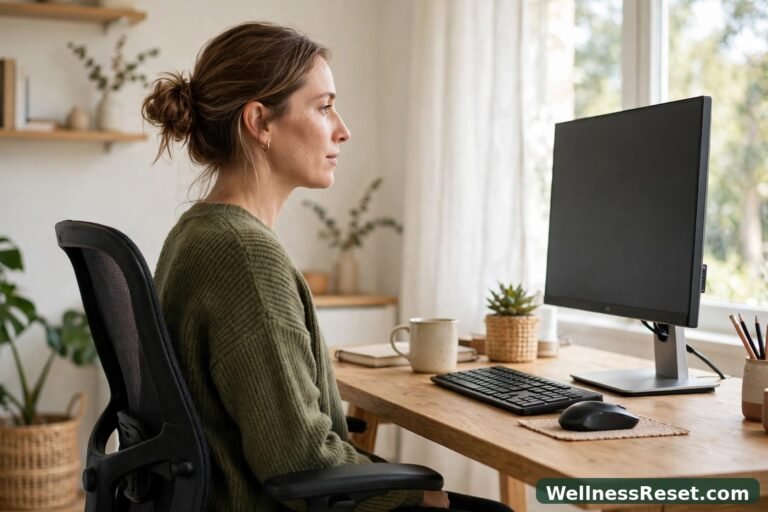
Your laptop screen goes dark for a second — a notification, a loading page, whatever — and in the reflection you catch yourself. Head jutting forward like a tortoise. Shoulders rolled in. Back shaped like a question mark.
You sit up straight immediately. Thirty seconds later, you are a question mark again.
That is not a willpower problem. Slouching is what your body does when the muscles that hold you upright get tired and the muscles in front get short from hours of folding forward. You cannot think your way out of it — but you can stretch and wake up the right muscles, and it takes about ten minutes, most of it in or next to your chair.
One honest note first: these moves fix the stiffness and the “desk shape” most of us build up over a workday. They do not fix structural problems, old injuries, or pain that shoots down your arms or legs. That is a physiotherapist’s job, not an article’s.
What “Bad Posture” Actually Is (It’s Three Things)
Desk posture is not one problem — it is three habits stacked on top of each other.
Forward head. Your ears sit inches in front of your shoulders. Your head weighs about 5 kilos; every inch it drifts forward adds roughly 4–5 kilos of load on your neck. That is why your neck aches by 4 pm.
Rounded shoulders. Your chest muscles shorten from reaching forward all day, and they drag your shoulders with them. Your upper back muscles, meanwhile, get long and lazy.
Tucked hips, flat lower back. Sitting folds your hip flexors short and switches your glutes off. Stand up and your lower back complains because it has been doing the hips’ job.
The seven moves below hit all three. Do them in order — head, chest, upper back, hips — once a day, ideally mid-afternoon when the slouch is at its worst.

The 7 Moves (About 10 Minutes)
1. Chin tucks — 10 reps
Sit tall. Pull your chin straight back, like you are making a double chin on purpose. Hold 5 seconds, release. You should feel a gentle stretch at the base of your skull and the front of your neck working. This is the single best move for forward head — boring to look at, genuinely effective. Best for: neck ache, head-forward posture.
2. Doorway chest opener — 30 seconds each side
Stand in a doorway, forearm flat against the frame, elbow at shoulder height. Step gently through until you feel a stretch across your chest and front shoulder. Not a yank — a slow lean. Tight chest muscles are half the reason your shoulders round forward; this is how you talk them out of it. Best for: rounded shoulders, tight chest.
3. Shoulder blade squeezes — 12 reps
Sit or stand. Squeeze your shoulder blades together and slightly down, like you are trying to hold a pencil between them. Hold 5 seconds. Do not shrug up toward your ears — down and back. This wakes up the mid-back muscles that go quiet all day. Best for: upper-back weakness, slouching shoulders.
4. Thoracic extension over your chair — 8 reps
Sit forward in your chair, hands behind your head (not pulling the neck — just cradling). Lean back over the top edge of the chair backrest, opening your chest toward the ceiling. Breathe out as you lean. Move one vertebra at a time, not like a collapsing deck chair. Best for: stiff mid-back, that “hunched” feeling.

5. Wall angels — 8 slow reps
Stand with your back against a wall, feet a few inches out. Press your lower back, upper back, and the backs of your hands into the wall, arms in a “goalpost” shape. Slowly slide your arms up toward a V and back down, keeping contact. Your arms will want to peel off the wall. That is the point — the struggle is the exercise. Best for: shoulder mobility, chest tightness.
6. Standing hip flexor stretch — 30 seconds each side
Half-kneel or stand in a lunge: one foot forward, knee bent, back leg straight behind you, tailbone tucked slightly under. You should feel the stretch at the front of the back leg’s hip. Sitting shortens these muscles; short hip flexors tilt your pelvis and your lower back pays for it. Best for: lower-back ache after sitting, tight hips.
7. Standing backbend — 5 slow reps
Hands on your lower back for support. Gently arch backward, looking up, hold 3 seconds, come back. Small range. This is the opposite shape of sitting, and your spine likes being reminded the other direction exists. Stop if it pinches. Best for: countering the all-day forward fold.

Problem → Quick Fix
| Problem | Quick fix |
|---|---|
| Neck aches by late afternoon | Chin tucks (move 1), 10 reps, twice a day |
| Shoulders roll forward on their own | Doorway chest opener (2) + blade squeezes (3) |
| Mid-back feels “stuck” | Thoracic extension over chair (4), 8 reps |
| Lower back complains after sitting | Hip flexor stretch (6) + standing backbend (7) |
| Everything, all of it, every day | Do all seven in order — 10 minutes, once daily |
Mistakes That Waste the Effort
The big one: doing these once, feeling better for an hour, and never doing them again. Posture is a daily deposit, not a one-time fix. Ten minutes today beats forty minutes on Sunday.
Second: yanking. Stretching should feel like a firm pull, never sharp or pinchy. If your neck clicks painfully during chin tucks, you are pulling too hard — halve the effort.
Third: holding your breath. People brace during stretches without noticing. Breathe slowly through every hold; the exhale is when the muscle actually lets go.
And the one nobody wants to hear: no exercise outruns eight unbroken hours of sitting. Stand up for two minutes every hour — get water, look out a window, anything. The moves fix the shape; the breaks stop it forming.

Final Words
You will not get a dancer’s posture from seven desk moves, and anyone promising that is selling something. What you will get is a neck that does not ache at 4 pm, shoulders that sit where they belong without constant reminding, and a back that does not protest when you stand up.
Ten minutes, in order, once a day. Start today — your 5 pm self will notice the difference before your mirror does. And if sitting all day also locks up your back specifically, our chair yoga routine for a stiff back pairs well with this one.
FAQs
How long before I see a difference?
Most people feel less stiffness within the first week of daily practice. Visible posture change — shoulders sitting back on their own — usually takes 4 to 6 weeks. Muscles adapt slowly; that is normal, not a sign it is failing.
Can bad posture be fixed at any age?
Yes, within reason. Muscles and joints respond to consistent movement at every age. What does not change much is bone structure — but the muscular slouch most desk workers have is absolutely changeable.
Do I need a posture corrector brace?
They can remind you to sit straight, but they do the muscles’ job for them, which can make the muscles lazier over time. Better to build the strength with moves like the ones above. If you use one, wear it short-term, not all day.
Why does my neck crack during chin tucks?
Usually just joints moving after being still — harmless if there is no pain. If cracking comes with pain, dizziness, or numbness, stop and get it checked rather than pushing through.
Is standing all day better than sitting?
Not really — standing still all day brings its own problems (feet, knees, lower back). The research keeps landing in the same place: alternating and moving regularly beats any single position.





4 Comments