
Chair Yoga for Neck Pain: 6 Gentle Moves to Undo “Phone Neck”
It is 2 in the afternoon. You tilt your head to the left and something in your neck goes crunch. You tilt it right — crunch again. Then you roll it in a full circle, hear a sound like stepping on bubble wrap, and feel… basically nothing. Same stiffness, now with bonus cracking.
That stiffness has a name everyone uses now: phone neck. Or desk neck. Same thing — hours of looking down and forward, the head drifting ahead of the shoulders, the neck muscles working overtime to hold up 5 kilos at a bad angle. By afternoon they are tired, tight, and complaining.
These six chair yoga moves take about eight minutes, and they are built for exactly this: the neck and shoulder tension that builds up from screens. Gentle is the operative word — the neck is not a joint you bully into submission.
Quick boundary, because necks deserve respect: mild stiffness and tension, fine. Sharp pain, numbness or tingling in your arms or hands, dizziness when you move your head — those are “see a doctor” signs, not “stretch harder” signs.
Why Your Neck Hurts (It’s the Angle)
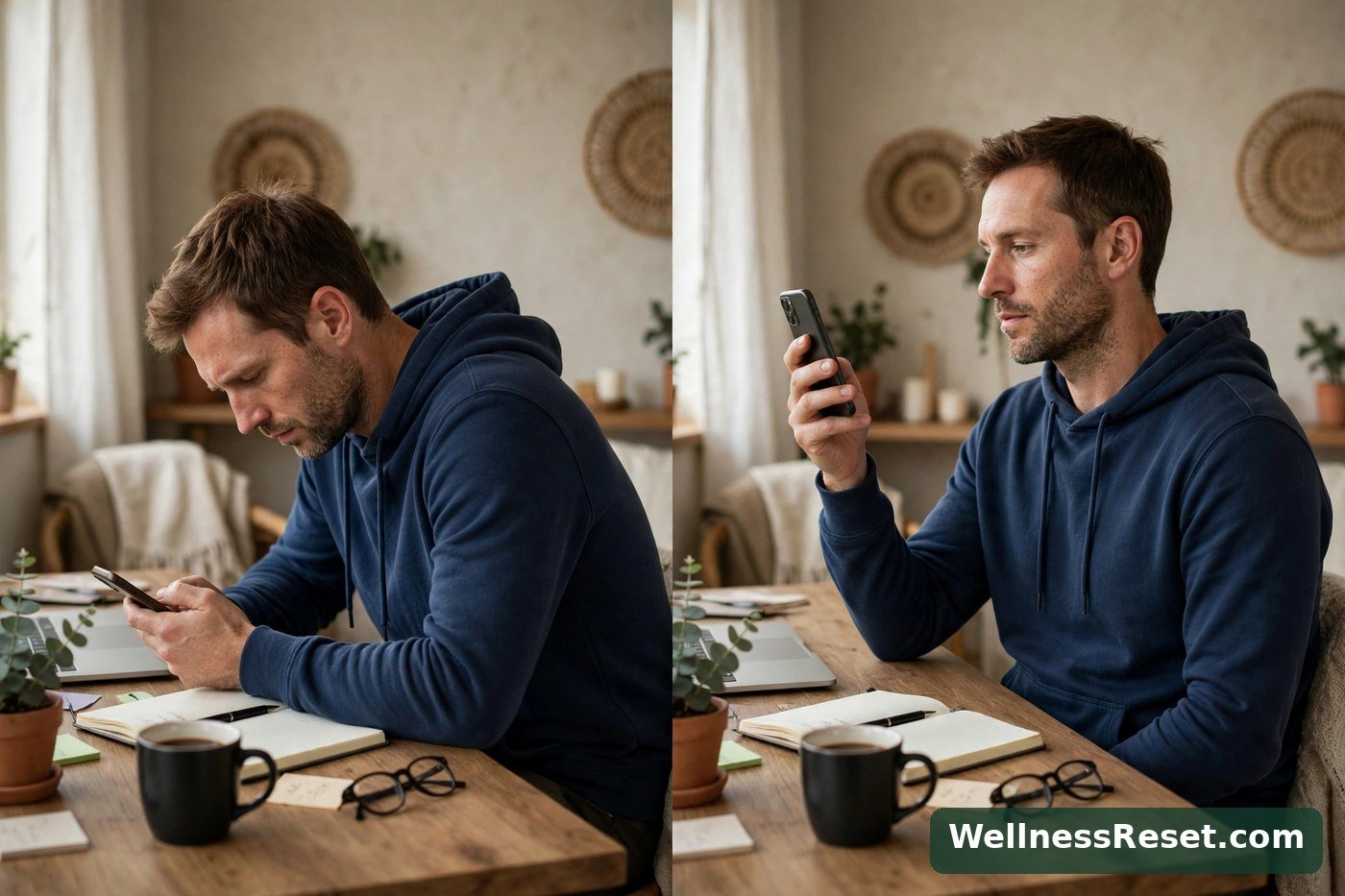
Hold your head upright and your spine stacks neatly — ears over shoulders, weight distributed. Tip your head forward 15 degrees to look at a phone and the effective load on your neck roughly doubles. At 45 degrees — the classic phone-scroll angle — it is like carrying 20+ kilos on your neck muscles.
Nobody holds that angle for a minute. People hold it for hours, in small doses, all day. The muscles at the back of your neck stay contracted the whole time; the ones at the front get weak from never working. The result is that 2 pm crunch.
The fix is not one heroic stretch. It is regularly reversing the angle — tucking the chin, opening the chest, moving the neck through its comfortable range — so the muscles get to do something other than “hold head forward.”
The 6 Moves (About 8 Minutes)
Sit tall, feet flat, shoulders relaxed. Move slowly — neck stretches should feel like a gentle pull, never a yank.
1. Slow half-circles — 4 each direction
Drop your chin toward your chest. Slowly roll your ear toward your right shoulder, then back to center, then to the left — a half-circle across the front, never tipping the head backward. Four slow rounds each way. Think honey, not machinery. Best for: general neck stiffness, warming up.
2. Ear-to-shoulder hold — 30 seconds each side
Tilt your right ear toward your right shoulder (do not lift the shoulder to meet it). Rest your right hand gently on the left side of your head — the weight of the hand is enough, do not push. Feel the stretch down the left side of your neck. Breathe into it. Best for: one-sided tightness, the side that always feels shorter.
3. Chin tuck + look — 8 reps
Do a chin tuck (pull chin straight back, making a deliberate double chin). Now, keeping the tuck, slowly turn your head to look over your right shoulder. Hold 5 seconds. Back to center, then left. This one targets the deep neck muscles that get lazy from forward-head posture — the muscles a plain stretch misses. Best for: forward head, deep neck weakness.

4. Shoulder shrugs + drop — 10 reps
Inhale: shrug your shoulders all the way up to your ears. Hold 3 seconds — really feel the tension. Exhale: drop them completely, like shrugging off a heavy bag. The contrast teaches your shoulders where “relaxed” actually is, because by afternoon most people have forgotten. Best for: shoulders living near your ears, tension headaches.
5. Cross-arm shoulder stretch — 30 seconds each side
Bring your right arm across your chest. Hook your left hand or forearm above the right elbow and gently draw it closer. You should feel the stretch in the right shoulder and upper back. Desk workers round forward all day; this opens the back of the shoulder that gets compressed. Best for: tight shoulders, upper-back ache.
6. Seated upper-trap stretch — 30 seconds each side
Sit on your right hand (palm down under your thigh — this anchors the shoulder). Tilt your left ear toward your left shoulder. You will feel a strong, specific stretch along the right side of your neck — that ropey muscle from ear to shoulder is the upper trapezius, and it carries most people’s stress. Keep the stretch moderate; this muscle responds better to patience than force. Best for: the classic “knot” between neck and shoulder.

Problem → Quick Fix
| Problem | Quick fix |
|---|---|
| General 2 pm neck stiffness | Slow half-circles (1) + shrugs and drops (4) |
| One side always tighter | Ear-to-shoulder hold (2) on the tight side, twice as long |
| Head juts forward (phone neck) | Chin tuck + look (3), 8 reps, twice daily |
| Knot between neck and shoulder | Upper-trap stretch (6), 30 sec each side, breathe slowly |
| Whole upper body locked up | Do all six in order — 8 minutes |
Mistakes That Make Neck Pain Worse
Cracking your neck hard for relief. That crunch feels productive but it is mostly joints popping, not muscles releasing. Aggressive self-cracking — especially twisting hard — can irritate the small neck joints. The moves above give longer-lasting relief without the drama.
Rolling the head in fast full circles. Tipping the head backward compresses the neck joints. That is why move 1 stays in half-circles across the front. Slow beats showy here.
Stretching into sharp pain. A gentle pull is the target. Sharp, shooting, or electric-feeling pain means stop immediately. “No pain, no gain” is terrible advice for necks.
Only stretching, never strengthening. Stretching loosens; the chin tucks (move 3) also strengthen the deep neck muscles. If your neck pain keeps returning, the weak front-of-neck muscles are usually the missing piece.

Final Words
Your neck does not need anything dramatic. It needs the opposite of what your day gives it: chin back instead of forward, chest open instead of rounded, slow movement instead of one frozen angle.
Eight minutes, once in the afternoon when the stiffness peaks. And one free upgrade that costs nothing: raise your phone to eye level instead of dropping your head to the phone. Your neck will thank you within a week. If the stiffness spreads to your back too, our chair yoga routine for a stiff back covers the rest of the chain.
FAQs
Is it normal for my neck to crack during these moves?
Very common, and usually harmless if there is no pain — it is just gas bubbles in the joints releasing. If cracking comes with pain, numbness, or dizziness, stop and get it checked.
How often should I do neck stretches?
Once a day is enough for maintenance. If you are in a bad flare-up of stiffness, twice a day (morning and mid-afternoon) for a week, then back to once.
Can phone neck be reversed?
The muscular part — stiffness, forward head, rounded shoulders — yes, with consistent movement like the above. It takes weeks, not days, because the muscles need to unlearn the pattern.
Should I use a neck massager or heat?
Heat (a warm towel, 10–15 minutes) can help tight muscles relax before stretching. Massagers feel good but do not fix the cause. Use them as a bonus, not the plan.
When is neck pain an emergency?
Severe pain after an injury, numbness or weakness in arms/hands, trouble walking or balancing, or neck pain with fever — do not stretch through these. See a doctor promptly.