
Knee Stretches
The stairs at my building have eleven steps. I counted them the morning my right knee decided it was done negotiating. Halfway up, it gave a small, sharp complaint — not enough to stop me, just enough to make me grip the railing and rethink the rest of the day. That is how stiff knees usually announce themselves. Not with drama. With a quiet refusal to do the ordinary things quietly.
If your knees feel like that — fine when you are sitting, grumpy when you stand up, worse on cold mornings or after a long car ride — gentle knee stretches can help. Slow, regular stretching keeps the muscles around the knee loose, and loose muscles mean the joint moves more freely. It will not rebuild cartilage or fix arthritis. Nobody honest will tell you it will. But for the everyday stiffness that makes stairs feel longer than they are, ten minutes a day is worth more than any gadget I have tried.
One thing first, because it matters more than any stretch in this article: if you have a diagnosed knee condition, a recent injury, a knee that swells, locks, gives way, or hurts sharply, check with your doctor or physiotherapist before starting. This routine is for stiff, achy, everyday knees — not for a knee that needs medical attention. And the rule that runs through the whole routine is simple: stop if it hurts. A stretch should feel like a gentle pull, never a sharp pain. If a movement hurts, you have gone too far. Back off, breathe, and try a smaller version tomorrow.
Why Gentle Knee Stretches Work
A knee is a hinge, but it does not work alone. The quadriceps at the front of your thigh, the hamstrings at the back, and the calves below it all pull on the joint. When any of those muscles get tight — from sitting all day, from walking less, from age — the knee has to work harder to bend and straighten. Stretching those muscles slowly, a few minutes a day, gives the joint a little more room to move.
The key word is slowly. Knees hate being rushed. A hard, bouncy stretch makes the muscles guard and tighten, which is the opposite of what you want. The routine below is deliberately boring: hold each stretch for 20 to 30 seconds, breathe normally, and never force the range. You are coaxing the muscles, not wrestling them.
Do the whole routine once a day if you can, ideally at the same time — after your morning tea works well, because your joints are at their stiffest then and you will feel the difference most. Six stretches, about ten minutes, most of them done sitting on a chair. You need nothing except a sturdy chair and a bit of floor space. If you already do chair-based movement, these knee stretches slot neatly into that habit — our Gentle Chair Yoga for Arthritis works the same joints from a different angle, and the two routines pair well on alternate days.
The Routine: 6 Gentle Knee Stretches
1. Seated Knee Extension
Best for: stiff knees first thing in the morning.
Sit tall, feet flat on the floor. Slowly straighten one leg out in front until the knee is nearly straight — not locked, just long. Hold 5 seconds, then lower it slowly. That is one rep. Do 8 to 10 per leg. If the leg shakes a little, that is normal; it settles after a few days.
2. Heel Slide
Best for: knees that feel stuck after sitting for a long time.
Sit with both feet flat. Slide one heel slowly forward along the floor, straightening the leg as far as it goes comfortably, then drag it back. Think of it as ironing the floor with your heel. 8 slow slides per leg, about 3 seconds out and 3 seconds back. The gentlest stretch in the set — a good first move on a bad day.
3. Seated Hamstring Stretch
Best for: tightness behind the knee and the back of the thigh.
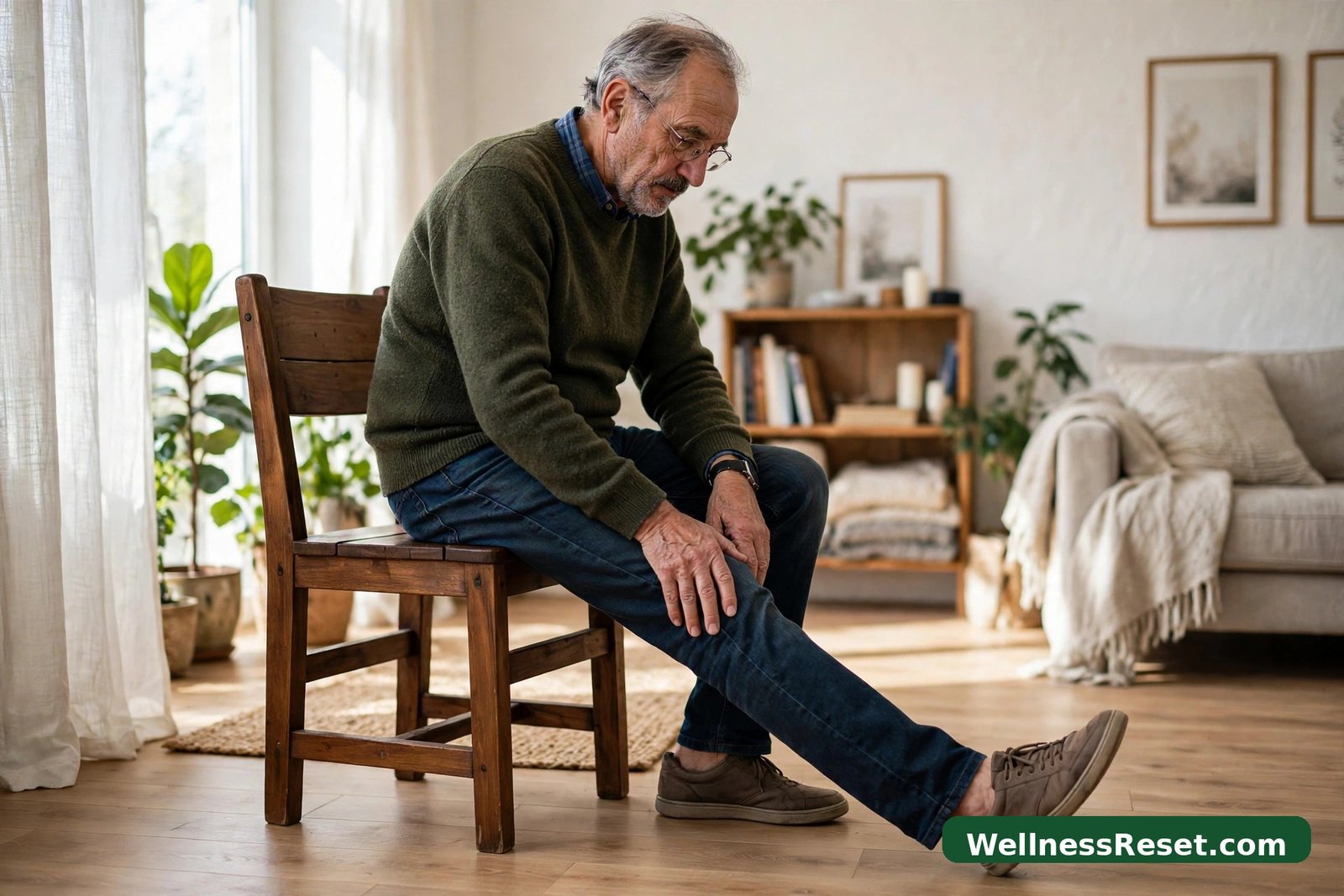
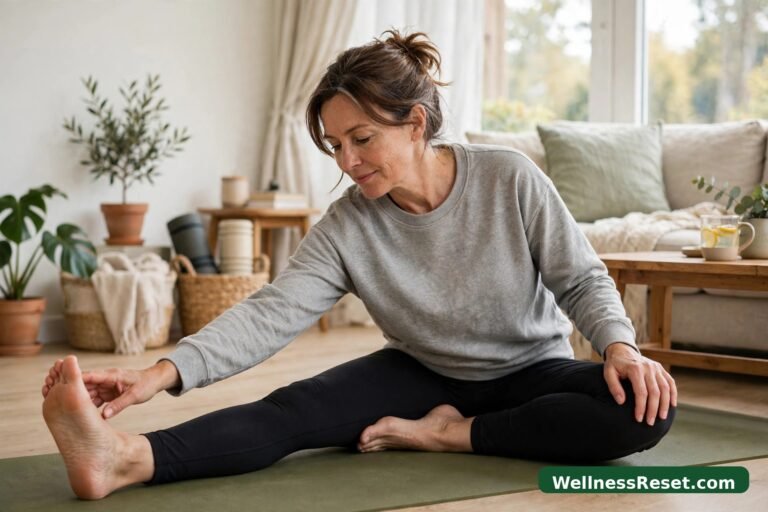
Sit near the front edge of your chair. Straighten one leg out in front, heel on the floor, toes pointing up. Sit tall, then lean forward from your hips — a small lean, maybe 10 centimetres — until you feel a gentle pull behind the knee. Hold 20 to 30 seconds. Do not round your back to reach further. Two rounds per leg.
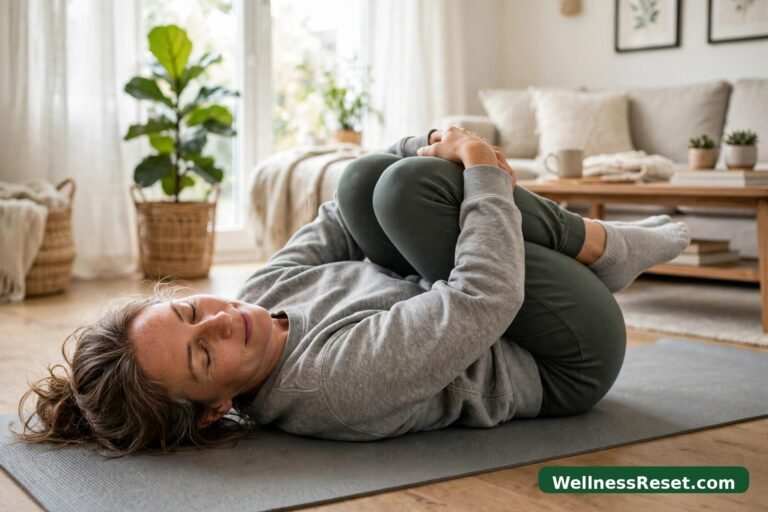
4. Knee-to-Chest (Lying Down)
Best for: knees that ache after walking or standing for a while.
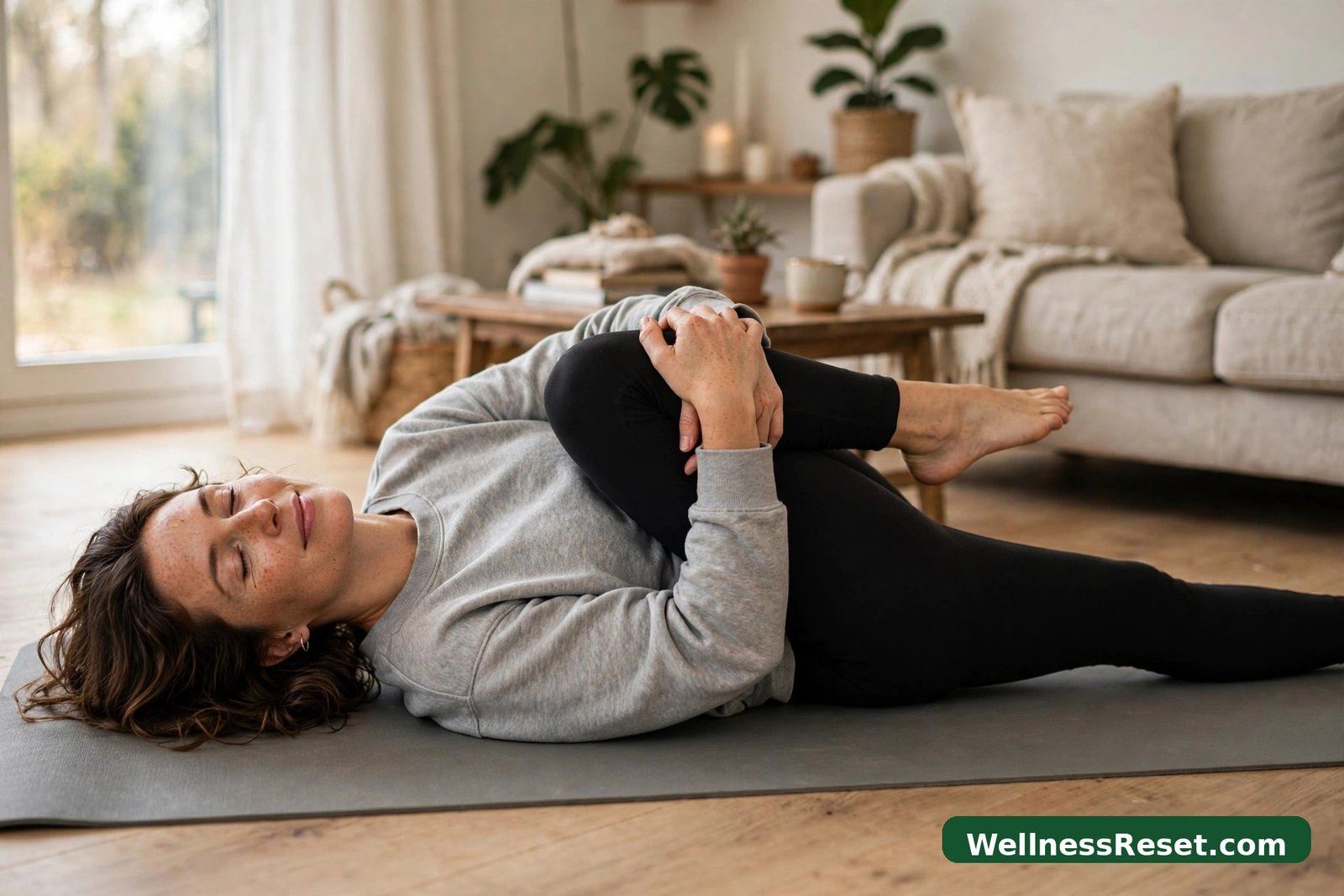
Lie on your back on a mat or a rug, knees bent, feet flat. Bring one knee slowly toward your chest, holding behind the thigh — not on top of the knee itself. Hold 20 to 30 seconds, then lower it back down. Alternate legs, 3 rounds each. If getting down to the floor is hard, skip this one and do the seated stretches twice instead. The routine still works.
5. Standing Quad Stretch (Holding a Wall)
Best for: the front of the thigh pulling on the knee.
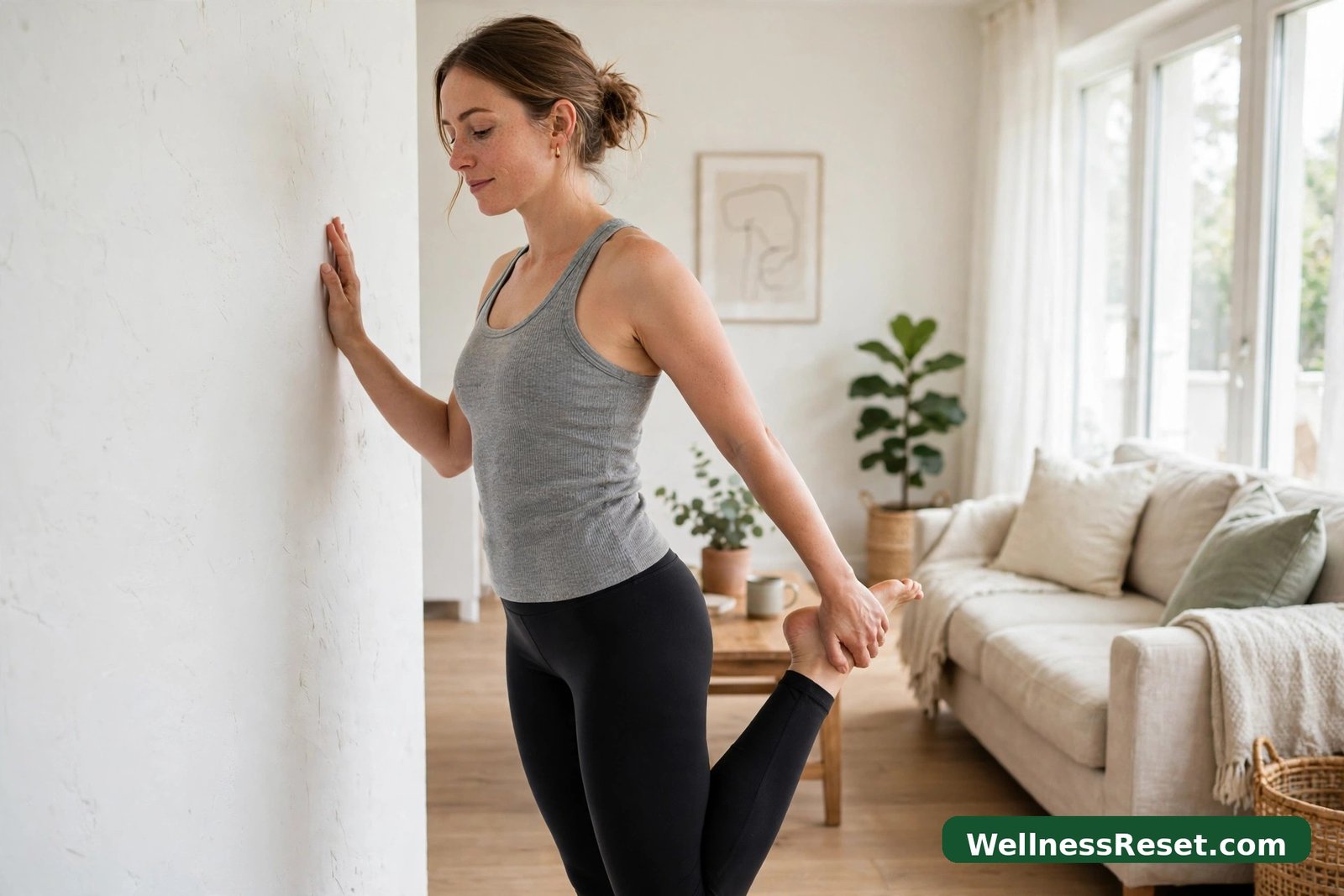
Stand sideways next to a wall, one hand on it for balance. Bend one knee and bring that foot up behind you, holding the ankle or the top of the foot with your free hand. Keep your knees close together and your standing knee soft, not locked. Hold 20 to 30 seconds. If you cannot reach your foot, loop a towel around it and hold the towel instead. This is the hardest stretch in the set, and it is optional. Two rounds per leg.
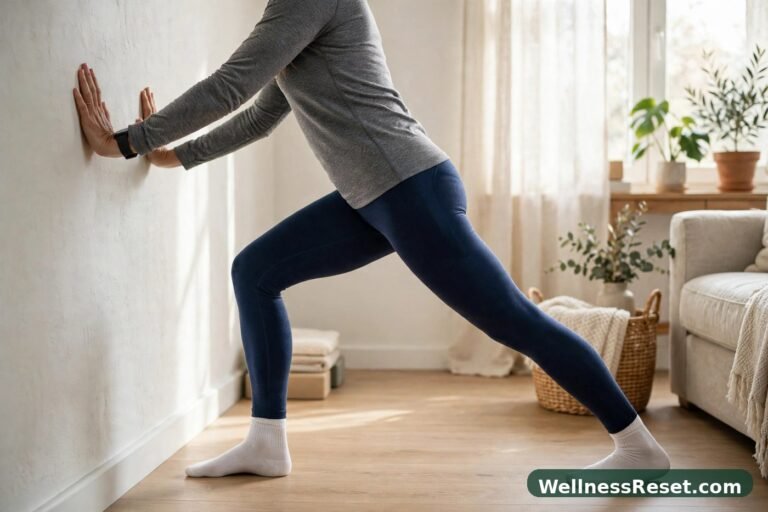
6. Calf Stretch Against a Wall
Best for: tight calves that make the knee feel stiff when you walk.
Face a wall, hands on it at shoulder height. Step one foot back, heel flat on the floor, and lean gently toward the wall until you feel a pull in the back calf. Hold 20 to 30 seconds, then switch. Keep the back heel down — the moment it lifts, the stretch leaves the calf and goes nowhere useful. Two rounds per leg.
Step by Step: Your 10-Minute Session
Minutes 1–2: warm up. Sit on your chair and march gently in place, lifting your feet a few centimetres off the floor, for about a minute. Then 5 slow ankle circles each way. Cold muscles stretch badly; two minutes of easy movement makes the rest of the session work better.
Minutes 2–4: seated knee extensions and heel slides. 8 to 10 extensions per leg, then 8 heel slides per leg. Slow and steady. This is the main event for the knee itself.
Minutes 4–7: hamstring stretch and knee-to-chest. Two rounds of the seated hamstring stretch per leg, then 3 knee-to-chest holds per leg if you are on the floor. Staying seated? Do a second round of hamstring stretches instead.
Minutes 7–9: standing stretches. Quad stretch and calf stretch, 20 to 30 seconds each side, holding the wall the whole time. Only if standing feels fine today. On a wobbly day, repeat the seated stretches and call it done.
Minutes 9–10: finish. Sit back down, feet flat, and take five slow breaths. Notice how your knees feel compared to ten minutes ago. Most days the difference is small but real — less creaky on the first few steps, a little freer turning around. That is the whole point. Small, daily, honest.
If you want to build this into a wider gentle-movement habit, our Mobility Exercises for Beginners covers the hips, shoulders and spine in the same slow style, and it pairs naturally with this routine on alternate days.
What Knee Stretches Can and Cannot Do
Let me be straight about this, because knee advice on the internet is full of promises. Regular gentle stretching can make stiff knees feel looser, make stairs and standing up easier, and keep the muscles around the joint working well. Most people notice the difference within two to three weeks of doing it daily.
What it cannot do: it cannot cure arthritis, repair a torn meniscus, or undo years of wear. It cannot replace physiotherapy after an injury. And if your knee is swollen, hot, red, locking, or giving way, stretching will not fix it and could make it worse — that is a doctor’s appointment, not a stretching session. The NHS has a clear, sensible guide to knee pain and when to get help, and it is worth reading if any of this sounds familiar: NHS Knee Pain Guide.
Troubleshooting
| Problem | Quick fix |
|---|---|
| A stretch feels sharp, not gentle | Ease off immediately — go half as far and hold half as long |
| Knee clicks or pops during a stretch | Painless clicking is usually harmless; stop if it hurts or the knee catches |
| One knee is much stiffer than the other | Give the stiff side an extra round, but never force it to match the other |
| Lower back aches during knee-to-chest | Keep the other knee bent with the foot flat — do not let the leg lie flat |
| Standing stretches feel wobbly | Do them next to a wall or a heavy table, hand on it the whole time |
| Knees feel worse the morning after | You probably pushed too far — halve the hold times for a week |
| No change after two weeks | Check your form against the steps above, and mention it at your next doctor visit |
Common Mistakes
Bouncing. The old “bounce into the stretch” habit is the worst thing you can do to a stiff knee. Bouncing triggers the muscle’s stretch reflex, which tightens it. Slow and still, every time.
Chasing the deepest stretch. The goal is not to get your heel to your backside or your forehead to your knee. The goal is a gentle pull held for 30 seconds. Depth comes on its own over weeks. Forcing it buys you a sore knee tomorrow.
Holding your breath. The moment a stretch gets interesting, people stop breathing. If you catch yourself doing it, ease off until you can breathe normally again. The breath tells you whether you are in the right range.
Doing it once and deciding it does nothing. One session loosens you for an hour. Twenty sessions change how your mornings feel. Give it three weeks before you judge it.
Stretching through real pain. There is a difference between the mild discomfort of a stretch and pain that makes you wince. The first is fine. The second is your knee telling you to stop. Listen to it — and if the same movement keeps hurting, get it checked rather than pushing through.
Final Words
Knees do not ask for much. Ten minutes, a chair, and a bit of patience. The routine in this article is not exciting, and that is the point — it is the kind of quiet daily habit that keeps stairs from getting longer and mornings from starting stiff. My eleven steps are still eleven steps. They just feel like eleven steps again, instead of a negotiation.
Start tomorrow morning, after your tea, while the kettle is still warm. Sit down, straighten one leg, and hold it for five slow seconds. That is the first stretch. The rest is just doing it again tomorrow.
FAQ
How often should I do knee stretches?
Once a day is a good rhythm — ten minutes, at the same time each day so it becomes a habit. Twice a day is fine too if your knees are very stiff, but keep each session gentle. Daily beats one long session a week.
Can knee stretches help with arthritis?
They can ease the stiffness around an arthritic knee and help you keep the movement you have. They cannot cure arthritis or regrow cartilage. If you have arthritis, check the routine with your doctor or physiotherapist first, and stop any stretch that causes sharp pain.
Is it normal for my knee to click when I stretch?
Painless clicking or popping is common and usually harmless — often just gas bubbles in the joint fluid or a tendon moving over bone. If the click comes with pain, swelling, or the knee catching or locking, get it checked.
Should I stretch a swollen knee?
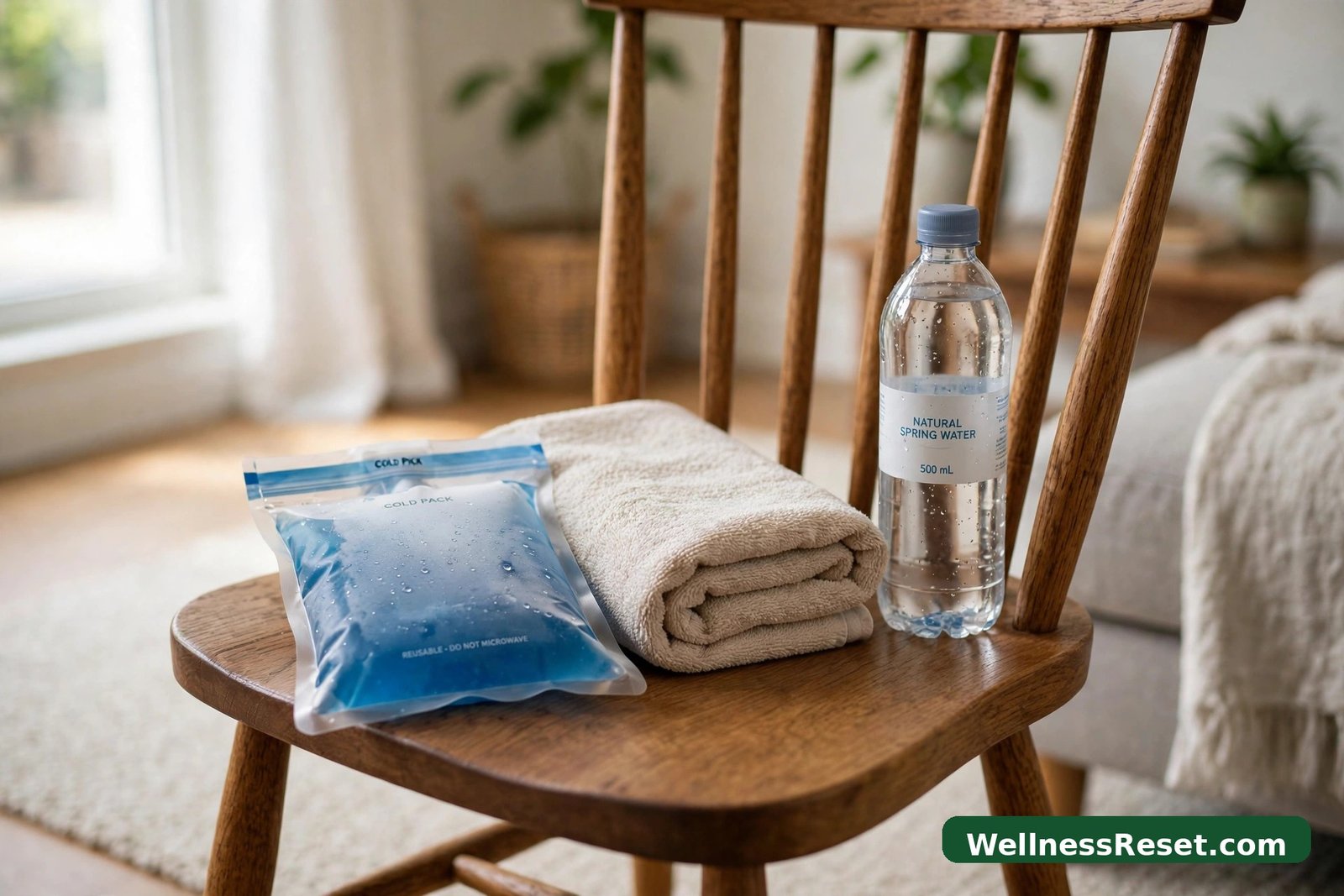
No — not until you know why it is swollen. A hot, swollen knee needs a doctor, not a stretch. Ice wrapped in a towel for 15 minutes can ease the discomfort while you wait for advice, but do not put ice directly on the skin.
Can I do these stretches if I have had a knee replacement?
Only with your surgeon’s or physiotherapist’s approval, and only the stretches they clear. After a replacement the rules are different — some movements are off-limits for months. Do not use this routine as a substitute for your post-surgery exercises.

3 Comments