Lower Back Stretches
I bent down to tie my shoes last Tuesday and my lower back simply refused. Not a dramatic spasm, not a collapse on the floor — just a hard stop, halfway down, like someone had quietly locked a door inside me. I stood back up very slowly, finished the laces sitting on the stairs, and spent the rest of the morning moving like a man carrying a tray of full glasses. If that scene sounds familiar, this routine is for you. Not a workout. Not a fix. Just fifteen slow minutes that help a sore, guarded lower back loosen up enough to get on with the day.
Lower back stretches work best when you stop treating your back like a problem to be solved and start treating it like a tired muscle that needs a bit of coaxing. The muscles around your lower back — the ones that run along your spine and wrap around your hips — tighten up when you sit too long, sleep badly, or lift something the wrong way. Once they tighten, they guard. They hold everything still, which feels protective, but the stillness is exactly what keeps the ache going. Gentle movement breaks that loop. You are not forcing anything open. You are reminding the muscles, slowly, that it is safe to let go.
Why Gentle Beats Aggressive Here
Here is the mistake I made for years. Every time my back went stiff, I tried to stretch harder — deeper folds, longer holds, pushing through the ache because I assumed the ache meant it was working. It does not. With a sore lower back, pushing through pain usually makes the muscles guard even harder, and you end up stiffer the next morning than you were the night before.
The rule that changed everything for me is simple: a stretch should feel like a mild pull, about a 3 or 4 out of 10. If it hits a 6, you have gone too far. Back off until you can breathe normally again. Breathing is the test. If you are holding your breath, the stretch is too deep. Ease out, breathe, try again smaller.
There is one more thing worth saying before the routine. These stretches help the everyday kind of back stiffness — the ache after a long drive, the tightness after a bad night’s sleep, the soreness after a day in the garden. They do not treat an injury. If your pain shoots down your leg, if you have numbness or tingling in your feet, if you cannot control your bladder or bowels, or if the pain came on after a fall — skip the routine and see a doctor first. That is not being cautious. That is the correct order of operations. The NHS back pain guide lays out the same warning signs clearly: NHS — Back Pain.
The Routine: Six Gentle Lower Back Stretches
Do these in order. The whole thing takes about 12 to 15 minutes, and you need nothing but a mat or a rug and a folded blanket. Do it once a day for a week before you decide whether it helps — one session loosens you for an evening; a week of them changes how your mornings feel.
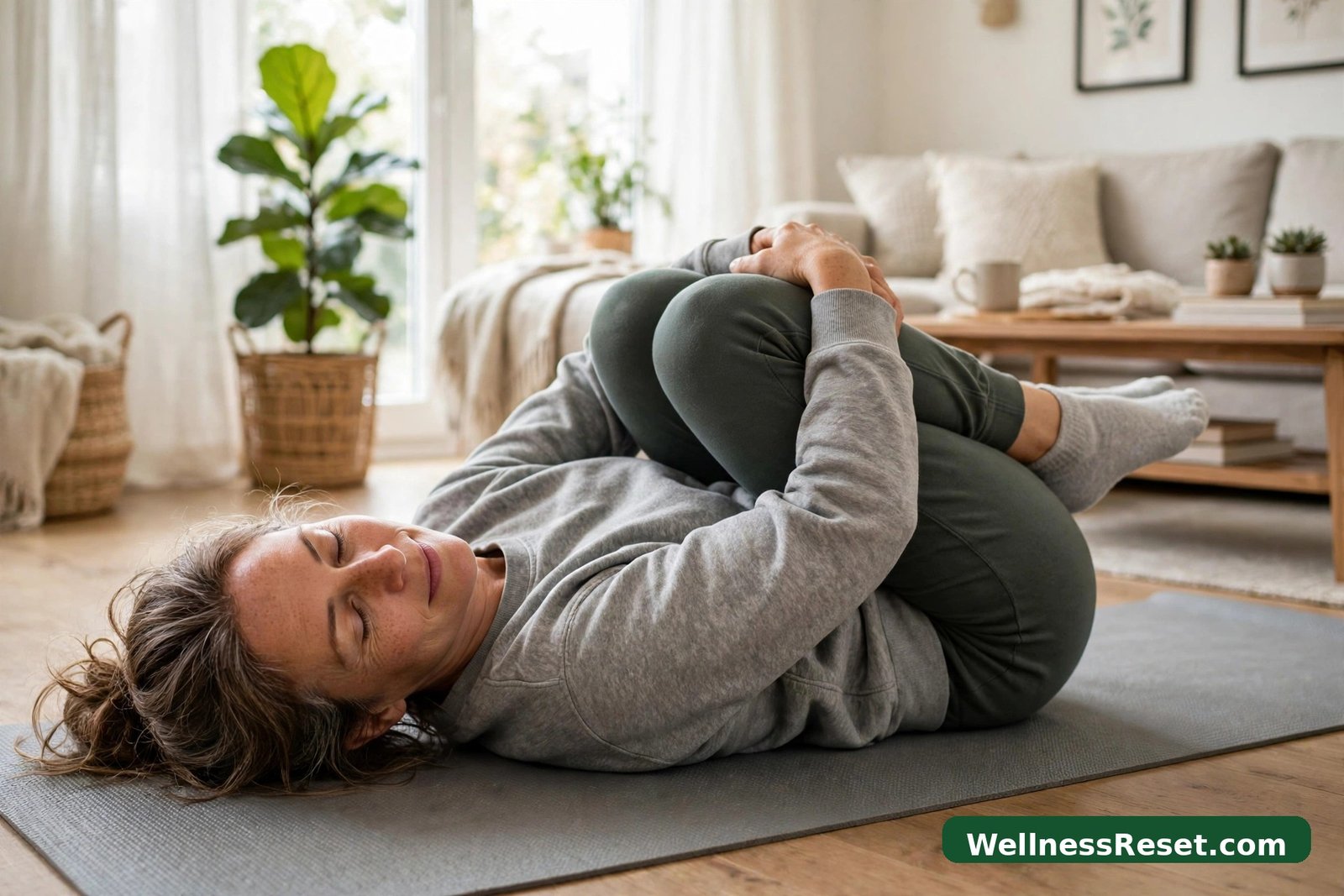
1. Knees-to-Chest
Lie on your back, knees bent, feet flat on the floor. Bring one knee up toward your chest and hold it there with both hands — just below the knee, not on the kneecap. Hold for 20 to 30 seconds, breathing slowly. Lower it, then do the other side. Then try both knees together, gently rocking side to side by a few centimetres. Three rounds each side.
Best for: first thing in the morning, when your back feels like it has set overnight.
2. Supine Spinal Twist
Still on your back, knees bent. Let both knees drop slowly to the right, keeping your shoulders flat on the floor — if your left shoulder lifts, you have gone too far, so bring the knees back a little. Arms out to the sides like a T. Hold for 30 seconds, breathing into the stretch. Bring the knees back to centre, then drop them to the left. Two rounds each side.
Best for: a one-sided ache, or that lopsided feeling after sleeping on one side all night.
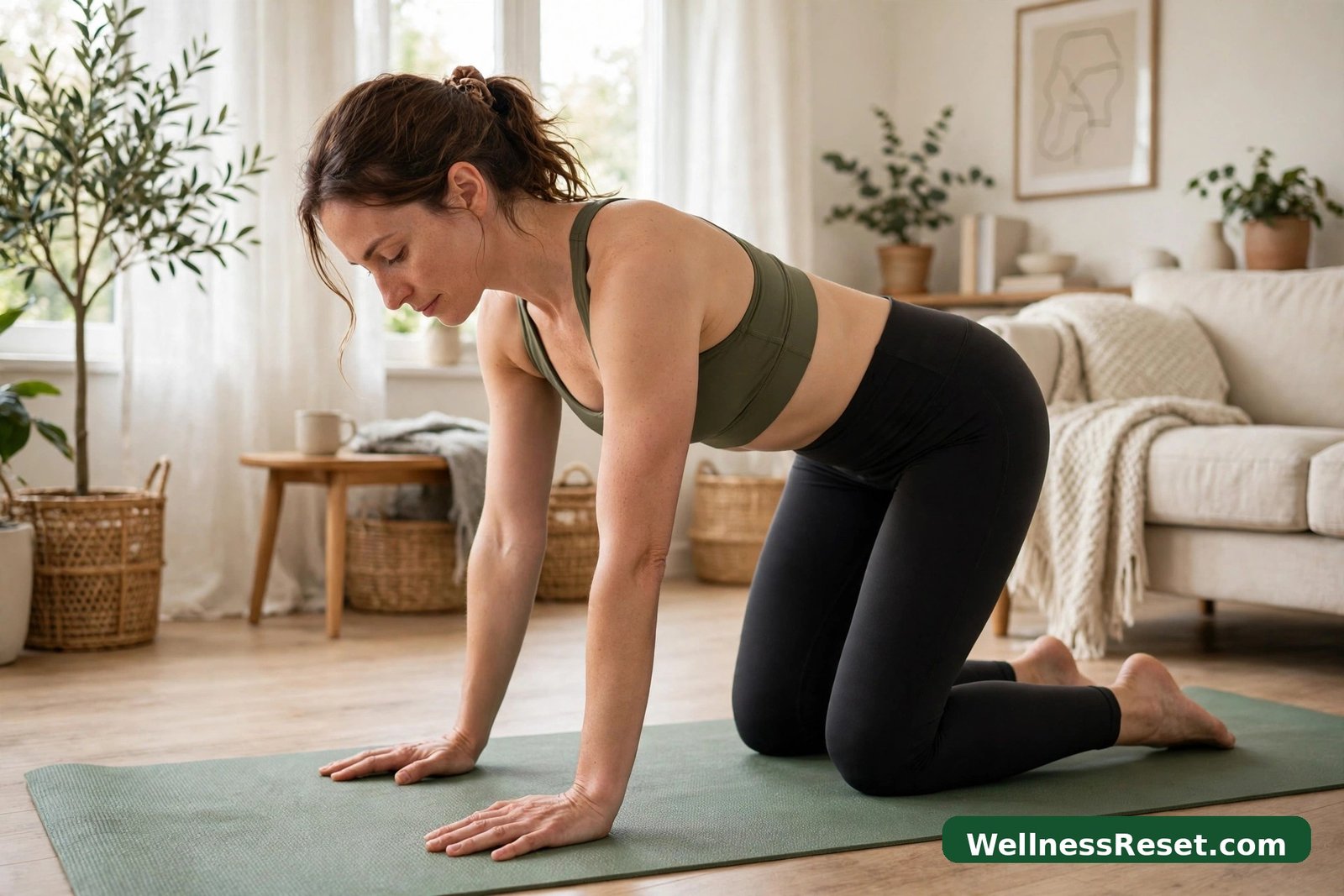
3. Cat-Cow on All Fours
Come onto your hands and knees, hands under your shoulders, knees under your hips. On an inhale, let your belly drop toward the floor and lift your head slightly — the cow. On the exhale, round your spine up toward the ceiling and tuck your chin — the cat. Move slowly, one full breath per shape, for eight to ten rounds. Keep the movement small. This is not a performance.
Best for: getting your spine moving again after a day of sitting still.
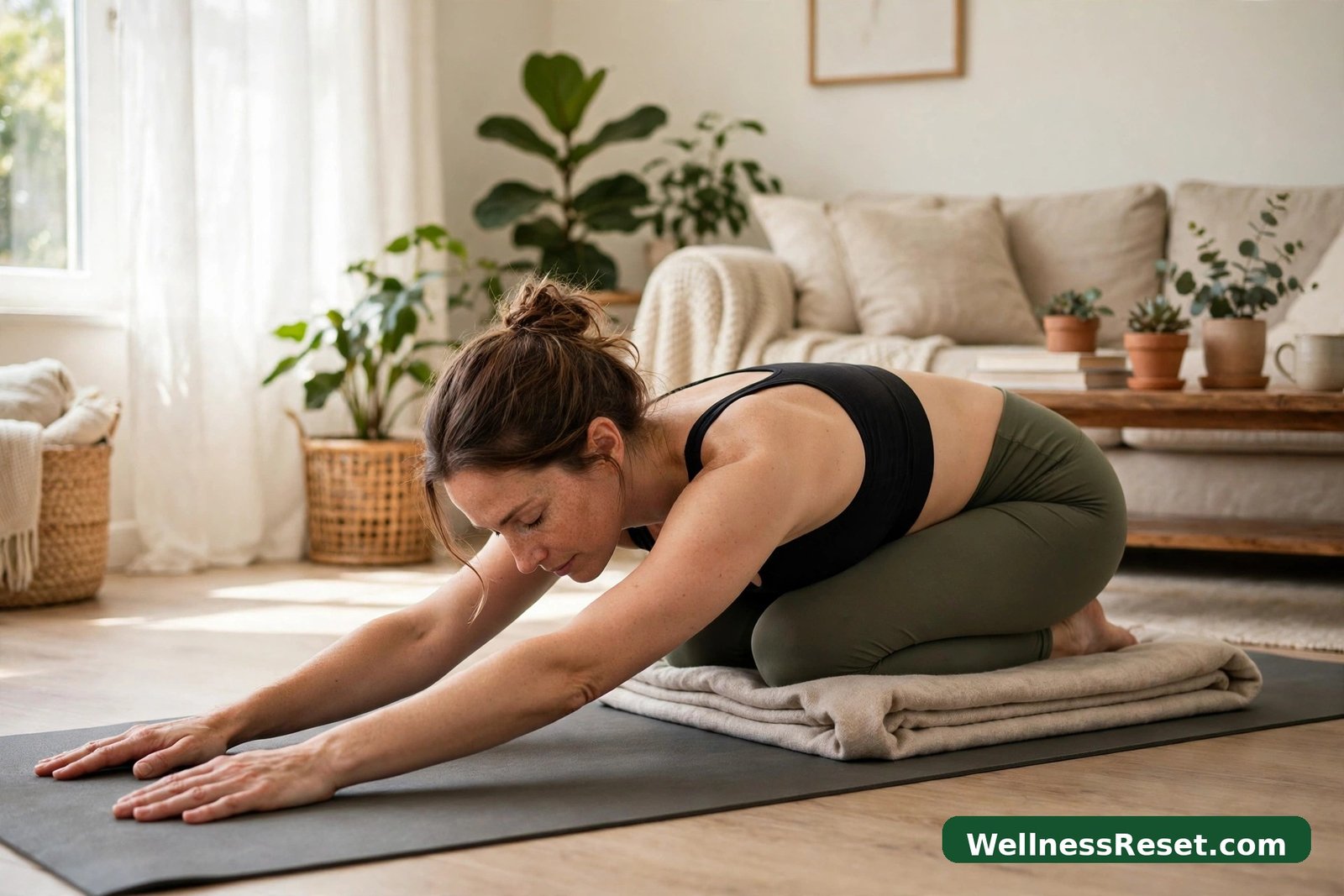
4. Child’s Pose with a Blanket
From all fours, sit your hips back toward your heels and walk your hands forward. Put a folded blanket under your knees first — it takes the pressure off and lets you actually relax into it instead of bracing. Forehead rests on the mat or on your forearms. Hold for 45 seconds to a minute, breathing slowly. If your hips do not reach your heels, that is fine. Wherever you stop is the pose.
Best for: the end of the day, when everything feels wound up and you want to switch off.

5. Seated Forward Fold
Sit on a sturdy chair, feet flat on the floor, knees about hip-width apart. Let your chest fold forward slowly over your thighs and let your hands rest on your shins or thighs — wherever they land without reaching. Let your head hang heavy for 20 to 30 seconds, then roll back up slowly, one vertebra at a time. Three rounds. If you feel dizzy at all, sit upright straight away and skip this one.
Best for: days when getting down on the floor feels like too much effort.
6. Pelvic Tilts
Lie on your back, knees bent, feet flat. Gently press your lower back into the floor by tilting your pelvis — imagine pulling your belly button toward your spine, just a little. Hold for five seconds, release, repeat ten times. It looks like nothing. It is not nothing. This is the quiet work that wakes up the deep muscles that support your spine, and it is the one stretch most people skip because it feels too easy.
Best for: building a bit of support back into a back that feels wobbly or unprotected.

A 12-Minute Sequence to Follow
If you like a plan rather than a list, here is how the six moves fit together into one session.
Minutes 1–3: knees-to-chest. Start here, on your back, letting the floor hold your weight. Three rounds, one knee then the other, then both together. This is the warm-up — do not rush it.
Minutes 3–6: supine spinal twist. Two rounds each side, 30 seconds a hold. Keep the shoulders down. The twist should feel like a slow wring, not a yank.
Minutes 6–9: cat-cow, then child’s pose. Eight rounds of cat-cow, then settle into child’s pose with the blanket for a full minute. This is the middle of the session, where the movement starts to feel easier than it did at the start.
Minutes 9–11: seated forward fold. Sit on your chair, three slow folds. If you are already on the floor and happy there, do the fold sitting on the mat with your legs out straight instead — same idea.
Minutes 11–12: pelvic tilts. Ten slow tilts, five seconds each. Then lie flat for a minute, knees bent, hands on your belly, and just breathe. Done.
If you want more movement once this routine feels easy, our beginner mobility guide is the natural next step: Mobility Exercises for Beginners. It builds on the same gentle pace, with more standing moves for hips and shoulders.
When to Stop (and When to See a Doctor)
Stop the routine straight away if you feel any of these: a sharp or shooting pain (different from a dull ache), pain that runs down one leg past the knee, numbness or pins and needles in your foot, or any weakness — like your leg giving way. Those are not “stretch through it” signals. They are “stop and get checked” signals.
Also book a doctor’s appointment if the pain has lasted more than a few weeks without improving, if it is worse at night and wakes you up, if you have a fever along with the back pain, or if you have a history of cancer or a condition that affects your bones. None of that is meant to frighten you — most back pain is ordinary and settles with time and gentle movement. But knowing the red flags means you can stretch with confidence instead of quietly worrying.
A word on timing too. If your back is at its worst first thing in the morning and eases as you move, that is common and usually the stiff-muscle pattern these stretches are made for. If it is getting steadily worse over days, or if it started after a specific injury, get it looked at before you start any routine.
Troubleshooting
| Problem | Quick fix |
|---|---|
| Lying flat on your back hurts | Bend your knees and put a cushion under them — flat legs pull on the lower back |
| A stretch feels sharp instead of mild | Come out of it halfway and hold there; sharp means too deep, always |
| Your knees ache during child’s pose | Add a second folded blanket under your knees, or sit on a cushion instead |
| You feel dizzy in the seated fold | Sit up straight away and skip that move; do the knees-to-chest instead |
| The twist pulls on one side only | Make it smaller on that side — halfway is a full stretch on a stiff day |
| You cannot get down to the floor | Do the whole routine seated: fold, twist in the chair, and pelvic tilts sitting tall |
| Mornings are the worst time | Do the knees-to-chest before you even get out of bed, under the covers |
Common Mistakes
Bouncing into the stretch. A little bounce feels productive. It is not. Bouncing triggers the muscles to tighten up to protect themselves — the opposite of what you want. Slow in, hold still, slow out.
Holding your breath. The second a stretch gets interesting, people stop breathing. If you catch yourself doing it, ease off until you can breathe normally. The breath is the pace-setter.
Doing only one side. A twist to the right feels easier than to the left, so people do the right twice and skip the left. Always do both sides, even if one side feels like nothing is happening. The stiff side is the one that needs it.
Stretching cold, first thing, aggressively. Straight out of bed your muscles are at their stiffest. Start with the gentlest move — knees-to-chest — and give yourself three minutes before anything else. The aggressive version of this routine at 6 a.m. is how people hurt themselves.
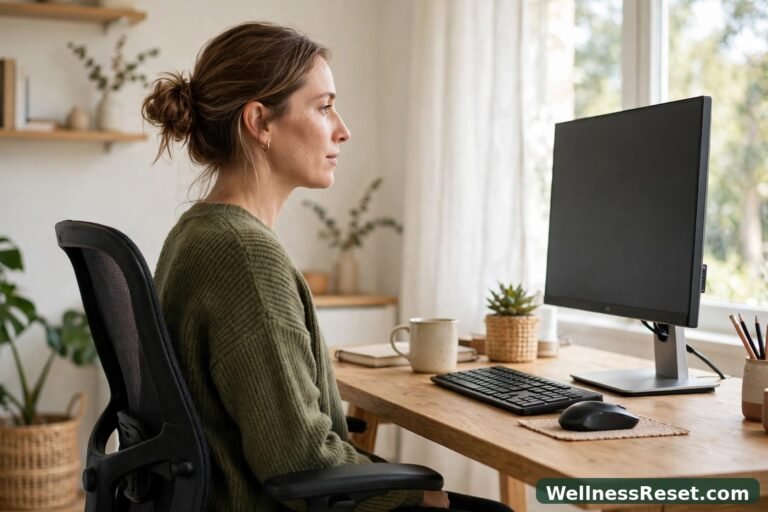
Sitting badly all day and expecting ten minutes to undo it. The routine helps, genuinely. But if you spend eight hours folded over a laptop, the stretch is fighting an uphill battle. Our desk posture guide covers the other half of the problem: Fix Your Posture at Your Desk.
Quitting after two days. Two sessions tell you nothing. Give it a full week, once a day, same time if you can — after your evening meal works for most people. If nothing has changed after two weeks of steady practice, that is useful information too, and worth mentioning to your doctor.
Final Words
A sore lower back makes everything smaller. You stop bending down. You stop reaching up. You plan your day around chairs with good back support. It is a miserable, quiet way to live, and the worst part is how normal it starts to feel.
These stretches will not rebuild your back or undo twenty years of desk work. What they do is simpler and, in my experience, more useful: they give you twelve minutes a day when your back is allowed to move gently, without bracing, without guarding, without hurry. Do that for a week and most people find the mornings get a little easier. The shoes get tied sitting down, then standing up. Then one day you bend down without thinking about it first — and that is the whole point.
Start tonight. Mat on the floor, blanket folded, knees to chest. Three slow breaths. See how it feels.
FAQ
How often should I do lower back stretches?
Once a day is enough for most people. Twice a day is fine if your back is particularly stiff — once in the morning and once in the evening. More than that is unnecessary; the muscles need time between sessions to actually loosen.
Can lower back stretches make back pain worse?
They can, if you push too hard or stretch through sharp pain. A mild pull that eases as you hold it is normal. Sharp pain, shooting pain, or pain that is worse the next morning means you went too deep — do it smaller next time, or skip that move and check with a doctor if it keeps happening.
How long until lower back stretches help?
Most people notice their back feels looser after the first few sessions, but a real change in how your mornings feel usually takes one to two weeks of daily practice. If nothing has changed after two weeks, or the pain is getting worse, see a doctor rather than stretching harder.
Should I stretch my lower back if it hurts right now?
If the pain is a dull ache or stiffness, gentle stretches like knees-to-chest are usually fine and often help. If the pain is sharp, shooting down your leg, or came on suddenly after a lift or a fall, do not stretch — rest, and get medical advice first.
Are lower back stretches safe for older adults?
Yes, generally — these are gentle moves, and the seated versions work well if getting on the floor is difficult. But if you have osteoporosis, a spinal condition, or a recent fracture, check with your doctor or physiotherapist first, since some twists and folds need modifying for fragile bones.