
5 Small Morning Habits That Actually Stick (None Take More Than 5 Minutes)
The alarm goes off. You hit snooze. Then again. Then you are vertical, rushing, phone in one hand, doing everything late — and by 10 am the day already feels like it is happening to you instead of with you.
Most morning-routine advice makes this worse. It shows you someone’s 5 AM routine with ice baths, journaling, and a 40-minute workout, and quietly implies you are failing at mornings. You are not failing. You just need habits small enough to survive a real morning — the snooze-button kind, the kids-screaming kind, the already-late kind.
These five take five minutes or less each. More importantly, each one is designed to be doable on your worst morning, not just your best one. That is the whole secret of habits that stick: they have to survive the bad days.
1. Water Before Phone
Your body wakes up mildly dehydrated — you have gone seven or eight hours without water. The phone, meanwhile, wakes you up mildly stressed: messages, news, someone’s opinion about something.
So the rule is stupidly simple: glass of water first, phone second. Keep a glass or bottle by your bed. Drink it while you are still half-asleep, before the screen lights up your face.
It is not magic. It does not “flush toxins” or any of that. It just rehydrates you and gives your brain five quiet minutes before the noise starts. In my experience, the people who struggle most with chaotic mornings are the ones whose first ten conscious minutes belong to other people’s priorities.
The 2-minute start: put a filled bottle on your nightstand tonight. That is the entire habit setup.
2. Three Minutes of Stretching (Not a Workout)
Not exercise. Not a routine with a name. Just three minutes of moving your body before the day folds you into a chair.
Touch your toes (or your shins — no judging). Roll your shoulders. Do five slow cat-cows on the bedroom floor or against the bed. Twist gently side to side. Done.
Why it works: sleep leaves your muscles stiff and your joints a bit rusty. Three minutes of easy movement tells your body the day has started, and it breaks the bed-to-chair pipeline where you go from lying down to sitting down with nothing in between. If you want a proper version later, our 10-minute morning stretching routine builds on exactly this.

The 2-minute start: tomorrow, before you touch your phone, stand up and touch your toes three times. That counts. Build from there.
3. Open the Curtains (Daylight Is a Drug)
This one sounds too simple to matter, which is exactly why people skip it. Morning daylight — real outdoor light through a window, not a tube light — is the strongest signal your body gets that it is daytime.
Light hitting your eyes in the first hour after waking sets your body clock. It tells your brain to stop making melatonin (the sleepy chemical) and start the daytime machinery. People who get morning light consistently fall asleep more easily at night — it is the same clock, both ends of the day.
Cloudy day? Still works — overcast sky is far brighter than indoor lighting. Five minutes near a window or on a balcony is enough.
The 2-minute start: open your bedroom curtains the moment you get up. If you make tea or coffee, drink the first few sips near the window.
4. Three Lines on Paper (Not “Journaling”)
Journaling sounds like homework. Three lines does not.
Grab any notebook and write three lines: one thing on your mind, one thing you need to do today, one thing you are not going to worry about until later. Ugly handwriting is fine. Nobody reads it. The point is getting the mental noise out of your head and onto paper, where it stops looping.
This works because morning anxiety is usually vague — a cloud of “so much to do.” Three lines turns the cloud into items. Items can be handled; clouds cannot.
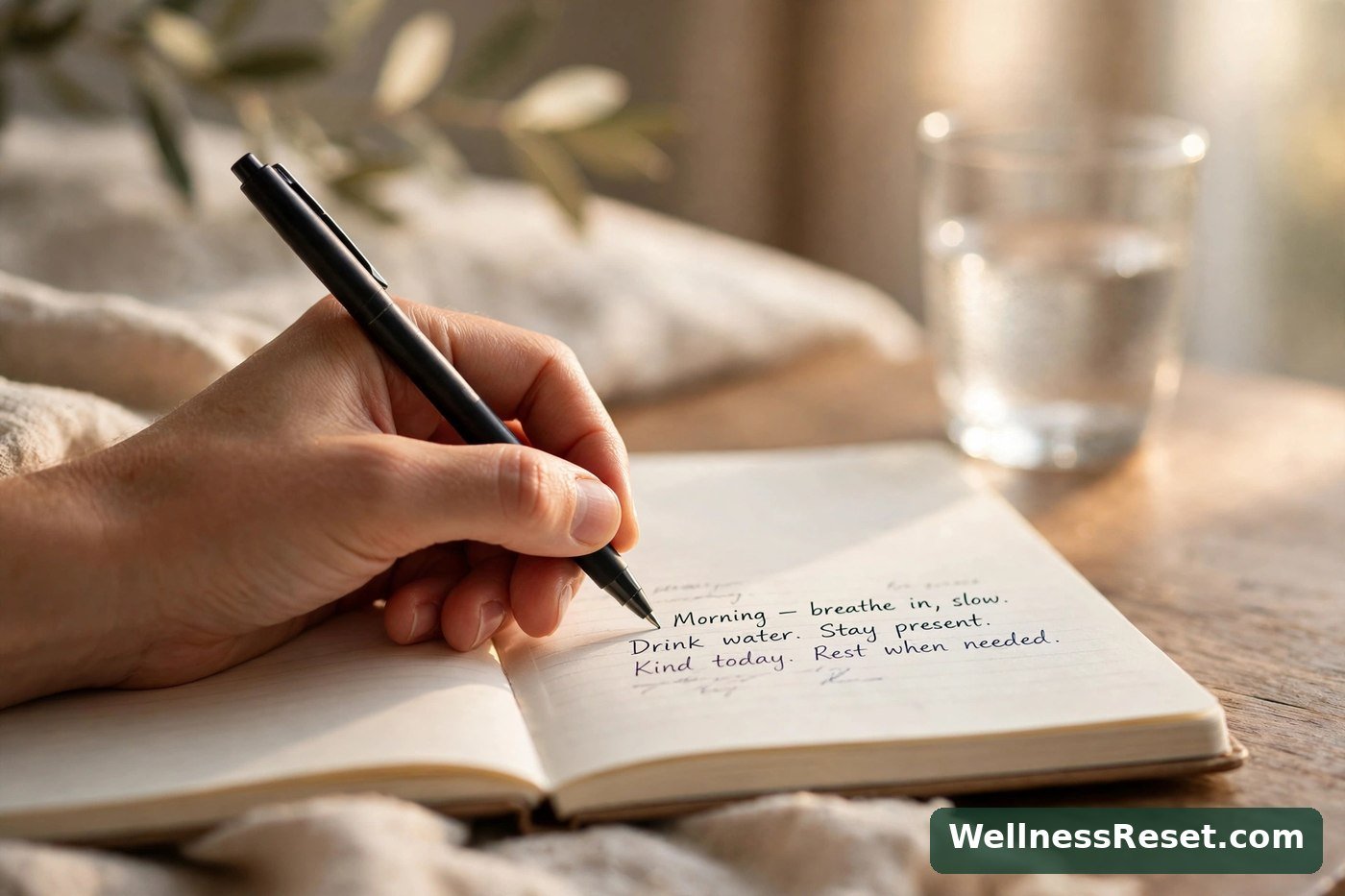
The 2-minute start: keep a pen and any notebook next to your bed. Tonight, write tomorrow’s three lines before sleeping if mornings are too rushed.
5. Decide Breakfast the Night Before (Just Decide)
Not cook it. Not meal-prep seven containers. Just decide.
Mornings run on decision energy, and it is thinnest when you are half-awake. “What should I eat” becomes a ten-minute scroll or a skipped meal. Deciding the night before — “tomorrow is eggs and toast” or “oats with banana” — removes one decision from the weakest part of your day.
And eat something with a bit of protein if you can. It keeps you full longer than a pure-carb breakfast, which means fewer 11 am crashes and less reaching for biscuits. Nothing fancy — eggs, curd, peanuts, paneer, whatever is already in your kitchen.

The 2-minute start: tonight, before bed, say out loud what tomorrow’s breakfast is. Sounds silly. Works anyway.
Habit → The 2-Minute Start
| Habit | The 2-minute start |
|---|---|
| Water before phone | Bottle on the nightstand tonight |
| 3-minute stretch | Touch your toes 3 times tomorrow morning |
| Morning daylight | Open curtains the moment you get up |
| Three lines on paper | Pen + notebook by the bed |
| Decide breakfast | Say tomorrow’s breakfast out loud tonight |
Mistakes That Kill Morning Habits
Starting all five on Monday. Pick one. Do it for a week. Add the second only when the first feels automatic. Five new habits at once is how you end up with zero by Friday.
Copying someone’s 5 AM routine. That person’s life is not your life. A routine that needs 90 free minutes and no kids is not a routine — it is a fantasy. Yours needs to survive your actual mornings.
Phone first, always. This is the one that quietly eats the others. If the phone comes first, the water waits, the stretch never happens, and the three lines become three hours of scrolling. Water before phone is first on the list for a reason — it protects everything after it.
Judging the habit by day three. New habits feel awkward and pointless for the first week or two. That is not evidence they are not working; it is just what “new” feels like. Give each one three honest weeks.
Final Words
Nobody’s life changed because they bought a nicer planner or woke up at 5. Lives change when small things happen reliably — water before phone, three minutes of movement, daylight, three lines, one decided breakfast. Boring. Repeatable. Yours.
Pick the easiest one. Start tonight (most of them start the night before, notice). And if your mornings are rough because your nights are rough, fixing your sleep schedule will do more for your mornings than any habit on this list.
FAQs
What if I am not a morning person?
Then do not try to become one overnight. These habits work at 6 am and at 9 am — they are about the first 20 minutes after you wake up, not about the clock. Night owls need water and daylight too.
How long until a habit actually sticks?
The popular “21 days” number is a myth. Research puts it anywhere from 18 to 250+ days depending on the person and the habit — average around two months. Smaller habits stick faster, which is why these are all tiny.
Should I do these in a specific order?
The order above is roughly the natural flow of a morning — water, movement, light, mind, food. But the best order is the one you will actually follow. Do not overthink sequencing.
What if I miss a day?
Nothing happens. The rule that matters: never miss twice. One missed day is life; two in a row is the start of quitting.
Can kids do these too?
The water, daylight, and breakfast-decision habits work great for kids. The three-lines habit works for older kids who like writing. Stretching together for three minutes is genuinely fun — try it before school.







2 Comments