How to Make Stretching a Daily Habit
Last January, I bought a brand-new yoga mat, unrolled it in the corner of my bedroom, and told myself this was the year I would stretch every day. The mat stayed there for three weeks, untouched. Not because I didn’t want to stretch — my neck was stiff every morning — but because “every day” felt like a promise I had already broken by day four.
That is how most stretching habits die. Not with a dramatic failure. With a quiet Tuesday where you are busy, you skip once, and the whole thing quietly falls apart.
Learning how to make stretching a daily habit has little to do with discipline. In my experience, it is about making the habit smaller, attaching it to something you already do, and removing the guilt that turns one missed day into a missed month.

Why Stretching Habits Fail
Most people start too big. A 30-minute routine, first thing in the morning, seven days a week. That works for about three days. Then a late night happens, or work runs long, and the routine doesn’t fit the day anymore. So it gets skipped. And skipped again.
The second problem is vagueness. “I should stretch more” is not a plan — no time, no place, no trigger. Your brain cannot act on a wish. It can act on “after I brush my teeth, I stretch for two minutes beside the bed.”
The third problem is the all-or-nothing rule we quietly set for ourselves. Miss one day, feel like a failure, quit. But a habit is not a test you pass or fail. It is just something you return to.
Habit Stacking: Attach It to Something You Already Do
Habit stacking is simple. Take a habit that is already automatic — brushing your teeth, making coffee, waiting for the kettle — and put stretching right after it. The old habit becomes the reminder.
Pick one anchor, not five. Good anchors are things you do every day without thinking:
- After brushing your teeth, stretch beside the bathroom door for 2 minutes.
- While the coffee brews, stretch in the kitchen — those 3 to 4 minutes are otherwise dead time.
- After lunch, stretch for 2 minutes before sitting back down at your desk.
- While dinner heats up, do one standing stretch.
Write it as one sentence and stick it somewhere visible for two weeks: “After I make coffee, I stretch for 3 minutes in the kitchen.”
If mornings are already crowded, stack stretching onto an evening anchor instead, like right after you change into home clothes. The best anchor is the one that actually happens every day, not the one that sounds impressive.
For ideas on the rest of your morning, see 5 Small Morning Habits That Actually Stick — none take more than 5 minutes. And if you already walk after meals, that walk can be your anchor: The 10-Minute Walk After Meals shows how one small post-meal habit can carry another.
The 5-Minute Starter: Small Enough to Do on a Bad Day
Forget the perfect routine for now. Your only job for the first two weeks is a 5-minute starter you can do half-asleep, in normal clothes, without a mat. Hold each move gently for about 30 seconds, never forcing a stretch into pain:
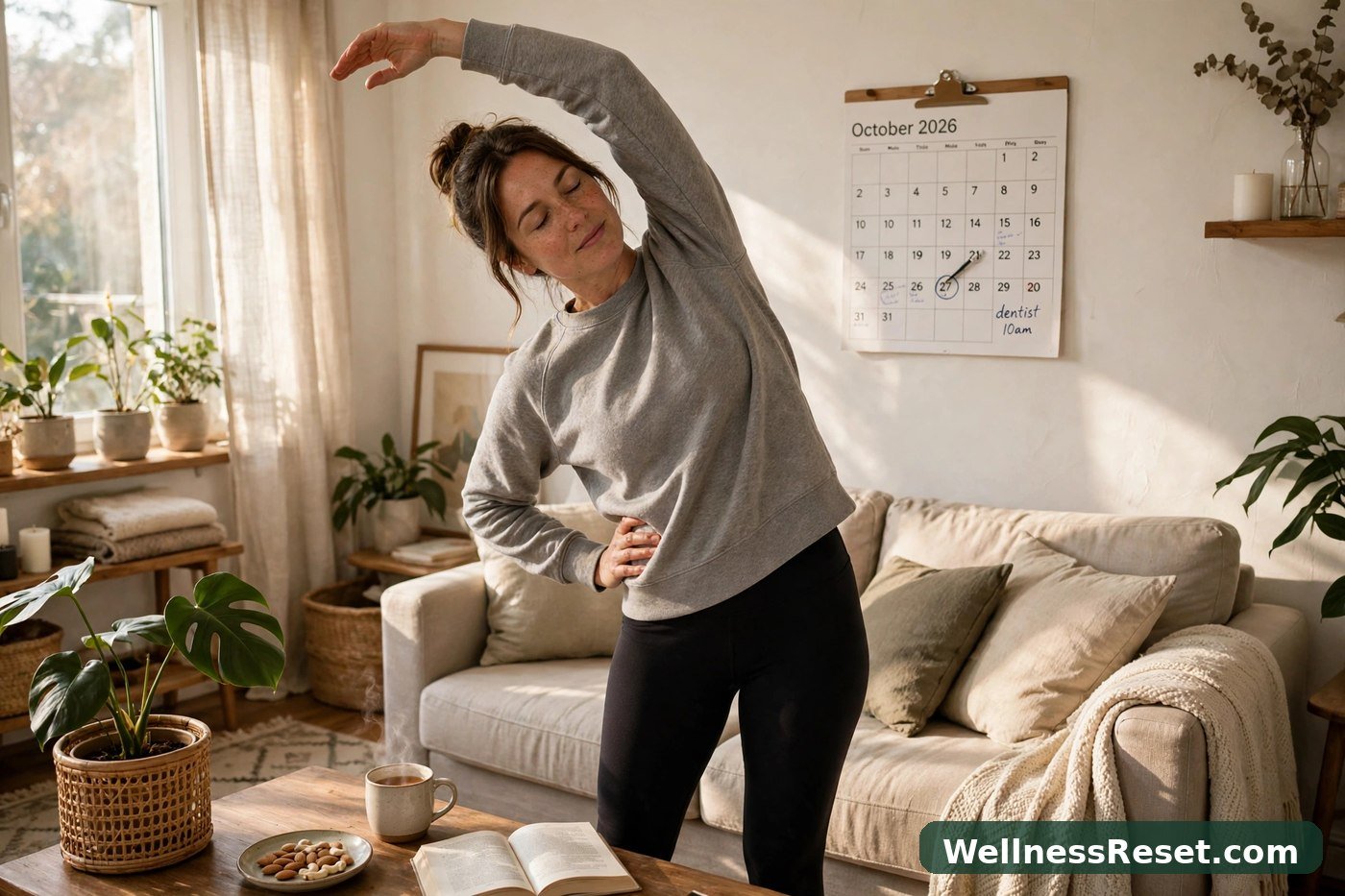
- Arms overhead, side to side — reach both arms up, lean gently left, then right, for about a minute total.
- Shoulder rolls and a chest opener — roll each shoulder back 5 times, then clasp hands behind your back and lift slightly.
- Neck release — drop one ear toward one shoulder, hold 30 seconds, switch sides. Slow. No yanking.
- Standing forward fold, knees soft — let your arms hang, bend your knees as much as you need.
- Seated or standing twist — sit tall and twist gently each way for 30 seconds.
That’s it. Five minutes, done. For a ready-made morning version, try The 5-Minute Morning Stretching Routine for People With No Time.
One honest caveat: this won’t fix everything. If you have sharp pain, numbness, or an old injury that flares up, see a doctor or physio first. Stretching helps everyday stiffness. It is not a treatment.
After two weeks of the starter, you can add a minute or two, or a second short evening session. Or not. Five minutes most days beats 30 minutes done twice and abandoned.
Tracking Without Pressure: Tick Marks, Not Streaks
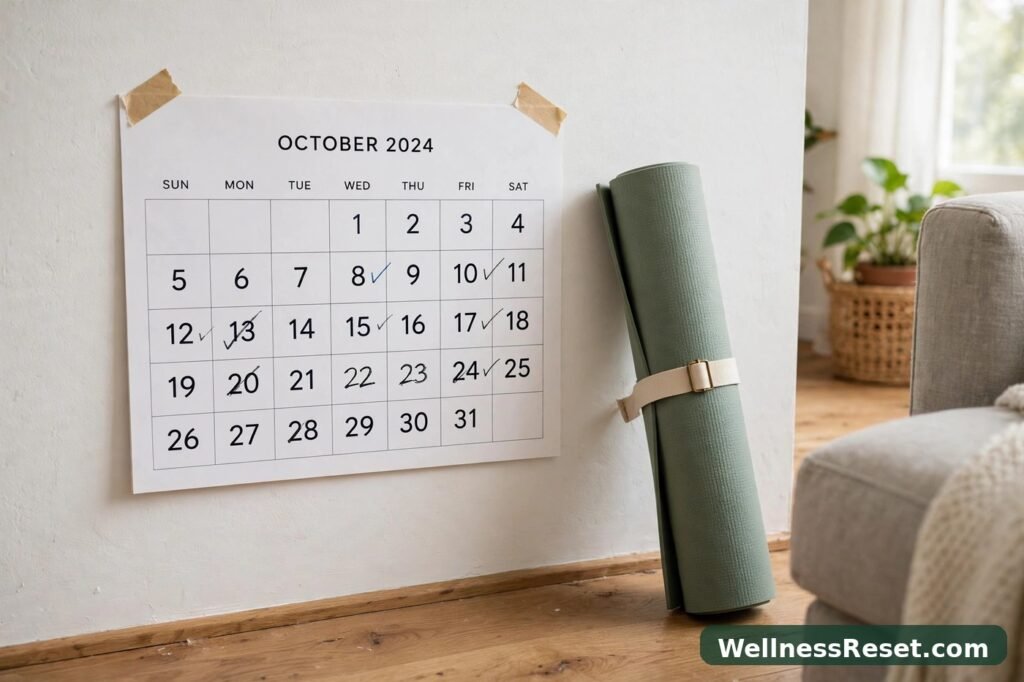
Put a paper calendar where you stretch — on the fridge, or on the bedroom wall next to the mat. Each day you stretch, draw a tick. That’s the whole system.
A paper calendar works better than an app here, because you see the month at a glance and nothing shames you with a notification. Count ticks at the end of the week. Four out of 7 is a good week. The goal is “most days,” not “every day without fail.”
Streaks sound motivating untill they break. And they always break — travel, illness, a genuinely awful week. When a streak breaks, most people feel they have lost something and stop. Tick marks don’t break. A blank day is just a blank square, and the next day you can tick again.
If you like a short burst to get going, The 7-Day Morning Stretching Challenge is a good kick-start for that first week — treat it as a beginning, not a test you must pass perfectly.
What to Do on Missed Days
You will miss days. Plan for it now, while you are motivated, so a missed day doesn’t need a decision later.
The rule I use is simple: never miss twice. One missed day is life; two in a row is the start of a new habit — the habit of not stretching. So after a miss, the next day’s stretch gets smaller, not bigger. Don’t “make up for it” with a 20-minute session. Do the 2-minute version. The point is to return, not to punish yourself.
Also, shrink the habit on hard days before you skip it entirely. Travelling? Stretch for 2 minutes beside the bed. Sick? One gentle neck and shoulder move, seated. Exhausted at 11 pm? Skip it and tick tomorrow. Rest is part of the habit too.
An evening anchor helps here: if the morning falls apart, the evening is your second chance. Our 10-Minute Evening Reset pairs a short wind-down with other small evening habits.

When It Gets Hard: Obstacle | Fix
| Obstacle | Fix |
| “I don’t have time” | Use the 5-minute starter, or the 2-minute version, stacked onto coffee or tooth-brushing. |
| “I keep forgetting” | Put the mat where you can see it, and stack stretching onto one daily anchor. |
| “I missed a day and feel guilty” | Use the never-miss-twice rule. Do 2 minutes the next day. |
| “It feels boring” | Change the music, stretch by a window, or move outdoors for a week. |
| “My body is too stiff” | Start small, not later: gentle 30-second holds, knees soft, no forcing. Stop if anything hurts sharply. |
| “Evenings are chaotic” | Move the anchor to the morning, or split it: 2 minutes morning, 3 minutes evening. |
Common Mistakes
Starting with a long routine. Twenty or 30 minutes sounds serious. It is also the fastest way to quit. Earn the longer routine with two easy weeks first.
Stretching cold and forcing it. Bouncing or yanking your neck doesn’t make you flexible faster. It makes you sore and wary. Gentle and steady wins here.
Changing the plan every week. A new routine every Monday feels productive. It is actually restarting from zero each time. Keep the same 5 moves for at least a month before judging them.
Hiding the mat. If the mat lives in a cupboard behind boxes, you will not use it. Leave it out where you stretch. Visible is doable.
Treating rest days as failures. A rest day during illness or after a hard week is sensible. The habit is “most days over months,” not “every day forever.”
Final Words
A daily stretching habit is not built in a week of enthusiasm. It is built in the small, slightly boring repetition of a 5-minute routine attached to coffee, tracked with tick marks, and returned to after every missed day without drama.
Start tomorrow, not Monday. Pick one anchor. Do five minutes. Tick the calendar. That is how it sticks — not by being perfect, but by being small enough to come back to.

FAQ
How long does it take for stretching to become a habit?
Most people feel it getting automatic after 3 to 4 weeks of most-days practice, though it varies. Watch your tick marks adding up, not the calendar for a magic day.
Is 5 minutes of stretching a day enough?
For everyday stiffness and keeping a habit alive, yes. Five gentle minutes most days beats a long session you only do twice a month.
What if I miss a whole week?
Restart with the 2-minute version. No catch-up session, no guilt speech. One small stretch tomorrow puts you back in the habit.
Should I stretch in the morning or evening?
Whichever time you will actually do it. Morning loosens you up before the day; evening suits rushed mornings. Keep one anchor for a month.
Do I need special equipment?
No. A chair and a bit of floor space are enough for the starter here. A mat is nice later, but it is not what makes the habit work.