
What Is Chair Yoga?
My neighbour is seventy-four, has two replacement knees, and does yoga every morning. Not on a mat. On a dining chair, in her kitchen, in her slippers, while the kettle boils. When I first saw her doing it I assumed she was doing some watered-down version of the real thing. Then I tried her ten-minute routine and realised my shoulders were the problem, not hers. That is chair yoga in one scene: real yoga, done with a chair doing half the work.
Chair yoga is yoga adapted so that most of it happens seated, or standing with a chair close by for balance. The poses are the familiar ones — twists, side bends, forward folds, gentle backbends — reshaped so your weight stays supported. Nothing about it is a trick or a shortcut. It is the same practice, with the floor removed from the equation.
What Chair Yoga Actually Is
Strip away the marketing and chair yoga is simple: a yoga practice where a sturdy chair replaces the mat as your base. You sit on it, stand behind it, or hold it while you move. The chair gives you three things a mat cannot: something to push against, something to hold when your balance wobbles, and a clear stopping point. That last one matters more than people think. On a mat, there is always further to go. On a chair, the seat edge tells you where enough is.
A typical class borrows from hatha yoga — slow movements, held poses, attention on breathing — and keeps everything low-impact. There is no jumping, no deep squatting, no getting up and down off the floor. Most sessions run 20 to 30 minutes, and the structure is predictable: a few minutes of seated breathing, gentle warm-ups for the neck and shoulders, a sequence of seated poses, a short standing section holding the chair, and a few quiet minutes at the end with your eyes closed.
The word “chair” fools people into thinking it is only for people who cannot stand. It is not. Office workers do it at their desks. Runners use it on rest days. Plenty of people who can do a full mat practice perfectly well still use a chair session on stiff mornings, because sitting down makes the stretch arrive sooner — you are not spending energy on balance, so you can actually feel the muscles you are trying to reach.
Who It Suits Best
Chair yoga suits anyone who wants yoga without the floor work, but a few groups get the most out of it.
Older adults. Getting down to a mat and back up again is the hardest part of yoga for many people over sixty-five. Chair yoga removes that entirely, and the seated poses still work the spine, hips and shoulders through their full comfortable range.
People with limited mobility. After a knee replacement, with arthritis, with a bad back, or while recovering from an injury, the chair carries your weight and lets you move the joints that can move. It is the difference between doing something and doing nothing.
Desk workers. If you sit for eight hours, your hips are folded all day and your shoulders creep toward your ears. A ten-minute chair session at lunch undoes more of that than an hour of willpower about “sitting up straight”.
Complete beginners. Mat yoga can feel like a performance — everyone else seems to know where their feet go. On a chair there is nowhere to fall and no pose to fail. It is the gentlest possible front door into yoga.
How It Differs From Mat Yoga
The differences are practical, not philosophical. Same breathing, same attention, same slow pace — different relationship with gravity.
On a mat, your body weight is the resistance. In a chair, the seat takes most of it, so a pose like a spinal twist becomes easier to hold and easier to breathe through. You get the stretch without the strain of holding yourself up.
Balance works differently too. On a mat, standing poses test your balance constantly. With a chair back under your hand, the balance question disappears and you can focus on the stretch itself. For someone whose balance is unreliable, that is not a small thing — it is the whole point.
The range is smaller, and honestly, that is a feature. Mat yoga tempts people to chase depth. Chair yoga keeps you in the middle of your range, where the useful work happens.

What a Typical Session Looks Like
Here is the shape of a standard 20-minute chair yoga session, so you know exactly what you are walking into.
Minutes 1–3: breathing. Seated tall, feet flat on the floor, hands resting on your thighs. Slow breaths in through the nose, out through the mouth. Four counts in, six counts out. Nothing fancy — this is just you arriving.
Minutes 3–8: warm-ups. Neck half-circles, shoulder rolls, wrist circles, ankle circles. Small movements, done slowly. This is where your body stops feeling like it has been sitting in a car for three hours.
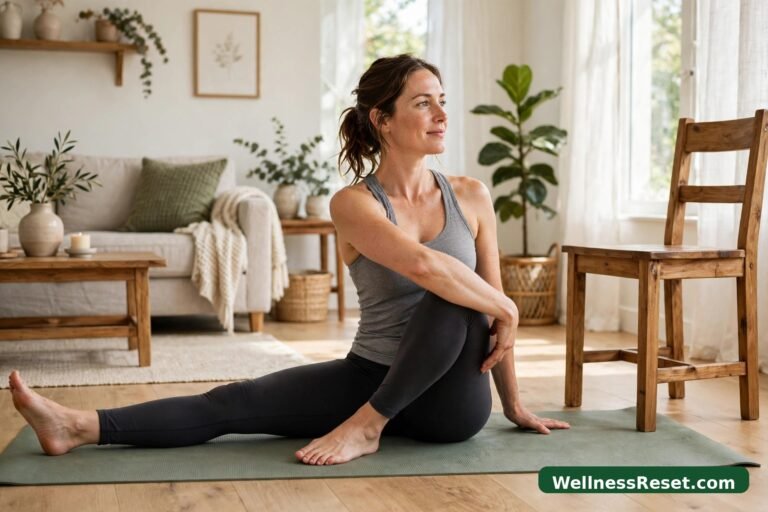
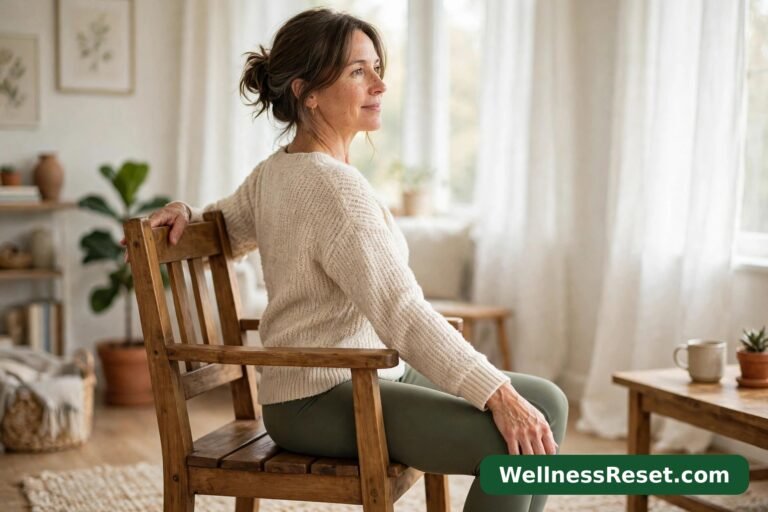
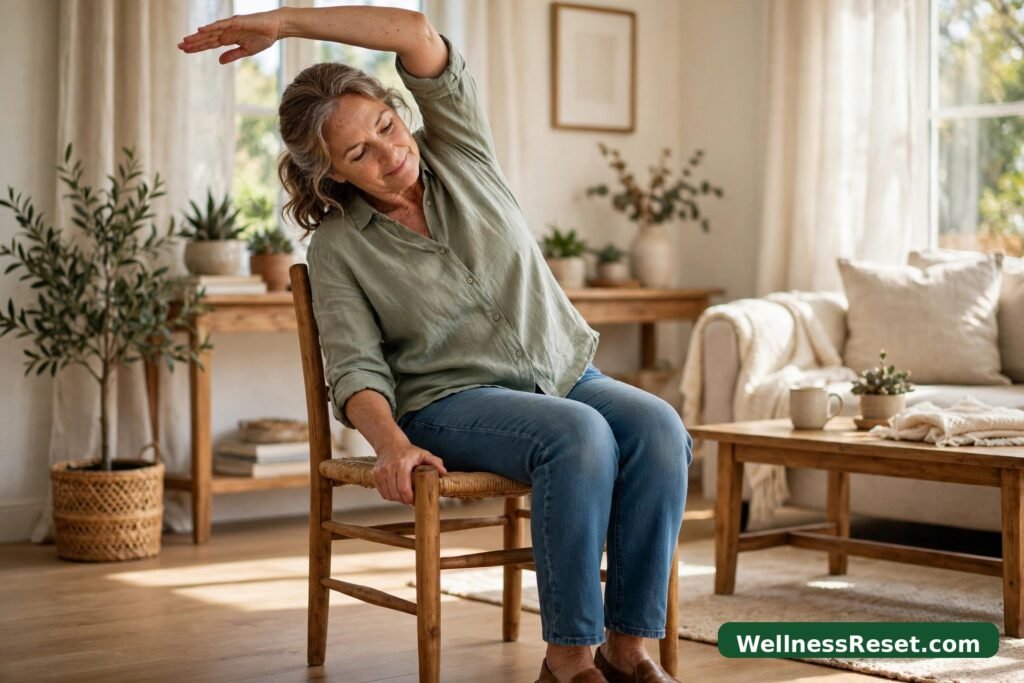
Minutes 8–16: the main sequence. Seated cat-cow (rounding and arching your spine with hands on your knees), a seated twist holding the chair back, a side bend reaching one arm overhead, a seated forward fold letting your chest drop toward your thighs, and a seated figure-four stretch for the hips. Each pose held for three to five slow breaths. If you want the full set of twelve, our poses guide walks through them one by one: 12 Chair Yoga Poses Every Beginner Should Know.
Minutes 16–19: standing with the chair. Holding the chair back, a gentle calf stretch, a slow march in place, a standing side bend. Only if standing feels fine — the whole section is optional.
Minutes 19–20: stillness. Hands on your thighs, eyes closed, three slow breaths. Done.
That is it. No chanting, no Sanskrit quiz, no flexibility test at the end. If a class you join looks very different from this — loud music, fast flows, deep binds — it may be a chair-flavoured fitness class, not chair yoga. Both are fine, but they are not the same thing.
What Chair Yoga Can and Cannot Do
Let us be honest, because the internet is not. Chair yoga can improve how your body feels day to day. Regular practice — three or four times a week — tends to loosen stiff shoulders, ease a tight lower back, and make ordinary movements like turning to reverse the car feel easier. It builds a little strength in the legs and core, mostly because you are using muscles you had forgotten about. And the slow breathing genuinely calms a busy mind; ten minutes of it before bed is worth more than scrolling your phone for an hour.
What it cannot do is just as important. It will not fix a slipped disc, cure arthritis, or replace physiotherapy. It will not make you flexible in a week, and it will not burn many calories — a gentle chair session uses about as much energy as a slow walk. Anyone promising dramatic results from chair yoga is selling something.
The honest framing is this: chair yoga is maintenance. Like brushing your teeth, the benefit is in the doing, regularly, over months. It keeps the range you have and slowly widens it. It will not rebuild a joint, but it will keep the rest of your body moving well around it. For a grounded overview of yoga’s place in a gentle routine, the NHS yoga guide is a sensible read: NHS Yoga Guide.
How to Start (and What You Need)
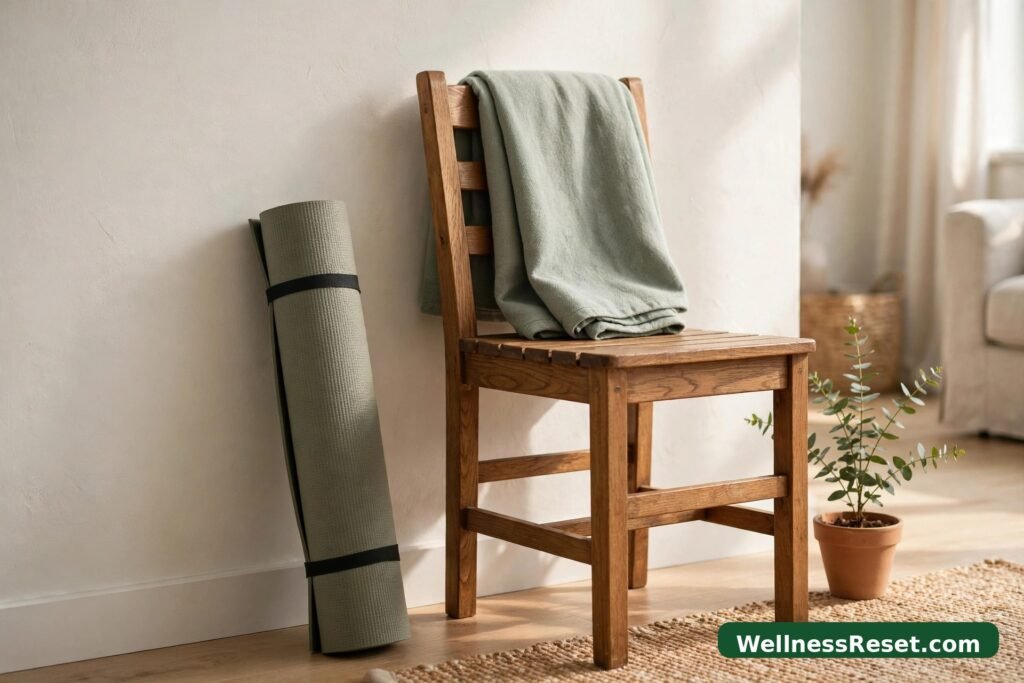
You need one thing: a sturdy chair with no wheels and no armrests getting in the way. A dining chair is perfect. An office chair on castors is not — it will roll away from you at exactly the wrong moment. A wheelchair with brakes on also works, and many hospital and community classes are built around exactly that.
Wear whatever you are already wearing. Flat shoes or bare feet, loose clothes. A cushion behind your lower back helps if the chair seat is deep. A folded blanket on the seat raises your hips if your knees sit higher than your hips — that one adjustment makes the seated poses far more comfortable.
Start with ten minutes, three times a week. Pick a fixed time — after breakfast works for most people — and do the same short sequence each time until it feels familiar. Once it does, our beginner mat routine is a natural next step if you ever want one: Gentle Yoga for Beginners. There is no rush, and no requirement to graduate. Plenty of people stay with chair yoga for years because it does exactly what they need.
One caution: if you have osteoporosis, a recent fracture, or a spinal condition, check with your doctor or physiotherapist before starting, and tell any class teacher about it. Most chair yoga is gentle, but some twists and forward folds need modifying for fragile bones. A good teacher will do that without fuss.
Common Mistakes Beginners Make
Perching on the edge. Sitting right on the front edge feels active but it is unstable. Sit back so your whole seat is on the chair, feet flat on the floor. Stability first.
Holding your breath. The moment a stretch gets interesting, people stop breathing. If you catch yourself doing it, ease off the stretch until you can breathe normally again. The breath is the pace-setter, not an afterthought.
Forcing the twist. A spinal twist should feel like wringing out a towel gently, not like cracking a safe. If your shoulders are nowhere near level, that is fine. Wherever you stop is the pose.
Choosing a wobbly chair. Wheels, swivels, folding chairs with a mind of their own — all bad. If the chair moves when you push on it, find another chair.
Doing it once and deciding it does nothing. One session loosens you for an hour. Twenty sessions change how your mornings feel. Give it a month before you judge it.

Troubleshooting
| Problem | Quick fix |
|---|---|
| Knees sit higher than hips | Sit on a folded blanket or cushion to raise your hips |
| Chair slides on a hard floor | Put a rubber mat or towel under the chair legs |
| Lower back aches during seated poses | Sit taller, or place a small cushion behind your lower back |
| Shoulders creep up near your ears | Drop them before each pose and check again halfway through |
| A twist feels pinchy | Make it smaller — turn halfway and breathe there instead |
Final Words
Chair yoga is yoga with the obstacles removed. No mat, no floor, no flexibility test, no special clothes. Just a chair, ten minutes, and the willingness to move slowly and breathe properly. My neighbour was right all along — the kitchen chair is a perfectly good yoga studio, and the kettle boiling is a perfectly good timer.
If you have been telling yourself you will start yoga “when you are more flexible” or “when your knees are better”, that day is not coming on its own. Start with the chair you are sitting on right now. Sit tall, roll your shoulders back once, and take three slow breaths. You have just done the first minute.
FAQ
Is chair yoga real yoga?
Yes. It uses the same principles — breath, posture, attention — adapted to a seated base. Yoga teachers, hospitals and physiotherapists all use it, and it appears in mainstream yoga teacher training.
Do I need to be flexible to start chair yoga?
No. That is the point. The poses meet you where you are, and flexibility improves slowly over weeks of practice. Nobody in a chair yoga class is expected to touch their toes.
How often should I do chair yoga?
Three to four times a week is a good rhythm. Ten to twenty minutes per session is enough. Daily is fine too — it is gentle enough that it does not need rest days.
Can chair yoga help with back pain?
It can ease the stiffness and muscle tension that make ordinary back pain worse, and many people find their backs feel better after a few weeks. But it does not treat the cause of back pain, and sharp, shooting, or long-lasting pain needs a doctor or physiotherapist, not a chair routine.
What kind of chair is best for chair yoga?
A sturdy dining chair with a flat seat, no wheels, and no armrests. The chair should not slide or tip when you lean on it. Avoid office chairs on castors and folding chairs.
Can I do chair yoga at my desk at work?
Yes, if your work chair is stable. A five-minute version — shoulder rolls, a seated twist, a side bend, three slow breaths — fits into a coffee break and makes the afternoon noticeably easier.