
12 Chair Yoga Poses Every Beginner Should Know
If you search “chair yoga poses” you get a wall of Sanskrit names and photos of people doing things that look nothing like sitting in a chair. That is exactly why most beginners never start — nobody gives them a simple menu.
Here is the menu. Twelve poses, nothing exotic, all doable in a regular sturdy chair with no armrests (dining chair, office chair with the wheels locked). They are grouped in the order you should do them: warm-up, main set, cool-down. You do not need all twelve every day. Pick five or six and you have a complete 15-minute practice.
One setup note that matters more than any pose: sit on the front half of the seat, feet flat on the floor, back not touching the backrest unless a pose says so. That one change turns “sitting” into “yoga.”
Warm-Up (5 minutes)
1. Seated Mountain (Tadasana)
Sit tall. Feet flat, hip-width apart. Press your sitting bones down, crown of the head up. Hands rest on thighs. Hold for 5 slow breaths. This is not “doing nothing” — it teaches your body the posture every other pose builds on. Best for: resetting slouchy desk posture.
2. Seated Cat–Cow
Hands on knees. Inhale: arch your back, chest lifts, look slightly up. Exhale: round your back, chin toward chest, belly pulls in. Six to eight slow rounds. The single best warm-up for a stiff spine, and it takes ninety seconds. Best for: morning back stiffness.
3. Neck Rolls
Drop your right ear toward your right shoulder, roll your chin to your chest, then to the left shoulder — slow half-circles only, never full head circles (those crunch the neck joints the wrong way). Three each direction. Best for: screen-stiff necks.
4. Seated Shoulder Rolls
Inhale: lift shoulders to your ears. Exhale: roll them back and down, squeezing the shoulder blades. Five rounds, then five forward. You will hear crackling. That is normal, and it feels great. Best for: tension held between the shoulder blades.

Main Set (8–10 minutes)
5. Seated Spinal Twist (Parivrtta Sukhasana)
Sit tall. Inhale to lengthen, exhale: twist right, left hand on your right knee, right hand on the seat behind you. Look over your right shoulder. Hold 5 breaths, switch sides. Do not force it — the twist comes from the belly, not yanking your neck. Best for: mid-back tightness from sitting.
6. Seated Forward Fold (Uttanasana)
Feet a little wider than hips. Exhale: fold forward from the hips, letting your hands slide down your legs toward the floor. Let your head hang heavy. Hold 5 breaths, then roll up slowly, head last. Best for: lower back and hamstrings.
7. Chair Warrior I (Virabhadrasana I)
Turn sideways on the chair, right leg over the back of the chair, left leg extended behind you with the foot flat. Inhale: raise your arms overhead, palms facing each other. Square your hips forward. Hold 5 breaths, switch sides. Best for: hip flexors and thighs that shorten from sitting all day.
8. Chair Warrior II (Virabhadrasana II)
Same sideways seat. Extend the front leg’s knee over the ankle, arms out to the sides at shoulder height, gaze over the front hand. Hold 5 breaths, switch. You will feel your legs working — this is where chair yoga stops feeling “easy.” Best for: leg strength, balance.
9. Seated Pigeon (Eka Pada Rajakapotasana prep)
Right ankle on your left knee, right knee relaxed outward. Sit tall and lean forward slightly from the hips until you feel the stretch deep in the right hip. Hold 5–8 breaths, switch sides. If the knee floats high, put a cushion under it — no forcing. Best for: tight hips, sciatica-style ache.
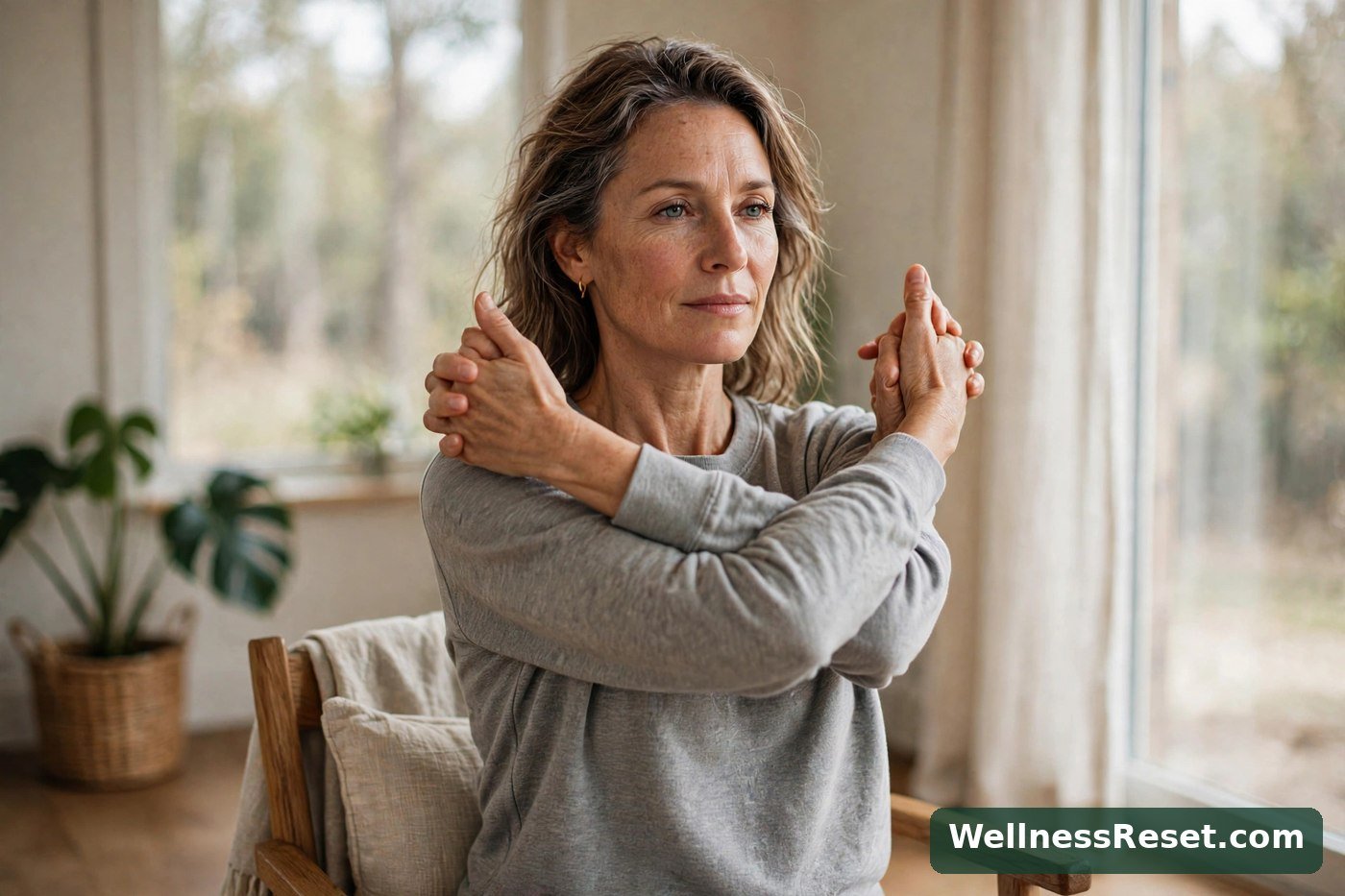
10. Seated Eagle Arms (Garudasana arms)
Extend arms forward, cross right arm under left, bend elbows, press palms together (or backs of hands). Lift elbows to shoulder height. Hold 5 breaths, switch the cross. Your upper back will feel like it is finally being wrung out. Best for: upper back and between-shoulder-blades tension.
Cool-Down (3–5 minutes)
11. Seated Side Bend (Parsva Sukhasana)
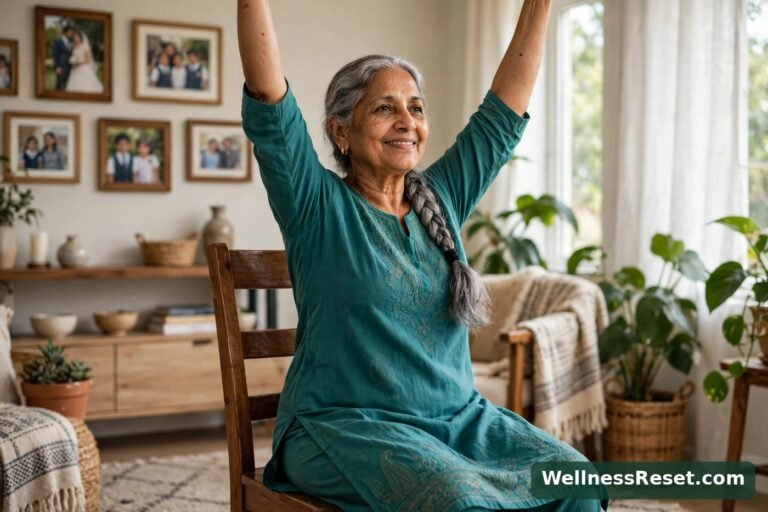
Sit tall, inhale: raise your right arm overhead. Exhale: lean left, reaching up and over. Feel the whole right side stretch. Hold 5 breaths, switch sides. Simple, and it hits the side-body muscles that never get stretched sitting at a desk. Best for: side stiffness, ribcage tightness.
12. Legs-Up-the-Chair Savasana
Turn sideways, swing your legs up so your calves rest on the seat of the chair, and lie back on the floor with your head on a cushion. Arms rest at your sides, palms up. Close your eyes. Two to three minutes. This is the best two minutes in the whole sequence — your lower back completely releases. Best for: ending practice, total reset.

Putting It Together: A 15-Minute Beginner Flow
You do not need all twelve daily. Here is the flow I suggest for the first two weeks:
Minutes 0–5: Mountain → Cat–Cow → Neck Rolls → Shoulder Rolls
Minutes 5–13: Spinal Twist → Forward Fold → Warrior I → Warrior II → Pigeon → Eagle Arms (5 breaths each side)
Minutes 13–15: Side Bend → Legs-Up-the-Chair Savasana
Do this 4–5 days a week. In week three, add or swap poses from the list above.
Problem → Quick Fix
| Problem | Quick fix |
|---|---|
| Chair slides or rolls | Use a dining chair, or push an office chair against a wall and lock the wheels |
| Knees hurt in Pigeon | Put a folded towel under the crossed knee so it has support — never push a painful knee down |
| Forward fold makes me dizzy | Come up very slowly, head last; keep the fold shallow (hands on shins instead of floor) |
| Warrior poses feel wobbly | Hold the chair back with one hand — balance comes with weeks, not days |
| Back of thighs too tight to fold | Bend your knees generously; the stretch is in the hips and back, not the hamstrings |

Common Mistakes
Holding your breath. Every stretch in this list works on the exhale. If you catch yourself straining and breathless, you are pushing too hard. Back off until you can breathe easily.
Copying the photo, not your body. The person in the picture has different hips, different hamstrings, different history. Your version of Warrior II is the right version of Warrior II.
Skipping the warm-up. Cat–Cow and shoulder rolls feel “too basic” until you do the twists without them and wonder why your back is cranky.
Doing it once and judging. The first session is orientation. The fifth session is when your body starts to recognize the shapes. Give it two weeks before deciding anything.
Final Words
Twelve poses sounds like a lot until you realize you already know four of them — you have been doing rough versions of cat–cow, twists, and forward folds your whole life without the names. Chair yoga is not a lesser version of yoga. It is yoga with the balance risk removed, which for most beginners is exactly what lets them actually do it consistently. Start with the 15-minute flow, five days, two weeks. Then come back to this list and build your own.
Pair it with the Chair Yoga for Beginners 10-minute routine on days you want a guided sequence, and the Chair Yoga for Seniors routine if you want an even gentler version of these same ideas.
FAQs
Do I need a special yoga chair?
No. A sturdy dining chair with no armrests is ideal. Folding chairs work if they do not wobble. Avoid anything with wheels unless you lock them and brace against a wall.
Is chair yoga real exercise?
It is real movement with real benefits — mobility, balance, strength, stress relief. It is not a cardio workout and will not replace one. Think of it as the foundation that makes everything else easier.
How often should a beginner do this?
Four to five days a week, 15 minutes, beats one heroic hour on Sunday. Consistency is the entire game.
What if I cannot do a pose at all?
Skip it for now and do the ones you can. Warrior poses and pigeon are the usual troublemakers — come back to them in a month. Nothing in this list is mandatory.
Can I do chair yoga with bad knees?
Mostly yes — chair yoga is knee-friendly by design since you are seated. Be cautious with Pigeon (support the knee) and skip anything that causes sharp pain. Dull stretch sensation is fine; sharp pain is a stop sign.





2 Comments