How to Get Flexible
Last spring I could not reach the bottom shelf of my wardrobe without a small performance. Not pain — just a body that had quietly decided certain distances were no longer available. I had not been injured. I had just sat down, for years, and stopped asking my body to bend. That is how most people lose flexibility: not in one dramatic moment, but in a thousand small decisions to not reach, not squat, not stretch.
Here is the good news, and it is genuinely good: flexibility comes back. Slowly, unevenly, and not as fast as the internet promises — but it comes back. How to get flexible is not a secret. It is a short routine, done most days, with patience. This is that routine, with the honest timeline attached.
What Flexibility Actually Is (and Is Not)
Flexibility is simply how far your joints and muscles let you move, comfortably. Touching your toes is flexibility. So is reaching the top shelf, turning to check your blind spot, or sitting cross-legged without your knees staging a protest. It is not a party trick. It is everyday range.
People confuse flexibility with mobility, and the difference is worth a minute. Flexibility is how far a joint can be moved — by gravity, by your hands, by a stretch. Mobility is how far you can move it yourself, with control. You need both, but flexibility is the foundation: if a muscle will not lengthen, no amount of strength will move the joint through it. If you want the mobility side too, our beginner routine pairs well with this one: Mobility Exercises for Beginners.
Flexibility is also not the same as being bendy. Some people are naturally loose-jointed; some are not, and never will be. Your goal is not to match them. Your goal is to recover the range your own daily life needs, and maybe a little extra. That is a much smaller, much more achievable target than the splits.
One more thing worth saying plainly: flexibility is use-it-or-lose-it. Muscles and the tissue around them adapt to whatever you ask of them, every day. Sit folded for eight hours and they will happily shorten to fit the chair. Stretch gently for ten minutes a day and they will lengthen again. Your body is not punishing you. It is just following instructions.
A Realistic Timeline (No Promises, Just Patterns)
Every flexibility article promises results in a week. Let us not do that. Here is what actually happens, based on how bodies adapt, not on what sells.
| Timeframe | What usually changes |
|---|---|
| First session | You feel looser for an hour or two — mostly the nervous system relaxing, not real tissue change |
| 1–2 weeks | Movements feel less creaky; your warm-up range improves within each session |
| 3–4 weeks | Everyday reaches feel easier; you notice it tying shoes or reaching a high shelf |
| 6–8 weeks | Measurable change — a stretch you could not reach before now arrives comfortably |
| 3 months | The new range starts to feel like yours, not borrowed for the session |
That timeline assumes three to five short sessions a week. Once a week will still help, just slower. And the timeline is not a straight line — some weeks nothing changes, then one morning you realise you reached the shelf without thinking about it.
The Five-Move Gentle Routine
Do these in order, after two minutes of walking around the house or marching in place. Never stretch cold muscles — that is how people pull things. Hold each stretch for 20 to 30 seconds, breathing normally. The stretch should feel like a gentle pull, never pain. If it hurts, you have gone too far. Back off until it feels like effort, not alarm.
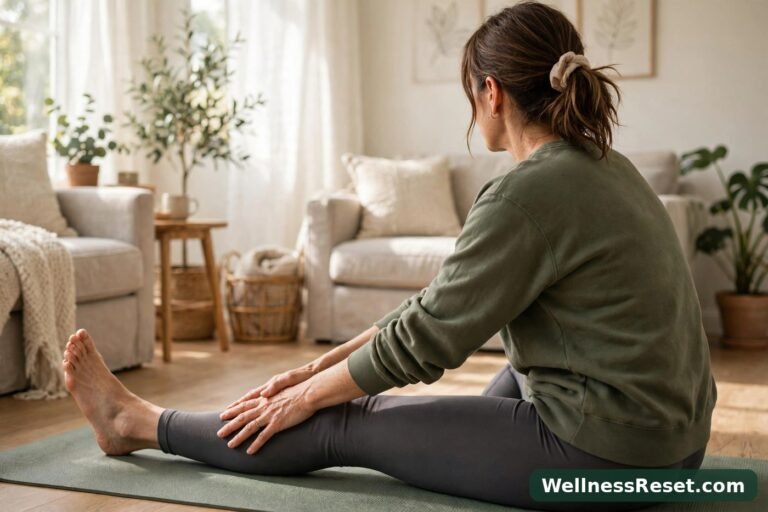
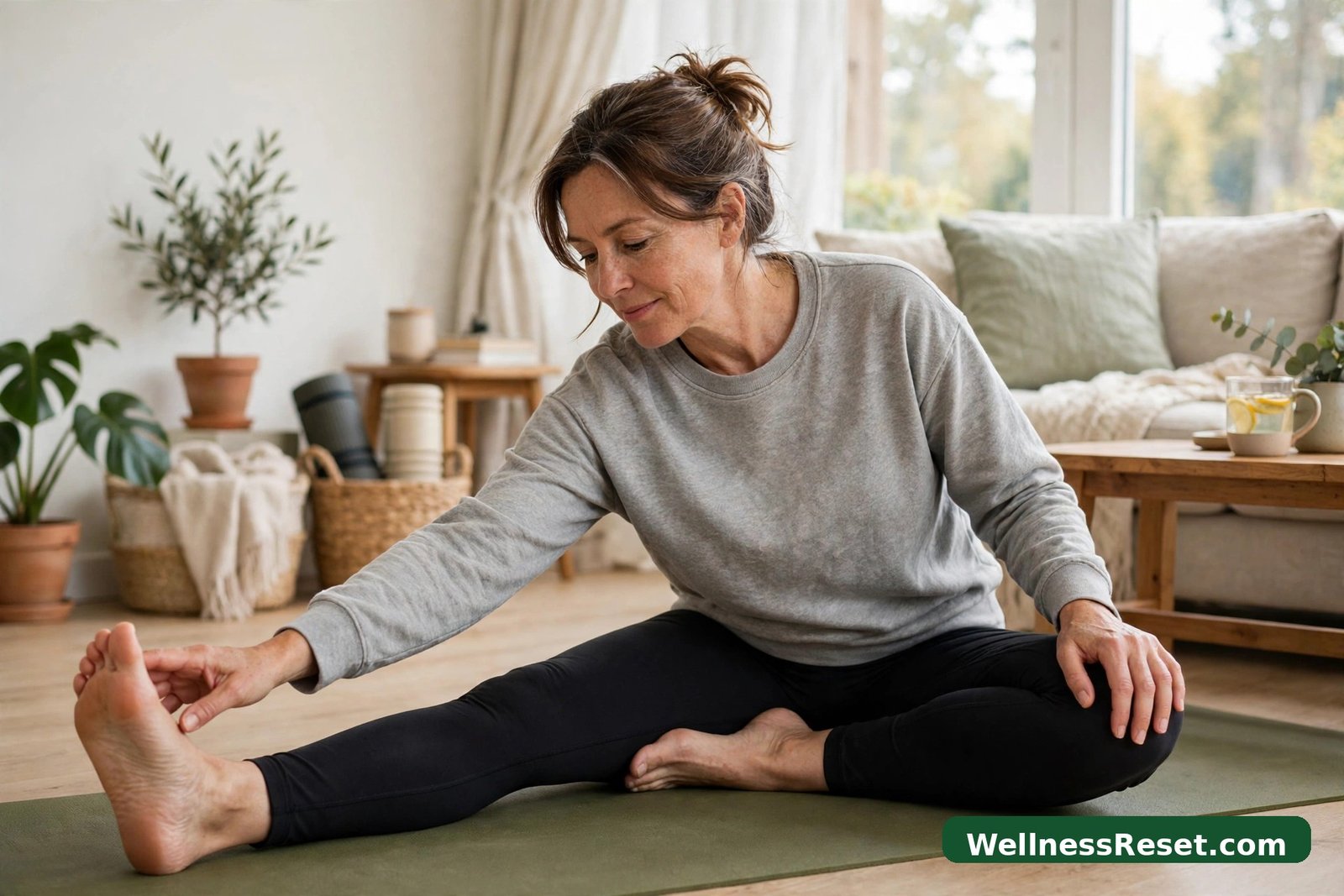
1. Seated hamstring stretch (3 minutes)
Sit on the floor or a mat with one leg straight out in front of you and the other bent, foot tucked against your inner thigh. Sit tall, then hinge forward from your hips — not by rounding your back, but by tipping your whole torso forward — until you feel a gentle pull behind your straight leg. Reach toward your foot, not at it. Hold 30 seconds, switch legs. Two rounds each side.
Best for: anyone who sits all day. Tight hamstrings are the single most common reason people cannot touch their toes, and they quietly pull the lower back into a rounded position all day long.
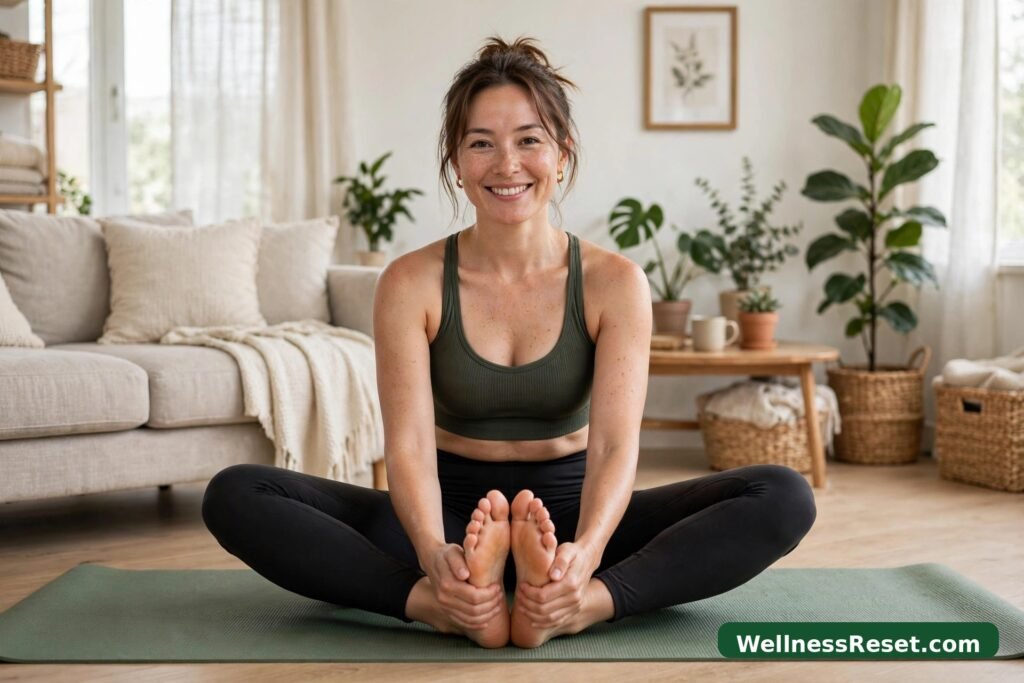
2. Butterfly stretch for hips (3 minutes)
Sit with the soles of your feet together and your knees falling out to the sides. Hold your feet with both hands and sit tall. Let your knees drop toward the floor under their own weight — do not push them down with your elbows, which is the classic mistake and the fastest way to irritate your knees. Hold 30 seconds, rest, repeat three times.
If your knees sit high off the floor, sit on a cushion. Raising your hips changes the angle completely and makes the whole stretch kinder. There is no prize for knees on the floor.

3. Doorway chest opener (3 minutes)
Stand in a doorway with your forearms on the frame at shoulder height, elbows bent at right angles. Step gently forward with one foot until you feel a stretch across your chest and the front of your shoulders. Hold 20 seconds, step back, repeat three times. Keep your ribs down — if your lower back arches, you have stepped too far.
Best for: desk shoulders, phone necks, anyone whose upper back has rounded into a permanent question mark. This one stretch undoes more sitting damage than any other I know. If you sit at a desk all day, pair this routine with better sitting habits during the day — our desk posture guide covers the setup: Fix Your Posture at Your Desk.
4. Wall calf stretch (3 minutes)
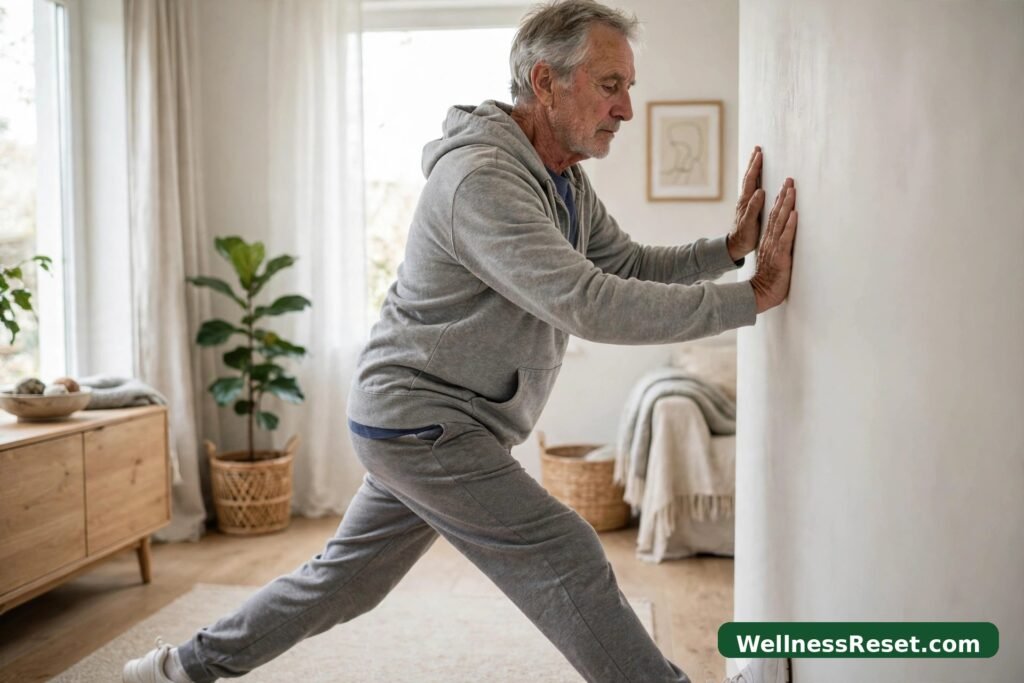
Face a wall, hands flat on it at shoulder height. Step one foot back, keeping that back heel pressed to the floor and the back leg straight. Lean forward until you feel a pull in the back calf. Hold 30 seconds, switch legs. Two rounds each side. If your back heel lifts, move your foot closer to the wall — a lifted heel cheats the stretch and teaches your calf nothing.
Best for: stiff ankles, tight calves from walking in flat shoes, and anyone whose balance feels wobblier than it used to be. Calf flexibility is quietly connected to ankle range, and ankle range is quietly connected to not tripping.
5. Neck and shoulder release (3 minutes)
Sit tall on a chair. Drop your right ear toward your right shoulder until you feel a gentle pull on the left side of your neck. Rest your right hand lightly on the side of your head — the weight of your hand is enough, do not pull. Hold 20 seconds, switch sides. Then roll both shoulders up, back, and down in slow circles, five times each direction.
Best for: end-of-day neck tension, tension headaches that arrive at 4pm, and anyone who holds stress in their shoulders without realising it. Which is most of us.
How Often, and When
Three to five days a week is the sweet spot, and fifteen minutes is enough. You can do this routine daily — gentle stretching does not need rest days the way strength training does. But three days a week, done properly, beats seven days done once and abandoned.
The best time is when your body is warmest: late afternoon or early evening, after you have been moving around. Morning stretching works too, but go gentler — your body is stiffer first thing, and the same stretch will feel tighter at 7am than at 5pm.
A practical tip that actually works: attach the routine to something you already do. After dinner, before the news, while the kettle boils — pick one anchor and do it there, every time. Flexibility routines die when they need a decision. They survive when they need no decision at all.
The Stop-If-It-Hurts Rule
This is the most important paragraph in the article, so read it twice.
A stretch should feel like a gentle pull — a 4 or 5 out of 10 on the discomfort scale. Sharp pain, pinching, shooting pain, or pain that lingers after you stop are all stop signals. Not “push through it” signals. Stop signals.
Stop and get professional advice if you notice any of these: pain that lasts hours after stretching, numbness or tingling in your hands or feet, a joint that locks or gives way, swelling, or pain that has been there for months and is getting worse. These are not flexibility problems. They are medical problems, and stretching will not fix them — it can make them worse.
Also: never bounce. Bouncing at the end of a stretch triggers a reflex that tightens the very muscle you are trying to loosen. Slow and smooth, always. And never force a stretch with your hands or by hanging weights off a limb. The stretch that arrives gently stays. The stretch you force leaves the next morning, taking a strained muscle with it.
Common Mistakes That Stall Progress
Stretching cold. Doing this routine first thing, straight out of bed, with no warm-up, is how people pull a hamstring. Two minutes of marching in place first. Always.
Holding your breath. The moment a stretch gets interesting, people stop breathing. Breathe normally. If you cannot breathe normally, the stretch is too deep.
Only stretching the easy bits. Everyone has a favourite stretch that feels good and a neglected area that does not. The neglected one is the whole point. Give your stiffest area the most patience, not the least.
Chasing the deepest version. A bigger stretch done badly is worse than a smaller stretch done well. If you cannot breathe and relax into a position, you do not own it yet. Stay where you are strong.
Comparing yourself to anyone. Your neighbour’s hamstrings are not your hamstrings. Your range is yours, your timeline is yours, and the only comparison that matters is you last month versus you now.

Troubleshooting
| Problem | Quick fix |
|---|---|
| A stretch feels pinchy, not pull-y | Make it smaller, or skip it for a week and try again |
| One side much tighter than the other | Give the tight side one extra round, gently — never force it to match |
| You feel nothing at all | Move a little deeper, or hold longer — 30 seconds, not 10 |
| Soreness the next day | Mild muscle tiredness is fine; joint pain that lingers is a stop-and-check signal |
| Knees complain in the butterfly | Sit on a cushion to raise your hips, and stop pushing your knees down |
| You keep forgetting to do it | Attach it to dinner or the evening news — same time, every day |
| Progress stalled after a month | Add a second weekly session, or hold each stretch for 45 seconds instead of 30 |
Final Words
Flexibility is not a talent. It is a habit with a slow payoff. Fifteen minutes, three to five days a week, five gentle moves, no forcing, no bouncing, no promises of splits by Sunday. That is how to get flexible — the boring way, which is also the only way that actually works.
Start today, not Monday. Do the five moves once, slowly, and notice which one surprised you most. That is your starting point. Everything else builds from there. For a structured companion routine, the NHS flexibility exercises are a good next step: NHS Flexibility Exercises.
FAQ
How long does it take to get flexible?
For most adults doing a short routine three to five times a week, everyday movements feel easier in three to four weeks, and measurable change in range arrives in six to eight weeks. Deeper flexibility takes three months or more. It is slower than the internet promises and faster than doing nothing.
Can I get flexible if I am over 60?
Yes. Tissue changes more slowly with age, but it still changes. Older adults often make the most noticeable gains simply because they have the most range to recover. Go gently, warm up first, and never bounce.
Do I need to stretch every day to get flexible?
No. Three to five days a week is enough for real progress. Daily is fine too, and it helps the habit stick, but missing a day does not undo your progress.
Is it better to stretch in the morning or evening?
Evening is usually better because your body is warmer and looser after a day of moving. Morning stretching is fine if you go gently and warm up first — never stretch hard on a cold body first thing.
Should stretching hurt?
No. A gentle pull is normal; sharp, pinching, or shooting pain is not. If a stretch hurts, ease off until it feels like effort, not pain. Pain that lingers after you stop is a sign to get professional advice.
Can stretching help with back pain?
It can ease the muscle stiffness and tension that make ordinary back pain worse, especially tight hamstrings and hip flexors. But stretching does not treat the cause of back pain, and persistent or severe pain needs a doctor or physiotherapist.