
Mobility Exercises for Beginners
Last winter I tried to reach a box on top of the wardrobe and discovered something embarrassing: my shoulder would not go there any more. Not painfully — just no. It stopped halfway, like a door hitting a jam. I was not injured. I was just stiff, in the particular way that comes from sitting all day, every day, for years. My joints had quietly lost range, and daily life had quietly started working around it.
Mobility exercises for beginners are how you win that range back. Not by forcing anything, and not by becoming flexible overnight, but by moving each major joint through its comfortable range, a little, most days. Fifteen minutes, no equipment, in your living room. This is the starter routine I wish someone had handed me before the wardrobe incident.
Mobility Is Not the Same as Flexibility
People mix these two up, and the difference matters. Flexibility is how far a joint can be pushed — by gravity, by your hands, by a stretch. Mobility is how far you can move it yourself, with control. You need both, but mobility is the one that shows up in real life: looking over your shoulder to reverse the car, squatting to a low shelf, getting up off the floor without a performance.
That is also why mobility work feels different from stretching. You are not holding a long, deep stretch. You are moving — slowly, smoothly, through the range you have, and gently nudging the edge of it. Nothing should be forced, nothing should be bounced, and sharp pain means stop, not push through. Mild effort and a gentle pull are fine. Sharp, pinching, or shooting pain is not.
One honest note: this routine is for ordinary, sit-all-day stiffness. It will not fix a frozen joint, a recent injury, or pain that has lasted months. If any movement here causes pain that lingers after you stop, or you have a diagnosed joint condition, check with a physiotherapist before continuing.
The 15-Minute Whole-Body Routine
Do these in order, top to bottom, like a wave down your body. Move slowly — about two seconds in each direction. Breathe normally. If a movement feels stuck, make it smaller, not harder. A small smooth movement beats a big jerky one every time.
1. Neck: half-circles and rotations (2 minutes)
Sit or stand tall. Drop your chin to your chest, then slowly roll your head to the right until your right ear is near your right shoulder. Roll back to centre, then to the left. Keep it to the front half only — no full head circles, which can pinch the neck. Five slow half-circles each way.
Then sit tall and turn your head to look over your right shoulder, as far as is comfortable. Hold for three seconds, return to centre, turn left. Five each side.
Best for: desk necks, reversing-the-car necks, anyone who spends hours looking down at a phone.
2. Shoulders: rolls, circles, and the doorway opener (3 minutes)
Roll both shoulders up, back, and down in big slow circles — five times. Then reverse: up, forward, down — five times. Let your arms hang loose; this is not a shrug contest.
Next, arm circles. Arms out to the sides at shoulder height, small circles forward for ten seconds, then backward for ten seconds. If your shoulders click a little, that is usually harmless — but if clicking comes with pain, skip the circles and stick to the rolls.
Finish with a doorway opener: stand in a doorway, forearms on the frame at shoulder height, and step gently forward until you feel a stretch across your chest. Hold ten seconds, step back, repeat three times. This one undoes a day of hunching over a keyboard like nothing else.

3. Spine: cat-cow and seated twists (3 minutes)
On hands and knees, do Cat-Cow: breathe in, let your belly drop and lift your head; breathe out, round your spine and tuck your chin. Eight slow rounds. If floor work is hard, do it seated on a sturdy chair with hands on your knees — the spine movement is what matters, not the position.
Then sit tall and twist: cross your arms over your chest, turn your upper body to the right as far as is comfortable, hold three seconds, return, turn left. Five each side. Keep your hips still and your movement slow. Your spine will thank you for the rotation — sitting gives it almost none all day.
4. Hips: marching, circles, and the 90/90 sit (4 minutes)
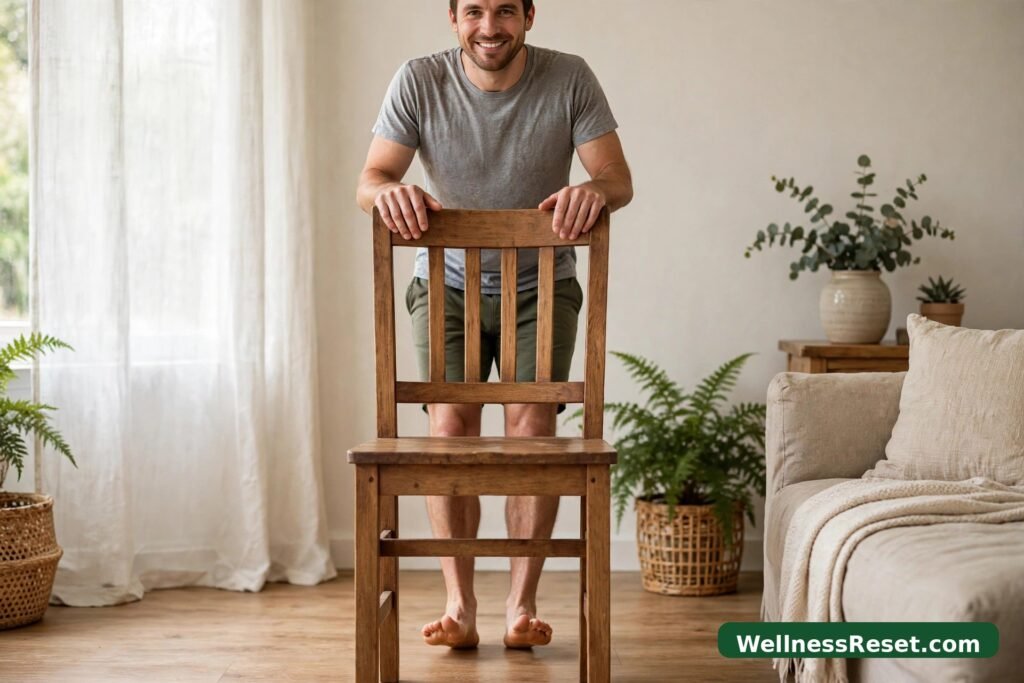
Stand behind a sturdy chair for balance. March in place, lifting each knee to a comfortable height — not high, just clear of the floor. Twenty marches total. This wakes your hip flexors up after hours of sitting folded.
Then hip circles: still holding the chair, lift one knee slightly and draw slow circles with it, five one way, five the other, then switch legs. Keep the circles small and smooth.
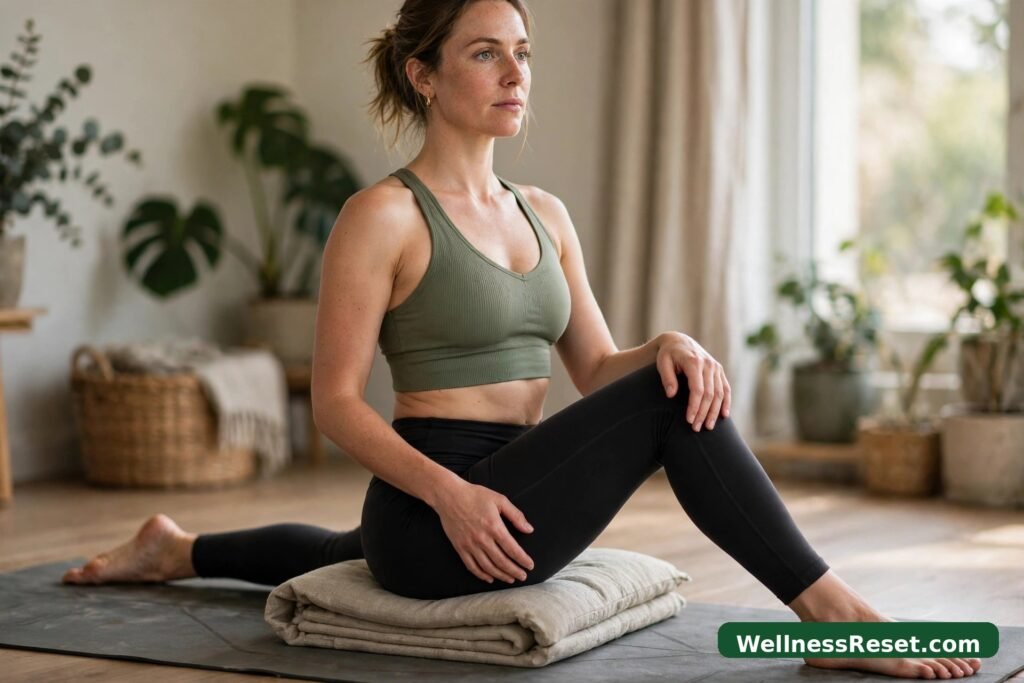
Finish seated for the 90/90: sit on the floor with both knees bent at roughly right angles, one leg forward, one leg back, both knees on the floor. Sit tall for five breaths, then switch sides. If this feels impossible, sit on a cushion to raise your hips — that one change makes it accessible for most people. Do not force your knees to the floor.
5. Ankles: circles, rocks, and calf raises (3 minutes)
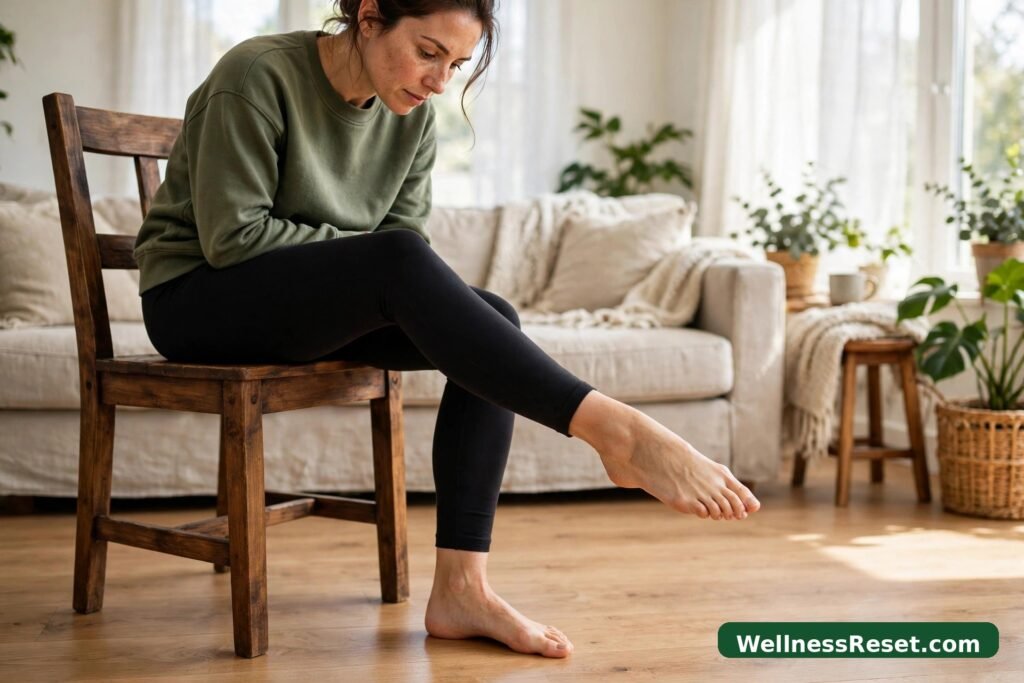
Sit on a chair, one foot lifted. Draw ten slow circles with your toes in each direction, then point and flex your foot ten times. Switch feet. Ankles lose range silently — you notice it when stairs feel harder or your balance feels wobblier, not before.
Then stand behind the chair and do heel-toe rocking: rise onto your toes, hold two seconds, rock back onto your heels with toes lifted, hold two seconds. Ten rounds. Finish with ten slow calf raises, holding the chair lightly. Keep your back heel flat on the floor during the calf work — a lifted heel cheats the stretch and teaches your ankle nothing.
For a deeper ankle-only session later, our ankle stretches routine pairs well with this one: Ankle Stretches.
How Often Should Beginners Do Mobility Work?
Three to five days a week is the sweet spot, and fifteen minutes is enough. Daily is fine too — mobility work is gentle enough that it does not need rest days the way strength training does. What matters is regularity. Joints respond to repeated, gentle signals over weeks, not to one heroic session.
Expect this timeline, roughly: in the first week, movements feel less creaky and your warm-up range improves within the session itself. After three to four weeks, you will notice everyday things getting easier — looking over your shoulder, reaching the high shelf, sitting cross-legged for longer. That is real progress, even though nobody else can see it.
If you sit at a desk all day, pair this routine with better sitting habits during the day. Our desk posture guide covers the setup: Fix Your Posture at Your Desk.
Common Mistakes That Stall Progress
Bouncing. Bouncing at the end of a stretch triggers a reflex that tightens the muscle you are trying to loosen. Slow and smooth, always.
Only doing the easy joints. Everyone has a favourite joint that moves well and a neglected one that does not. The neglected one is the whole point. Give your stiffest area the most patience, not the least.
Chasing range instead of control. A bigger movement done badly is worse than a smaller movement done well. If you cannot control the last few degrees, you do not own them yet. Stay where you are strong.
Skipping the warm-up. Cold joints are stiff joints. Walk around the house for two minutes, or march in place, before you start. Five minutes of gentle movement first makes everything after it work better.
Doing it once and deciding it does not work. Mobility changes take weeks. One session will make you feel looser for an hour. Twenty sessions will change how you move.
Troubleshooting
| Problem | Quick fix |
|---|---|
| A movement pinches or catches | Make it smaller, or skip it for now and try again in a week |
| Knees complain on the floor | Do the floor sections seated on a chair or a raised cushion |
| Balance wobbles during standing work | Always keep a chair or wall within hand’s reach |
| One side much stiffer than the other | Give the stiff side one extra round, gently — never force it to match |
| Soreness the next day | Mild muscle tiredness is fine; joint pain that lingers is a stop-and-check signal |
| Cannot fit 15 minutes in | Do the neck, shoulders, and ankles only (7 minutes) — partial beats skipped |
Final Words
Mobility is unglamorous work. Nobody posts about their hip circles. But it is the work that keeps everyday movement easy — reaching, bending, turning, getting up — for years longer than sitting still does. Fifteen minutes, most days, in the order above, and your joints get the message: we still use this range, keep it open.
Start today, not Monday. Do the routine once, slowly, and notice which joint surprised you most. That is your starting point. Everything else builds from there. For a structured next step, the NHS flexibility exercises are a good companion routine: NHS Flexibility Exercises.
FAQ
Are mobility exercises safe for beginners?
Yes, when done gently and within a comfortable range. Move slowly, never bounce, and stop if you feel sharp pain. If you have a joint condition, a recent injury, or pain that lasts, get professional advice first.
How are mobility exercises different from stretching?
Stretching usually holds one position to lengthen a muscle. Mobility work moves a joint actively through its range, building control as well as flexibility. Both help; mobility transfers more directly to everyday movement.
Do I need equipment?
No. A sturdy chair for balance and a cushion for floor sitting are all you need for this routine. No bands, rollers, or special gear required to start.
Can I do mobility exercises every day?
Yes. This routine is gentle enough for daily practice, and daily is ideal if you sit for most of the day. Even three days a week will show results within a month.
When should I stop and see someone?
Stop and get advice if a movement causes sharp or shooting pain, pain that lingers for hours afterwards, swelling, numbness, or a joint that locks or gives way. Those are not normal beginner stiffness.





2 Comments