Gentle Yoga for Beginners
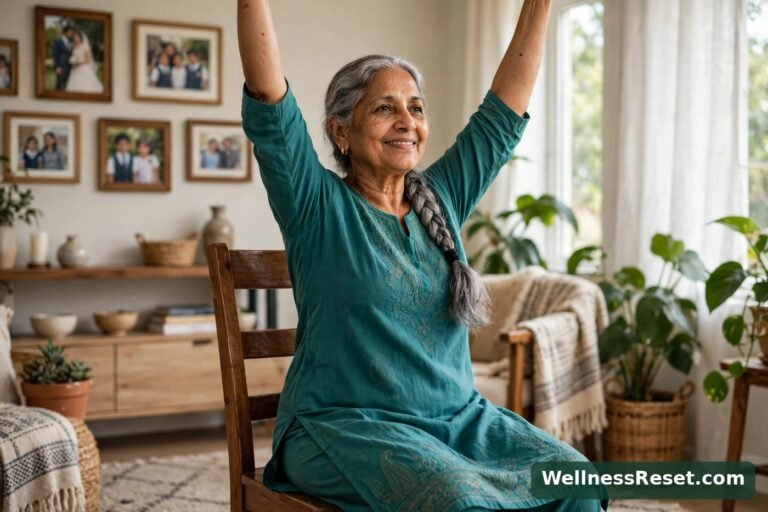
The first yoga class I ever tried ended with me hiding at the back, red-faced, while everyone around me folded in half like they were made of rubber. I did not go back for a year. When I finally did, it was a gentle class, the teacher kept saying “find your version of the pose,” and for the first time I understood what yoga was actually for. Not performance. Just moving slowly, breathing properly, and leaving feeling better than when you walked in.
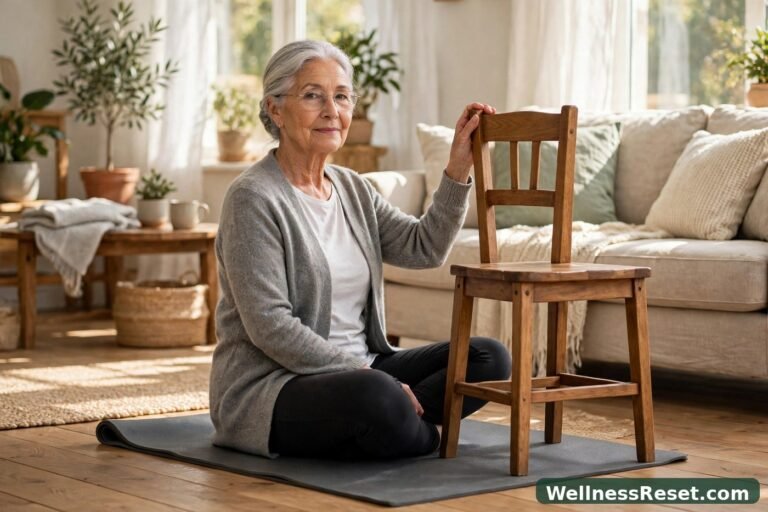
That is what this gentle yoga routine is. Thirty minutes, on a mat, with a sturdy chair nearby for balance or support whenever you want it. No headstands, no pretzel poses, no flexibility test. If you can get down to the floor and back up again — with the chair’s help if needed — you can do this.
What “Gentle” Actually Means Here
Gentle yoga is not a watered-down version of real yoga. It is yoga at a pace your joints and your nervous system can actually follow. Poses are held longer, transitions are slower, and there is time to breathe in each position instead of rushing to the next one. You will still work — your legs will know about the standing poses afterwards — but nothing should hurt, and nothing should feel like a race.
It is also different from chair-only yoga. In our chair routines, you stay seated for almost everything. Here, the mat is home base and the chair is your backup: something to hold for balance, to sit on for a rest, or to lean on when getting up and down. If you are new to yoga and unsure about floor work, that chair makes the whole thing feel doable. Start with our seated introduction if floor work feels out of reach right now: 12 Chair Yoga Poses Every Beginner Should Know.
One honest note before we start: gentle does not mean suitable for everyone in every situation. If you have a recent injury, a joint replacement, osteoporosis, or a condition that affects your balance, check with your doctor or physiotherapist first, and tell any class teacher about it too. Sharp pain is always a stop signal, in any pose.
What You Need
- A yoga mat, or a folded blanket on a non-slip surface
- A sturdy chair without wheels, placed at the top of your mat
- A cushion or folded towel for under your knees
- A blanket for the final rest
- Water nearby, and clothes you can move in
Do this barefoot if you can. Socks on a smooth floor are a slipping hazard, and your feet grip better than you expect once you try.
The 30-Minute Routine
Move through these in order. Breathe normally throughout — if you are holding your breath, you are pushing too hard. Rest in Child’s Pose or on the chair whenever you need to. Nobody is timing you.
1. Seated breathing and neck release (3 minutes)
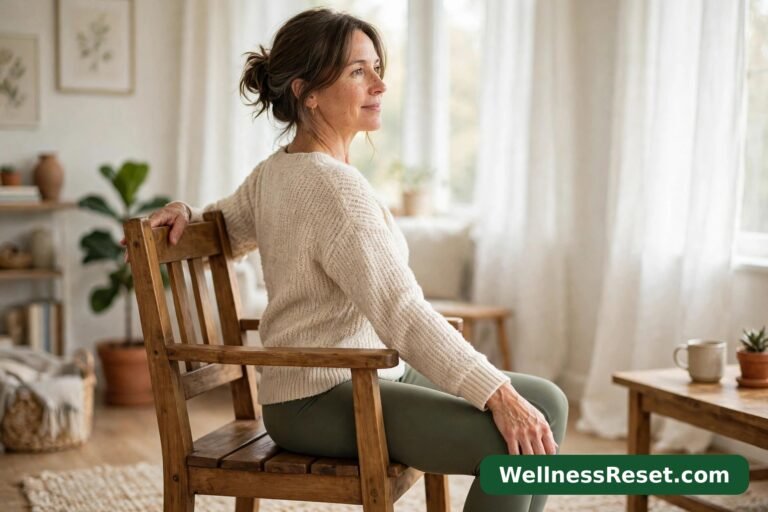
Sit on the mat with your legs crossed, or sit on the chair if the floor is uncomfortable. Hands rest on your knees. Close your eyes if that feels okay.
Breathe in slowly through your nose for a count of four, out through your nose or mouth for a count of six. Five rounds. Then let your breathing return to normal and drop your right ear toward your right shoulder. Hold for three breaths. Repeat on the left. Roll your shoulders up, back, and down three times.
Best for: arriving, settling a busy mind, loosening a stiff neck before anything else moves.
2. Cat-Cow on hands and knees (4 minutes)
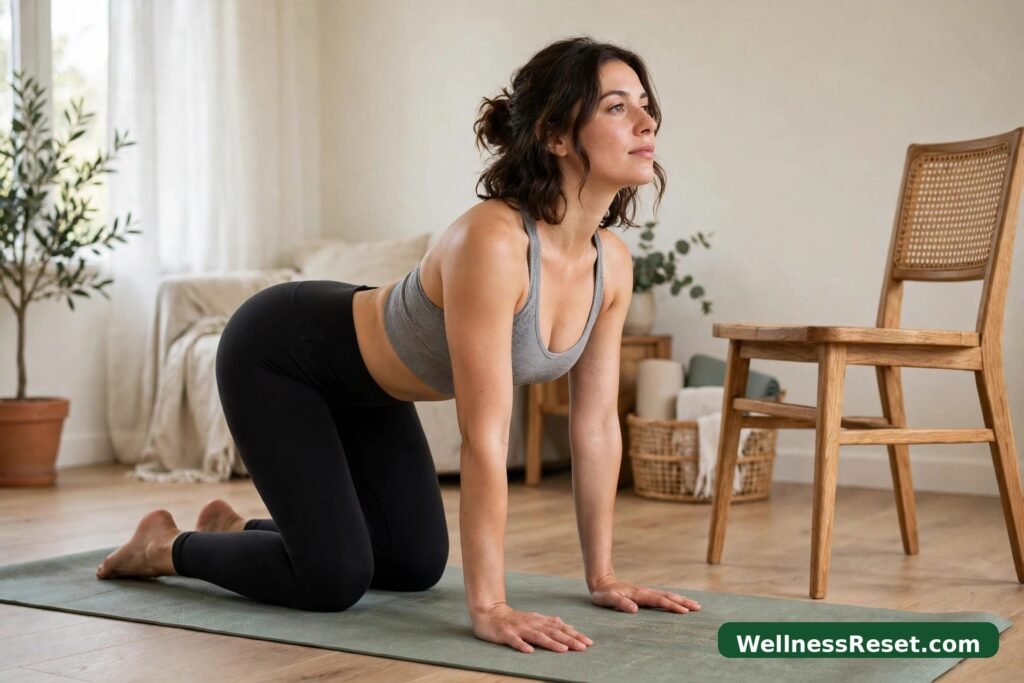
Come to hands and knees, wrists under shoulders, knees under hips, chair within reach. On an in-breath, let your belly drop, lift your head gently, and arch your back — Cow. On an out-breath, tuck your chin, round your spine, and press the floor away — Cat. Move slowly, one breath per movement, for eight rounds.
If your wrists complain, make fists instead of flat palms, or do this seated on the chair with hands on your knees. If your knees complain, double up the cushion underneath them.
3. Child’s Pose rest (2 minutes)
Sit your hips back toward your heels, arms stretched forward on the mat, forehead resting down. If your hips do not reach your heels, put a cushion between your calves and thighs, or rest your forehead on stacked fists. Stay for six slow breaths. This is a rest pose, not a stretch to endure — come out early if your knees protest.
Best for: a breather between sections, calming the breath, stretching the back gently.
4. Standing: Mountain and gentle side bends (5 minutes)
Stand at the top of your mat, feet hip-width apart, chair beside you for balance. Stand tall, arms by your sides, weight even across both feet. This is Mountain Pose. It looks like just standing, but stand with intention: feet grounded, knees soft, shoulders down, head level. Hold for five breaths.
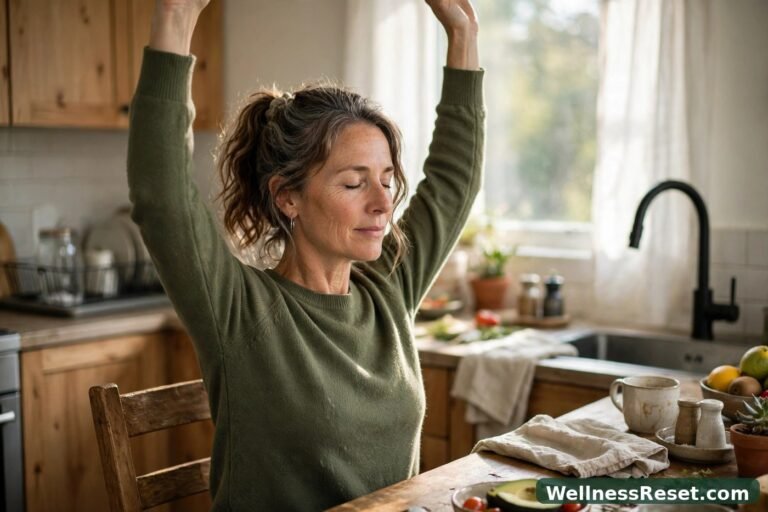
Now raise your arms overhead on an in-breath, then lean gently to the right, keeping both feet planted. Hold for three breaths, come back to centre, lean left. Repeat twice each side. If raising both arms is uncomfortable, raise one arm at a time, or keep hands on your hips and just lean.
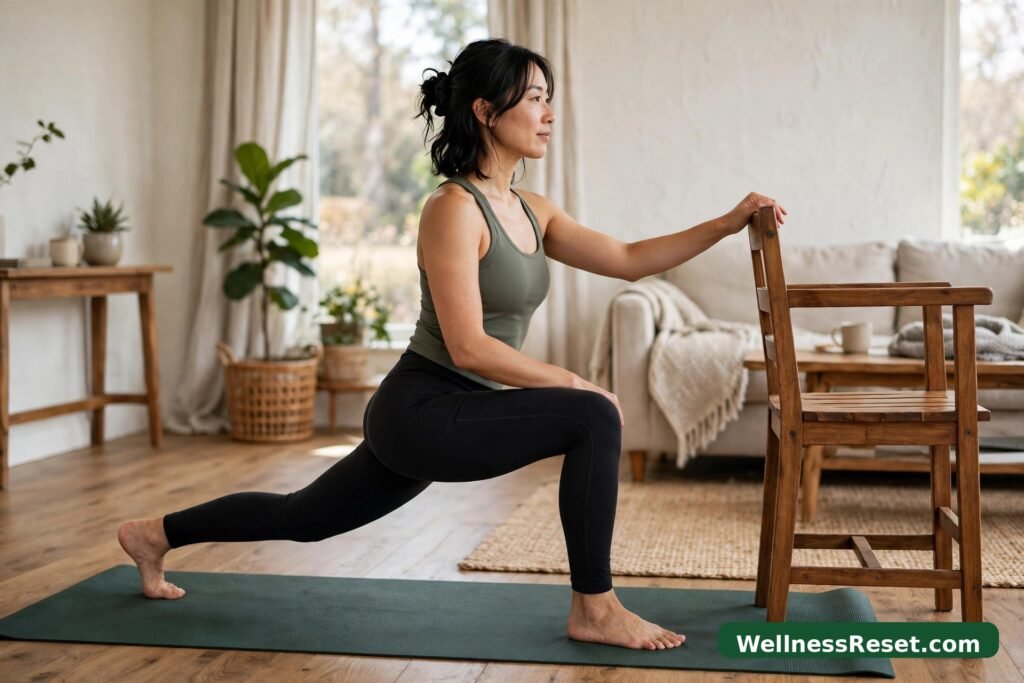
5. Warrior I, the gentle version (5 minutes)
From standing, step your left foot back about a metre, keeping your right knee bent over your right ankle. Hands can rest on the chair back for balance, or on your hips. Keep your back heel down if you can — if it lifts, shorten your step. Hold for four breaths, breathing into the stretch at the front of your left hip. Step forward, shake your legs out, and repeat on the other side.
This is the strongest pose in the routine, and the one beginners rush. Shorten the step until it feels steady, not wobbly. A wobbly Warrior is a sign to make the stance smaller, not to push through.
6. Seated forward fold and seated twist (5 minutes)
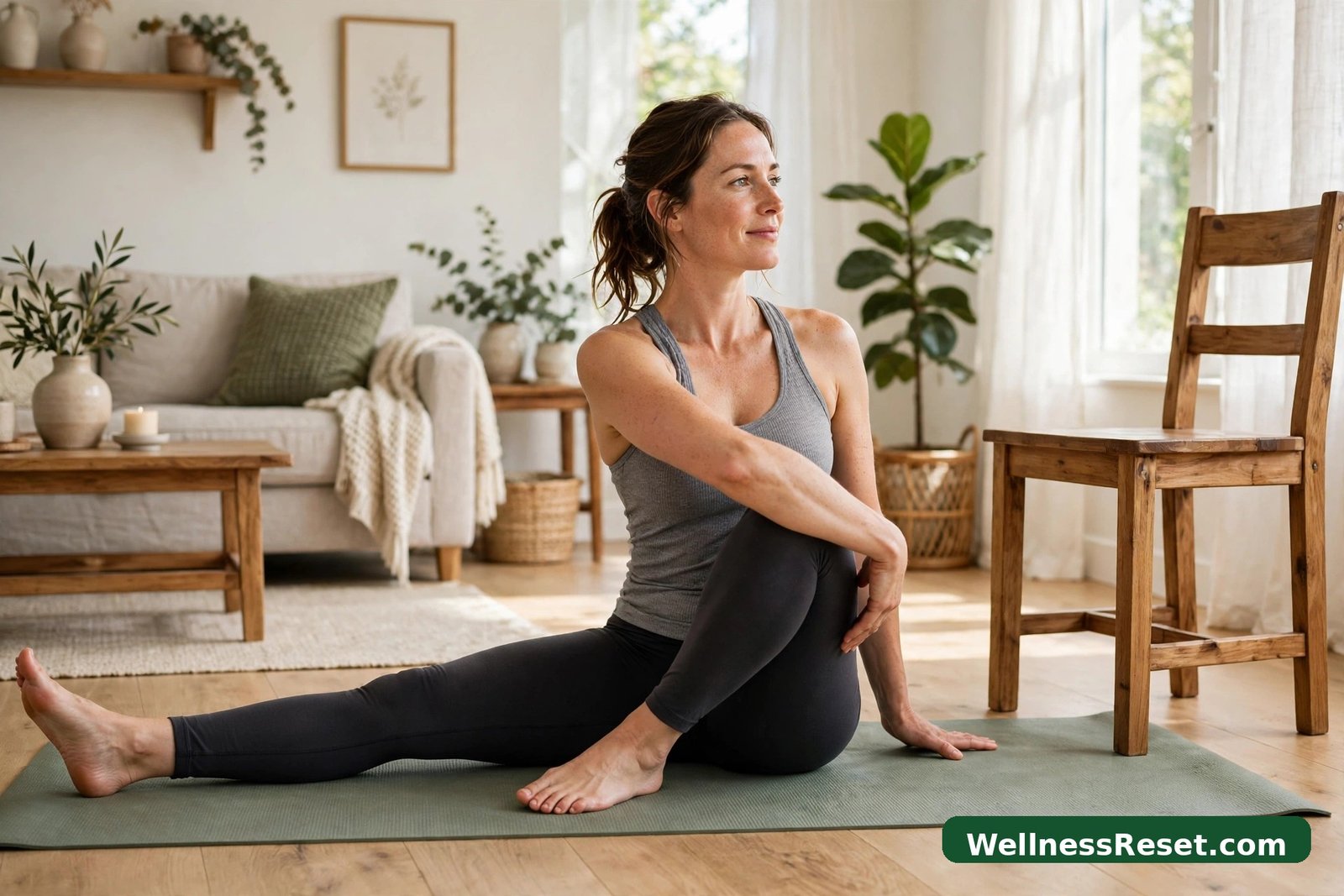
Sit on the mat with legs stretched out in front of you, sitting on a folded blanket if your lower back rounds. On an in-breath, reach your arms up. On an out-breath, hinge forward from your hips, hands sliding down your legs as far as they comfortably go — shins, ankles, wherever they land. Your knees can bend a little. Hold for five breaths, then sit up slowly.
Now bend your knees, feet flat on the floor. Cross your right leg over your left, place your right hand behind you, and twist gently to the right, looking over your right shoulder. Hold for four breaths. Unwind slowly and repeat on the left.
Best for: hamstrings, lower back, and the satisfying feeling of wringing out a long day.
7. Lying down: knees to chest and Savasana (6 minutes)
Lie on your back, knees bent, feet flat. Hug one knee to your chest, hold for four breaths, switch legs, then hug both knees for four breaths. Roll gently side to side if that feels good on your lower back.
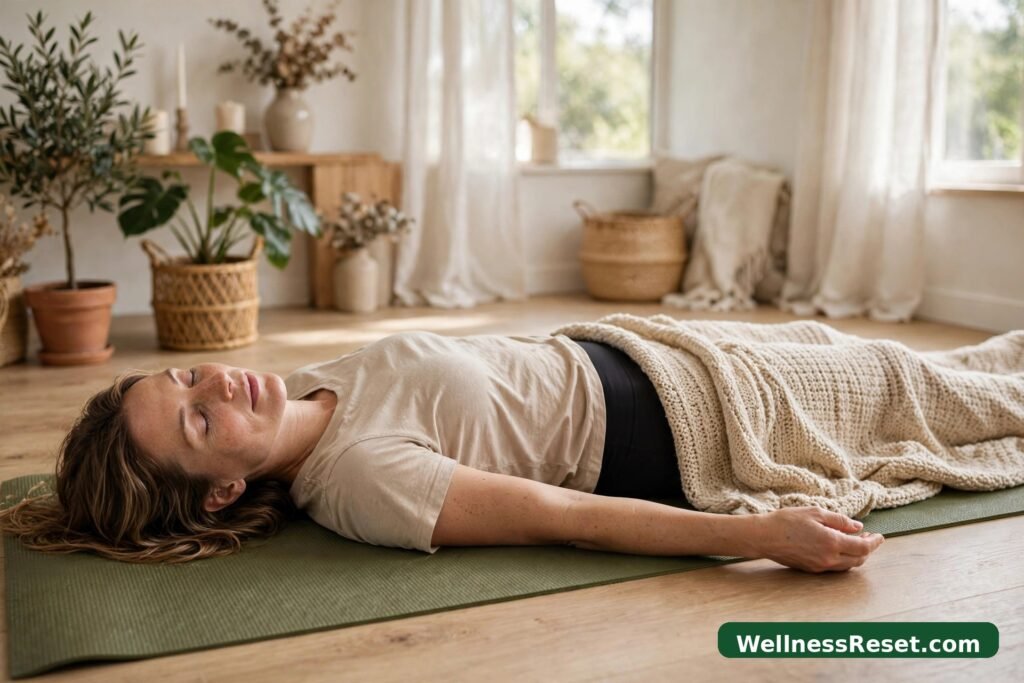
Then stretch out for Savasana, the final rest. Legs slightly apart, arms by your sides, palms up, eyes closed. Cover yourself with the blanket. Stay for at least three minutes. This is not wasted time — it is the part where your body absorbs the practice. If your mind wanders, bring it back to your breath, without scolding yourself. Wandering is normal.
How Often, and How to Progress
Twice a week is a great start. Three times is even better, but twice done consistently beats five times done for a fortnight and then abandoned. After two or three weeks, you can hold the standing poses a breath or two longer, or add a second round of the side bends and Warrior. Progress in gentle yoga looks boring from the outside: same poses, steadier balance, calmer breath. That is the whole point.
If a pose keeps hurting in the same place, that is information, not failure. Swap it out — Warrior becomes a shorter step, the forward fold becomes a seated version with bent knees — or skip it for now. There are plenty of poses left.
Common Mistakes Beginners Make
Copying the person next to you. In a class, the person next to you might have done yoga for ten years. Your version of a pose is the one that feels steady and comfortable in your body today. That is not a consolation prize; it is the actual practice.
Holding your breath. Breath-holding is your body’s way of saying a pose is too much. Back off until you can breathe normally, then stay there.
Skipping Savasana. Leaving before the final rest is like cooking a meal and skipping eating it. Stay for the rest, even if it feels like doing nothing. Especially if it feels like doing nothing.
Practising on a full stomach. Wait at least an hour after a light meal, two after a heavy one. A full stomach and forward folds do not mix.
Buying everything first. You do not need special clothes, blocks, straps, or a fancy mat to start. A blanket and a chair from your kitchen are enough. Buy props later, if you find you want them.
Troubleshooting
| Problem | Quick fix |
|---|---|
| Knees hurt on the floor | Double cushion, or do the pose seated on the chair |
| Wrists ache in Cat-Cow | Make fists, or do Cat-Cow seated with hands on knees |
| Balance wobbles in standing poses | Keep the chair within hand’s reach and shorten your stance |
| Cannot sit cross-legged comfortably | Sit on the chair, or on a folded blanket with legs stretched out |
| Hamstrings feel very tight | Bend your knees in every forward fold — tight hamstrings are normal |
| Getting up and down is hard | Use the chair to lower yourself and push up from it; sit on the chair for floor poses if needed |
Final Words
Gentle yoga asks very little of you: a mat, a chair, thirty minutes, and a willingness to move slowly. What it gives back is less obvious but real — a back that complains less, a breath that stays calmer under stress, and a half hour in your week that belongs entirely to you. Start with this routine twice a week. In a month, you will not be a different person. You will just be a slightly steadier, slightly calmer version of the one you already are.
If arthritis or stiff joints are part of your story, our gentle chair-based routine for arthritis is a good companion to this one: Gentle Chair Yoga for Arthritis. And if you want a broader view of what yoga can and cannot do for beginners, the NHS yoga guide is worth a read: Yoga — Torbay and South Devon NHS Foundation Trust.
FAQ
Do I need to be flexible to start gentle yoga?
No. That is the most common myth about yoga. Flexibility is something yoga builds over time, not something you need before you start. Stiff beginners are normal beginners.
Is gentle yoga enough exercise?
It counts as strengthening and flexibility work, and it improves balance, but most forms of gentle yoga are not strenuous enough to count as your full aerobic exercise. Pair it with walking for a well-rounded week.
How is gentle yoga different from chair yoga?
Chair yoga is done mostly seated in a chair. This gentle yoga routine is done on the mat, with the chair nearby only for support and balance. Both are gentle; the difference is where you spend most of the practice.
What if I cannot get down to the floor?
Then do the whole routine from the chair for now — seated breathing, seated cat-cow, seated twists, and a seated rest at the end. Floor work can wait until it feels possible, and the chair version still counts.
How soon will I notice a difference?
Most people notice easier breathing and a calmer evening after the first few sessions, and steadier balance and looser hips after three to four weeks of twice-weekly practice. If pain increases instead, stop and get advice.