
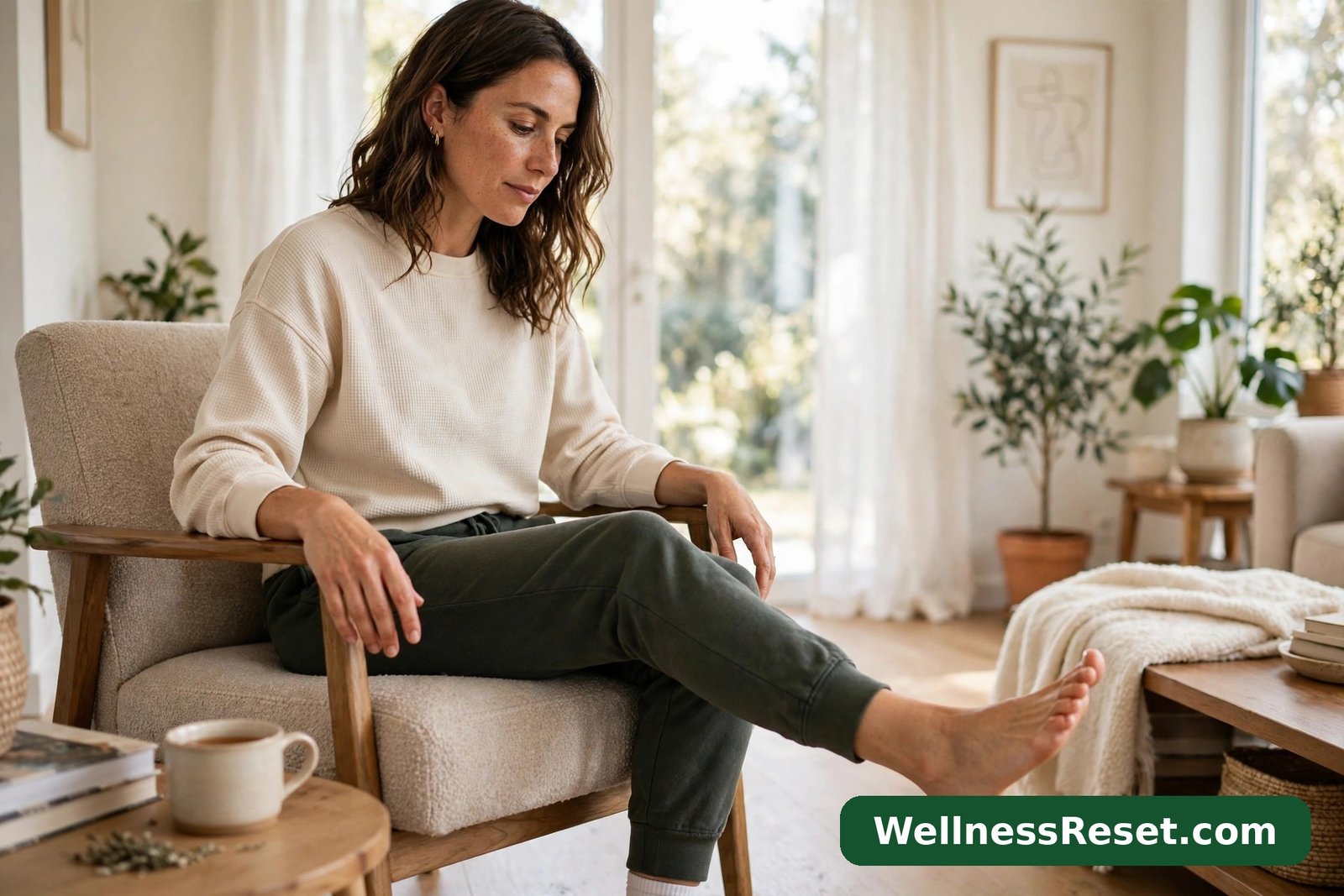
Ankle Stretches
Nobody thinks about their ankles until they do. For me it was a flight — four hours sitting, then standing up in the aisle and realising my ankles had simply stopped cooperating. The first steps were stiff, almost wobbly, and I caught the seat in front of me like a man twenty years older than I am.
Ankles are easy to ignore because they are small and they mostly behave. But they carry everything above them, and they spend most modern days in exactly one position: bent at ninety degrees, under a desk, in shoes that do not let them move. These ankle stretches are the first dedicated ankle routine on this site, written for that sit-all-day stiffness — gentle comfort and mobility only, not treatment for an injury or a condition.
You need a chair and a wall or counter for balance. That is it. This is general wellness information only, not medical advice. Stop any stretch that causes sharp pain, swelling, or instability, and talk to a doctor if ankle pain, swelling, or weakness keeps coming back.
Why Ankles Get Stiff From Sitting
An ankle is not one joint; it is a small, busy hinge with a lot of tendons crossing it, and it is designed to move through a wide range — pointing, flexing, rolling in and out. Sitting all day asks it to do none of that. Shoes add to the problem: stiff soles and a raised heel keep the ankle in a shortened position for hours, so the calf and the front of the ankle gradually lose their comfortable range.
The result is not dramatic. It is the stiff first steps after a long meeting, the ankle that clicks on the stairs, the feeling that your feet have “gone to sleep” even though they have not. Gentle, regular ankle stretches keep that range available — not by forcing it, but by reminding the joint, daily, of the movements it was built for. The same basic moves appear in NHS ankle-exercise guidance from Leeds Teaching Hospitals, which lists ankle range-of-movement exercises including pointing, flexing, and circling the foot.
A note on honesty: ankle stretches will not fix a sprain, a fracture, arthritis, or any diagnosed ankle problem, and this article does not claim otherwise. If your ankle is swollen, bruised, unstable, or painful for more than a few days, that is a doctor’s visit, not a stretching routine. What follows is for ordinary, sit-all-day stiffness only.
Before You Start
- Sit first, stand second. The first three moves are seated, so your ankles warm up before they take your weight.
- Move slowly. Ankle circles done fast are just wiggling. Slow circles, feeling each part of the rotation, are the stretch.
- Keep shoes off if you can. Bare feet or socks let you feel the movement properly. If you need shoes for support, choose flat, flexible ones.
- Stop-if-it-hurts rule. Mild tension and a gentle pull are fine. Sharp pain, pinching at the front of the ankle, swelling, or a feeling that the ankle might give way — stop immediately.
1. Ankle Circles — The Warm-Up That Does the Most
Sit in a chair, feet flat. Lift your right foot a few centimetres off the floor. Slowly draw ten circles with your toes, clockwise, making each circle as big and smooth as you can. Then ten the other way. Lower the foot, and repeat on the left.
Best for: the very first move, and for ankles that feel stiff after sitting, driving, or a flight.
If one direction feels “catchy” or rough, slow down even more in that direction. Smoothness matters more than size.
2. Toe Points and Flexes — Range, Both Ways
Still seated, right foot lifted. Point your toes firmly, like a ballet dancer, hold for three seconds, then flex hard — pull your toes back toward your shin — and hold for three seconds. Ten repetitions each foot, alternating point and flex.
Best for: restoring the basic up-and-down range that sitting steals, and for calves that feel tight first thing.
Do not rush the holds. Three honest seconds at each end beats twenty rushed wiggles.
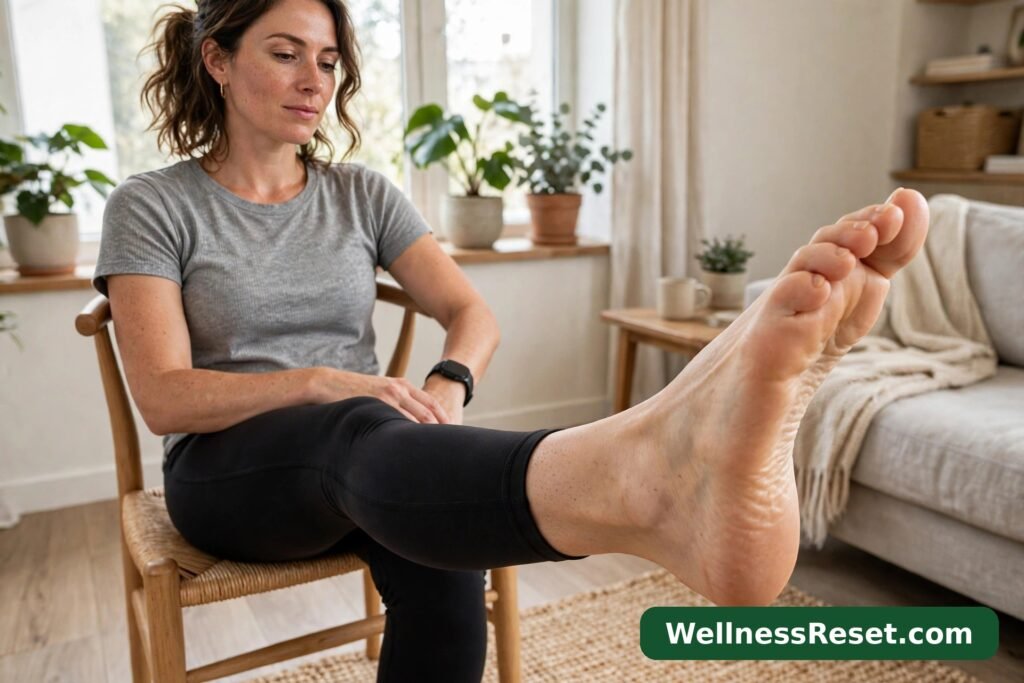
3. Alphabet Ankles — A Sneaky Full-Range Workout
Seated, right foot lifted. “Write” the alphabet in the air with your big toe, A through Z, in capital letters. Switch feet and repeat. It sounds silly. It is also the most complete ankle movement most people will do all day, because it forces every direction — up, down, in, out — without you having to think about anatomy.
Best for: days when circles feel boring, and for anyone who needs a reason to keep going for a full minute per foot.
If Z feels like a chore, write only A through M on each foot and build up. The point is range, not calligraphy.
4. Heel-Toe Rocking — Seated, Then Standing
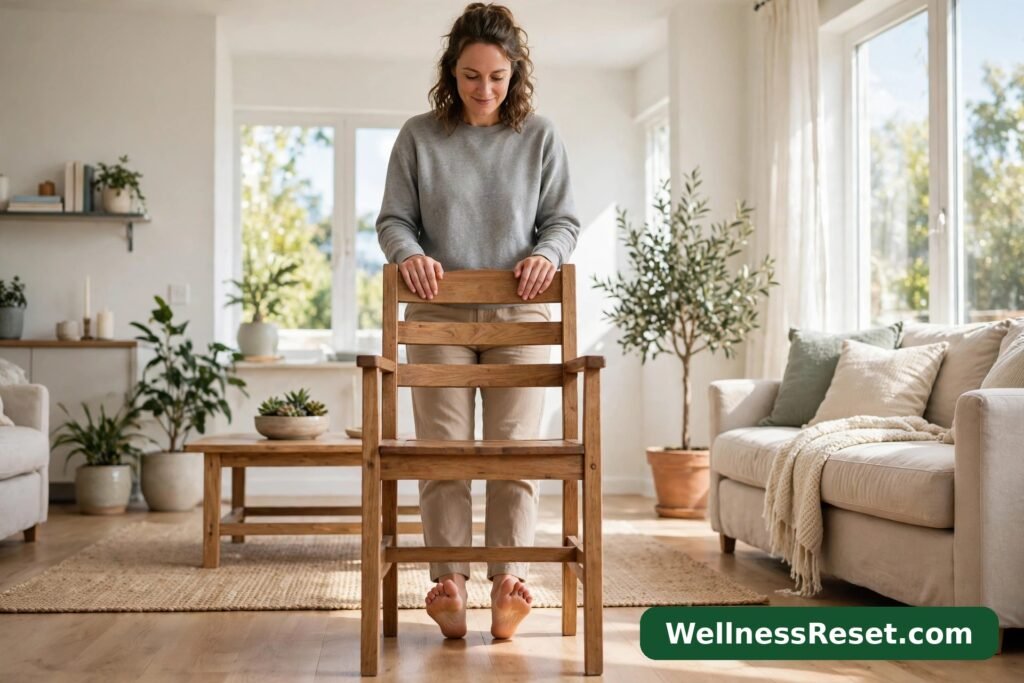
Seated first: feet flat, lift your heels so you are on the balls of your feet, hold for three seconds, then lift your toes so you are on your heels, hold for three seconds. Ten rounds. Then stand behind your chair, hands lightly on its back, and do the same rocking standing up — ten rounds, slow, holding the chair as much as you need.
Best for: calf and shin comfort, and for the transition from sitting to walking — do a few rounds before you stand up after a long sit.
Standing rocking should feel steady. If you wobble, hold the chair with both hands and take smaller rocks.
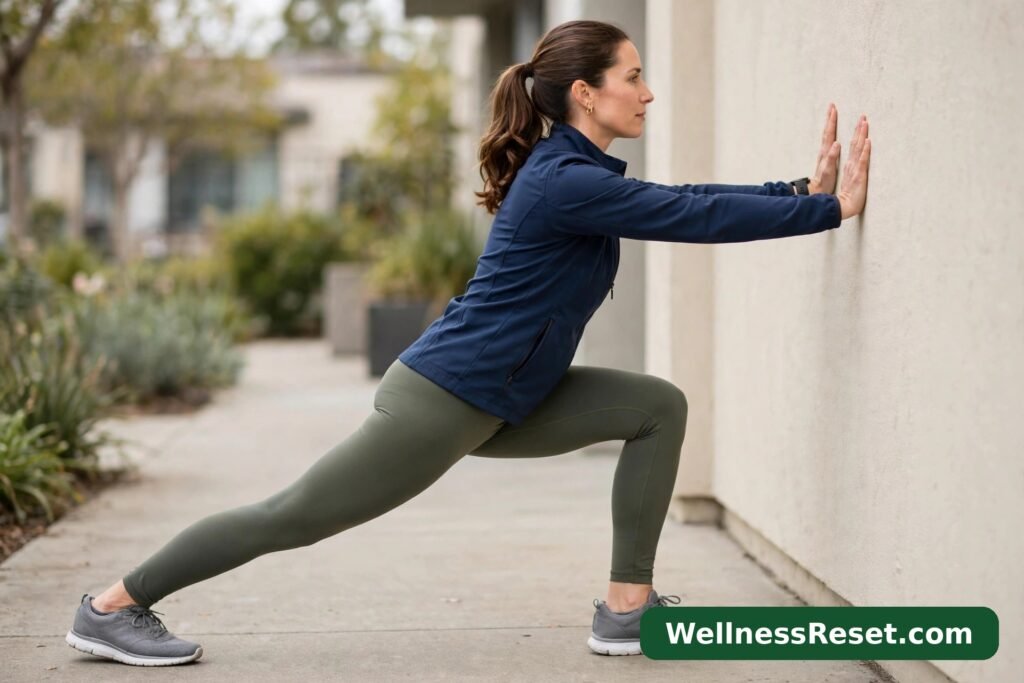
5. Wall Calf Stretch — The One That Changes Walking
Face a wall, hands on it at shoulder height. Step your right foot back about a metre, heel pressed firmly into the floor, left knee bent slightly. Hold for five breaths, feeling the stretch up the back of the right calf. Then bend the back knee slightly — keeping the heel down — for three more breaths, which shifts the stretch lower, toward the Achilles area. Switch legs.
Best for: tight calves from sitting or from shoes with a heel, and for first-step stiffness in the morning.
Heel on the floor is non-negotiable. If it lifts, step closer to the wall. A shorter step with the heel down beats a long step with the heel floating.
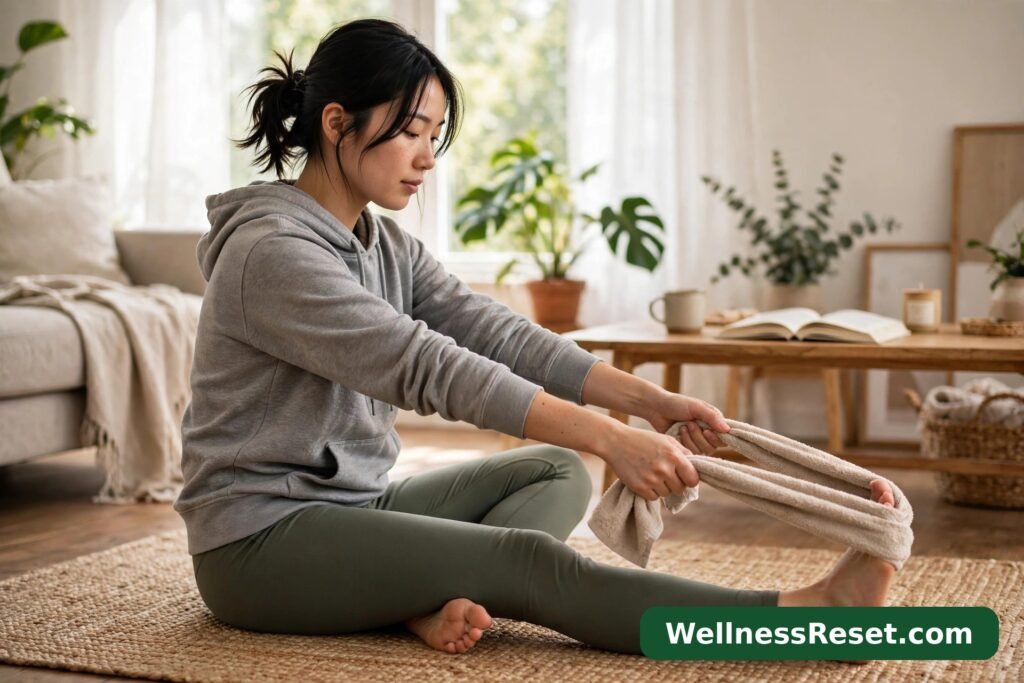
6. Seated Towel Stretch — A Gentle Pull for the Whole Back of the Leg
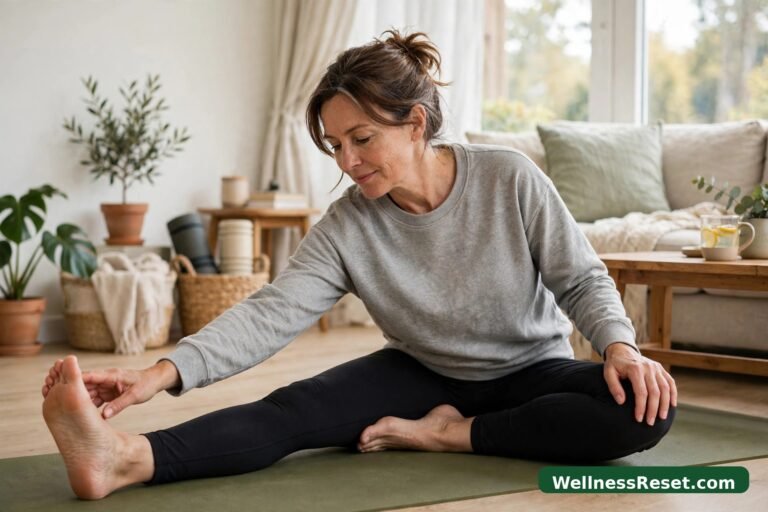
Sit on the floor or on a chair with your right leg extended in front of you, knee soft. Loop a towel around the ball of your foot and hold both ends. Gently pull the towel toward you until you feel a stretch up the calf and behind the knee. Hold for five breaths, breathing normally. Release slowly and switch legs.
Best for: a deeper calf stretch without standing, and for evenings when you want something quieter than the wall stretch.
Keep the knee soft, not locked, and pull gently. This is a stretch, not a tug-of-war with your own foot.
A 15-Minute Ankle Stretches Routine, In Order
- Minutes 0–3: Ankle circles, ten each way, each foot.
- Minutes 3–6: Toe points and flexes, ten each foot.
- Minutes 6–9: Alphabet ankles, one full alphabet per foot.
- Minutes 9–12: Heel-toe rocking, seated then standing, ten rounds each.
- Minutes 12–14: Wall calf stretch, each leg.
- Minutes 14–15: Seated towel stretch, each leg, as a cool-down.
Do it once a day to start — morning if your first steps are the stiffest, evening if sitting all day is the problem. Twice a day is fine too, as long as every move stays gentle.
When to stop: stop if a stretch causes sharp pain, pinching at the front of the ankle, swelling, bruising, numbness, or a feeling that the ankle might give way. Rest, and talk to a doctor if pain, swelling, or weakness keeps coming back. Mild tension that eases as you hold is normal; pain that gets worse as you hold is not.
Quick Fixes for Common Ankle Problems
| Problem | Quick fix |
|---|---|
| Stiff first steps after sitting | 10 ankle circles each way before standing |
| Calves feel tight all day | Wall calf stretch, heel down, twice a day |
| One ankle feels “catchy” in circles | Slow the circles right down in the catchy direction |
| Ankles wobble on standing rocking | Hold the chair with both hands, smaller rocks |
| Feet feel asleep after long sitting | Toe points and flexes, 10 reps, before standing |
| Morning first steps are the worst | Heel-toe rocking seated, then standing, before walking far |
If balance is a wider concern than just ankles, our chair yoga for better balance routine builds on these ankle moves with chair-supported balance work — a natural next step once the ankles feel freer.
Common Mistakes
Forcing the range. Yanking the foot into a deep point or flex triggers guarding, and the ankle tightens instead of loosening. Gentle and held wins.
Skipping the seated warm-up. Standing calf stretches on cold, stiff ankles are uncomfortable and unproductive. Circles first, always.
Lifting the heel in the wall stretch. The heel-down rule exists for a reason: lift it, and the stretch moves to the wrong place and the ankle loses support.
Only stretching the stiff ankle. Stretch both sides, every time. The “good” ankle is often just quieter, not looser, and imbalances cause their own problems.
Stretching through swelling or instability. Swelling, bruising, or an ankle that feels like it might give way is not stiffness — it is a signal to stop and get checked, not to stretch harder.
Final Words
Ankle stretches are unglamorous. Nobody posts about them, nobody brags about their ankle routine. But the first steps after a long sit, the stairs without a handrail death-grip, the walk that feels easy instead of creaky — those small, daily things run through your ankles.
Start with the circles today, before you next stand up from a long sit. Ten each way, slow. That is one minute, and it is the whole habit in miniature.
For a gentler, joint-friendly routine that pairs well with ankle work — especially if stiff joints are a wider pattern, not just an ankle thing — see our gentle chair yoga for arthritis routine, which keeps the same stop-if-it-hurts rule throughout.
FAQ
How often should I do ankle stretches?
Once a day is a good baseline for sit-all-day stiffness. Twice a day is fine if every move stays gentle.
How long should I hold each ankle stretch?
Three to five breaths for holds like the calf stretch, or ten slow repetitions for circles and points-and-flexes.
Can ankle stretches help with ankle pain?
These stretches are for ordinary stiffness and comfort only — they are not treatment for pain, injury, or any diagnosed condition. Persistent pain, swelling, or instability needs a doctor, not a stretching routine.
Should I stretch my ankles barefoot?
Bare feet or socks are best, because you can feel the movement properly. Flat, flexible shoes are fine if you need support.
What if an ankle stretch hurts?
Stop that stretch right away. Mild tension is normal; sharp pain, pinching, swelling, or instability is not. Talk to a doctor if it keeps coming back.



One Comment