
Chair Yoga for Better Sleep
The Night My Brain Would Not Switch Off
It was 11:40 pm. I had been in bed almost an hour, staring at the ceiling, replaying a work conversation that did not even matter anymore. My shoulders were up around my ears, my jaw was clenched, and every time I closed my eyes my mind found one more thing to chew on. Next morning I woke up tired, drank two coffees, and repeated the whole cycle.
That night taught me something I had ignored for years: sleep does not start when your head hits the pillow. It starts with what you do in the hour before bed. For me, the thing that finally made a difference was not a new mattress or a supplement. It was ten quiet minutes in a chair.
One honesty note first. This is a wind-down routine, not a treatment. It will not cure insomnia, fix a sleep disorder, or guarantee you fall asleep faster. It may help your body shift out of “alert mode” into something calmer. If you regularly struggle to sleep for weeks, or wake up gasping or in pain, talk to your doctor, not a blog post.
Why a Chair Routine Works When Bedtime Yoga Does Not
In my experience, most evening yoga routines fail for a boring, practical reason: they ask too much. You are supposed to roll out a mat, change clothes, get down on the floor, and remember a sequence — all when your energy is lowest. So you skip it. Then you feel guilty, which is the opposite of relaxing.
A chair fixes that. You are already sitting somewhere in the evening — sofa, kitchen table, armchair. No need to change clothes or find floor space.
There is a second reason, and it matters more. The moves are slow on purpose. Cat-cow loosens a stiff spine. Neck rolls release phone tension. A gentle twist moves your back in a direction it rarely goes. Belly breathing slows your breath, which tends to slow everything else with it. Legs up takes the weight off your feet. Nothing dramatic — just a sequence that tells your body the day is done.

The 10-Minute Routine, Move by Move
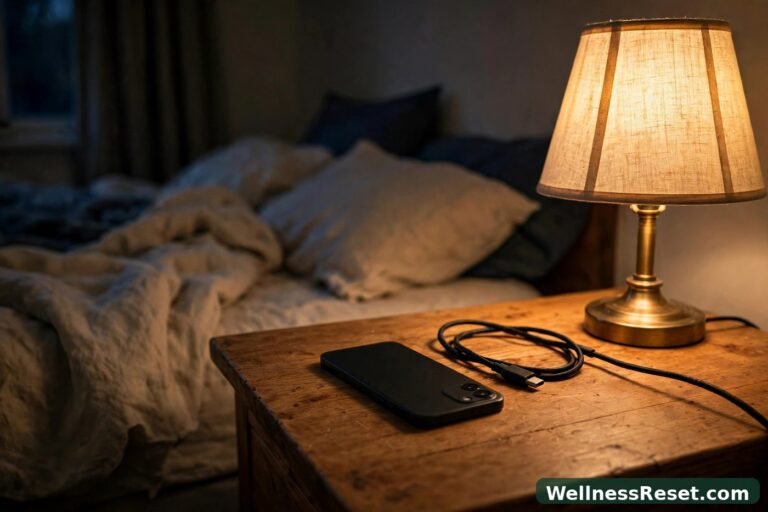
Do these in order, in a dim room, phone face-down out of reach. Keep every movement slow — about half the speed you think you should go. If anything hurts, skip it. Mild stretch is fine; sharp pain is a stop sign.
1. Seated Cat-Cow — 2 minutes
Sit near the front of your chair, feet flat on the floor, knees over your ankles, hands on your thighs.
On an inhale, gently arch your back, lift your chest a little, and let your head tilt back slightly. On the exhale, round your back, tuck your chin toward your chest, and let your shoulders roll forward. That is one round. Do 8 slow rounds.
Best for: a stiff back after a full day at a desk.
2. Slow Neck Rolls — 2 minutes
Sit tall but not stiff. Drop your right ear toward your right shoulder — do not yank it, let the weight of your head do the work. Hold for 3 slow breaths. Roll your chin slowly down to your chest, then up to the left side, hold 3 breaths there, then roll back the same way. That is one set. Do 3 sets, moving smoothly, like drawing a wide U-shape with your chin.
Best for: phone-neck tension and headaches that start at the base of the skull.
3. Gentle Seated Twist — 2 minutes
Sit sideways if your chair has arms, or just turn in place. Left hand on the outside of your right knee, right hand on the chair back behind you. Inhale to lengthen your spine a fraction, exhale and turn gently right. Hold 4 slow breaths, breathing into your ribs. Return to centre slowly, then repeat on the left.
Best for: a back that feels “stuck” after sitting all day. Do not force the twist — what works best is a turn you could hold while having a conversation, easy and unforced, maybe 70% of your full range.

4. Belly Breathing — 2 minutes
This is the quiet heart of the routine. Sit back, feet flat, hands on your belly. Breathe in slowly through your nose for a count of 4, feeling your belly rise. Pause. Breathe out slowly through your mouth for a count of 6, feeling it fall. That is one round. Do 8 rounds. If counting feels like homework, just make the exhale longer than the inhale. For a structured pattern on other nights, try the 4-7-8 breathing method: https://wellnessresett.com/the-4-7-8-breathing-method-calm-your-mind-before-sleep/
Best for: a racing mind and that wired-but-tired feeling.
5. Legs Up on a Stool — 2 minutes
Put a low stool in front of your chair. Sit back, feet up on the stool, knees slightly bent, light blanket over your legs. Hands in your lap, eyes closed, breathe normally for 2 minutes. No effort, no counting, no technique. The full stop at the end of the sentence.
Best for: tired, heavy legs, and a clear “the day is finished” signal.
Putting It All Together: Your 10 Minutes
Here is the routine at a glance:
- Seated cat-cow — 2 minutes, 8 slow rounds
- Slow neck rolls — 2 minutes, 3 sets each side
- Gentle seated twist — 2 minutes, 4 breaths each side
- Belly breathing — 2 minutes, 8 rounds of in for 4, out for 6
- Legs up on a stool — 2 minutes, eyes closed, blanket on
Start about 30 to 45 minutes before bed, in the same chair, at roughly the same time, for at least a week before you judge it. Routines work because they become a cue — your body starts to recognise “chair, dim light, slow breathing” as the start of winding down. One random night will not tell you much.
Keep the stool and blanket next to the chair permanently. The nights I skipped were the nights I had to go looking for the stool first. Make it easier than skipping it.
When Things Do Not Go Smoothly
| Problem | Quick fix |
|---|---|
| Your mind keeps racing through the whole routine | Do not fight it. Notice the thought, then bring your attention back to your feet on the floor. That redirect is the practice, not a failure. |
| You feel sleepy halfway through | That is fine. Finish with legs up and head to bed. |
| A move feels uncomfortable or pinches | Skip it tonight, or swap in an extra minute of belly breathing. |
| Your chair is too soft or too low | Use a firmer dining chair. If your feet do not reach the floor, put a folded towel under them. |
| You do it but still lie awake | That happens, and it does not mean the routine failed. Sleep has many inputs — light, caffeine, stress, room temperature. For the rest, our sleep hygiene rules cover the basics: https://wellnessresett.com/sleep-hygiene-10-simple-rules-that-fix-more-than-any-supplement/ |

Common Mistakes to Avoid
Rushing through it like a workout. If you blast through all five moves in 4 minutes, you have done a stretch session, not a wind-down. Slow is the whole point — 2 minutes per move.
Doing it in bright light with the TV on. Dim the overhead light, use a lamp, TV off for ten minutes. If screens keep you wired at night, a screen-free wind-down pairs naturally with this routine: https://wellnessresett.com/digital-sunset-screen-free-wind-down/
Forcing the twist or the neck rolls. Evening is not the time to chase a deeper stretch. If you wake up sore, you went too far.
Starting too late. If you begin half-asleep on the sofa, you will fall asleep there and wake up stiff at 1 am. Start while you are still awake enough to enjoy it.
Expecting a miracle on night one. This is a habit, not a switch. Give it a week. Some nights will feel better than others.

Final Words
Ten minutes, one chair, five slow moves. That is the whole routine, and honestly, its simplicity is why it stuck for me when fancier routines did not. I do it in the same armchair most nights, usually around 10:15, lamp on low, blanket over my legs for the last two minuts. Some nights I fall asleep easily afterwards, some nights I still lie awake a while. But I go to bed feeling like the day is over, instead of carrying it into the dark with me.
Try it tonight. Not perfectly, not with special clothes or equipment — just a chair, a stool, and ten unhurried minutes.
Frequently Asked Questions
Can I do chair yoga for better sleep every night?
Yes. The moves are gentle, so nightly practice is fine for most people. If any move causes pain, skip it or check with a doctor before continuing.
Do I need a special chair?
No. Any firm, stable chair with a flat seat works. Avoid very soft armchairs and chairs with wheels. A dining chair is ideal.
What if I cannot do the twist because of a back problem?
Skip it and do an extra minute of belly breathing instead. Never twist through pain, and if you have a diagnosed back condition, check with your doctor first.
Is this routine enough on its own for good sleep?
Honestly, no — not by itself. Light exposure, caffeine timing, room temperature, and regular sleep times all matter too. Think of this routine as the calming last chapter of your evening, not the whole book.