Chair Yoga Exercises
My chair yoga habit started on a Tuesday I had not planned to exercise at all. I had been sitting at the kitchen table for three hours, answering emails, and when I stood up my back felt like it had been folded in half. I sat straight back down — not to work, but because standing hurt more than sitting — and did the only thing I could think of: I stretched, right there, in the chair.
That ten minutes changed how I think about exercise. Chair yoga exercises are not a watered-down version of “real” yoga. They are yoga adapted to the chair most of us already spend our days in, and for a stiff back, tight hips, or a day when getting on the floor feels like too much, they are often the smarter choice.
This routine takes about 20 minutes. You need a sturdy chair without wheels, a bit of floor space, and shoes you can move in — or bare feet, if you prefer. This is general wellness information only, not medical advice. Stop any move that causes sharp pain, and talk to a doctor if pain, numbness, or weakness keeps coming back.
Why Chair Yoga Exercises Work So Well
A chair does three useful things at once. It takes weight off your legs, so you can focus on your spine and shoulders instead of worrying about balance. It gives you something solid to hold, so standing moves feel safe. And it is always there — no mat to unroll, no special clothes, no drive to a studio.
In my experience, that last point matters most. The routine you actually do, in the chair you already sit in, beats the perfect routine you keep postponing. Chair yoga exercises fit into a lunch break, a gap between calls, or the half hour before dinner. You do not need to “make time” for them in the same way. You just need to stand up from the chair a little less stiff than you sat down.
These chair yoga exercises are for general, everyday stiffness — not for a recent injury, and not as a replacement for physiotherapy. They are also deliberately not seniors-only. If you are 35 and desk-bound, or 55 and getting back to movement after a long break, this routine is for you too. For a second seated routine to compare, the British Heart Foundation’s chair-based exercises guide covers similar seated moves in a different order.
Before You Start: The Chair Check
Not every chair works. A wheeled office chair will roll when you lean, and a deep sofa will swallow your posture before you begin. Use this quick check:
- Sturdy and armless, if possible. Arms get in the way of twists and side bends.
- Feet flat on the floor. If your feet dangle, put a folded blanket or a couple of books under them.
- Sit on the front half of the seat. Your back should not touch the backrest for most moves — you are meant to hold yourself up.
- Space behind you. You will stand behind the chair for the last two moves, so push it away from the wall a little.
Sit tall, shoulders down, chin level. Take three slow breaths before the first move. That small pause is part of the routine, not a delay before it.
1. Seated Cat-Cow — Wake the Spine Up
Sit forward in your chair, feet flat, hands on your knees. Breathe in and arch gently — chest forward, shoulders back, look slightly up. Breathe out and round — chin toward your chest, belly pulled in, hands pressing lightly into your knees. Move slowly, one breath per shape, for eight rounds.
Best for: the first move of the day, and for a back that feels “stuck” after sitting.
Do not force the arch. A few centimetres of movement, done smoothly, is worth more than a dramatic bend that pinches.

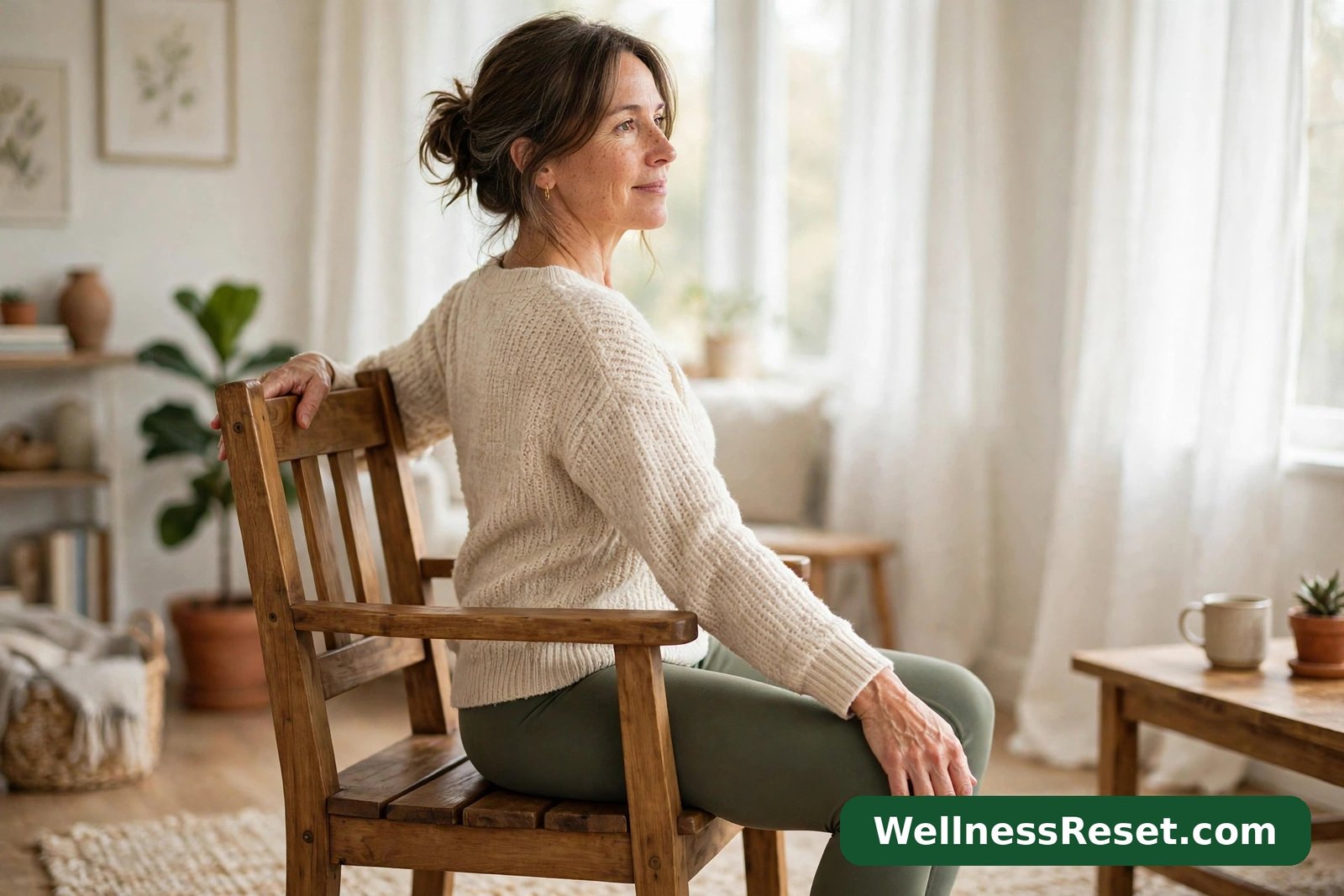
2. Seated Twist — For the Middle Back
Still seated, feet flat. Breathe in to lengthen your spine, then breathe out and turn gently to the right, left hand on your right knee, right hand resting on the chair seat behind you. Hold for five breaths, looking over your right shoulder only as far as is comfortable. Return to centre and repeat on the left.
Best for: the twisty, locked feeling you get from sitting sideways to a screen all day.
Keep both sitting bones on the chair. If one hip lifts, you have turned too far — back off until both stay down.
3. Seated Forward Fold — Hamstrings Without the Floor
Sit forward, feet a little wider than hip-width. Breathe in, arms reaching up. Breathe out and fold forward from the hips, hands sliding down your shins toward your ankles — only as far as your back stays long. Let your head hang. Hold for five breaths, then roll up slowly, one vertebra at a time.
Best for: tight hamstrings and a lower back that complains when you bend to pick things up.
Bend your knees a little if the backs of your legs feel like guitar strings. Straight legs are not the goal here; a long back is.
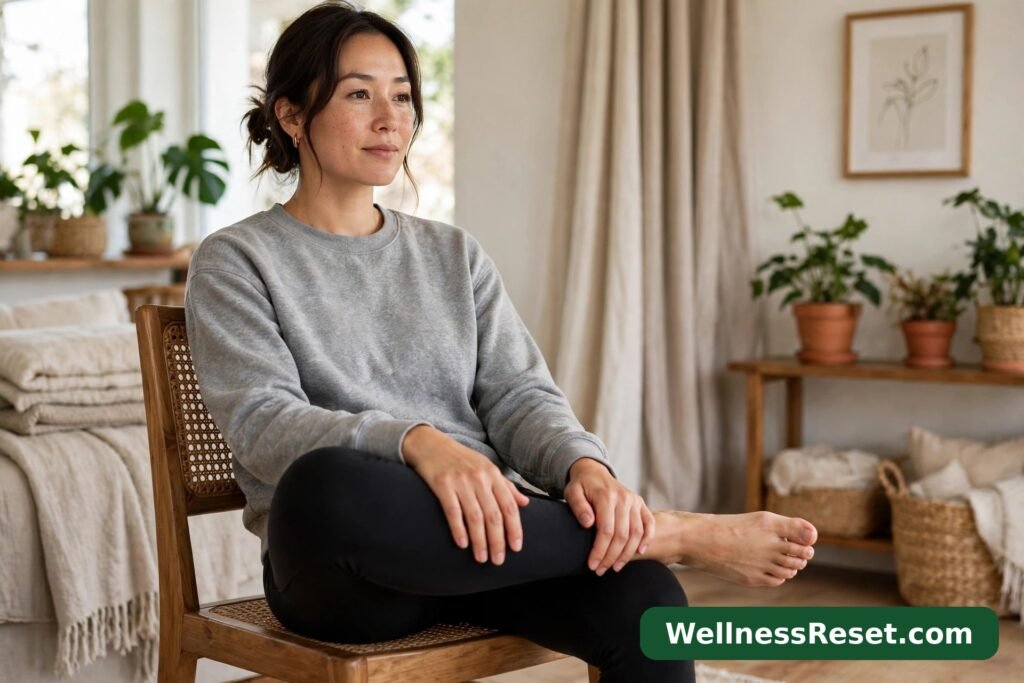
4. Chair Pigeon — The Hip Opener Everyone Needs
Cross your right ankle over your left knee, flexing the right foot so the ankle, not the knee, takes the pressure. Sit tall, then hinge forward just a few centimetres until you feel a stretch deep in the right hip and outer thigh. Hold for five breaths. Uncross slowly and switch sides.
Best for: hips that tighten from hours of sitting, and anyone whose lower back aches after a long drive.
If the cross feels pinchy in the knee, lower the foot to the floor and just do a gentle figure-four with the ankle resting higher on the shin. Never push through knee pain.
5. Seated Shoulder Rolls and Eagle Arms
Roll both shoulders up, back, and down in slow circles — ten each way. Then cross your right arm under your left at the elbows and press the backs of your hands together, or palms if they meet. Lift your elbows to shoulder height and hold for five breaths. Unwind and switch sides.
Best for: desk shoulders, and as a reset between the lower-body moves and the standing finish.
This pair is also the core of our beginner routine — if you want a slower, first-timer version of chair yoga, start with these chair yoga for beginners moves and build up to today’s full routine.
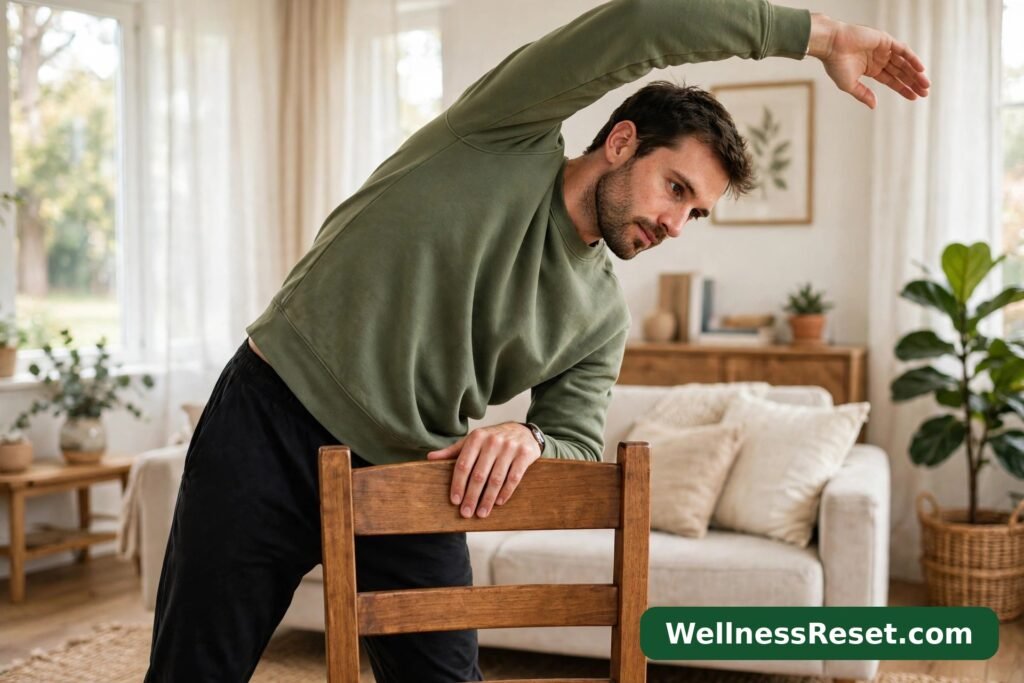
6. Chair-Supported Standing: Mountain and Gentle Side Bend
Stand behind your chair, hands lightly on its back. Feet hip-width apart, stand tall for five breaths — this is mountain pose, with a chair for confidence. Then keep one hand on the chair, reach the other arm overhead, and lean gently away from the chair for three breaths. Come back to centre and switch sides.
Best for: anyone who wants a little standing work without worrying about balance.
Hold the chair as much as you need to. Using support is not cheating; it is the whole point of chair-supported yoga.
7. Chair Squat (Sit-to-Stand) — Strength, Gently
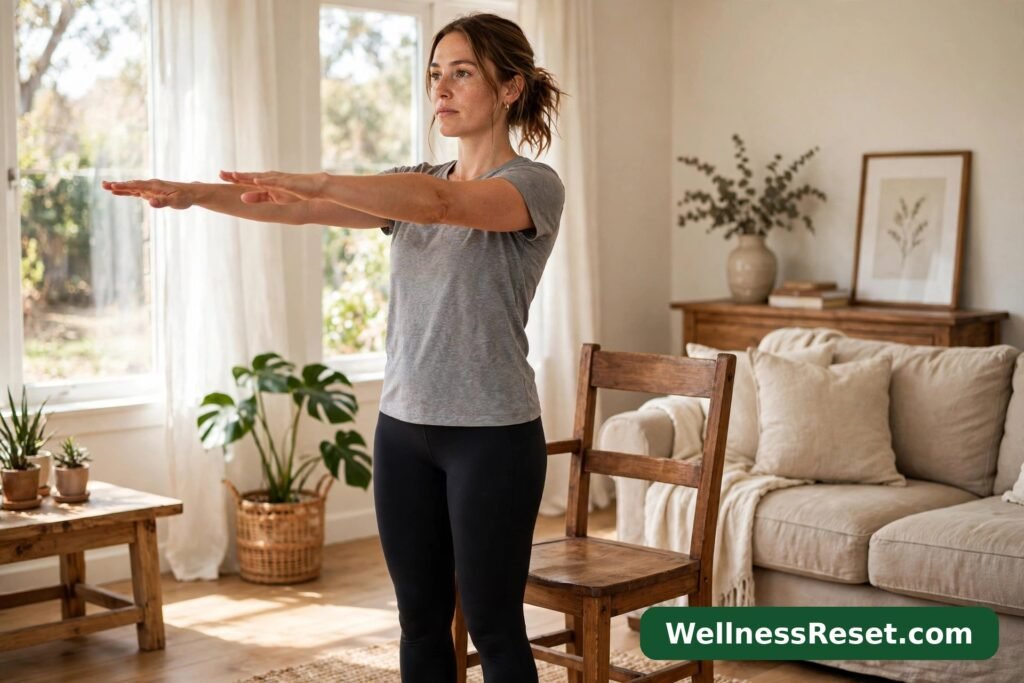
Stand in front of your chair, feet hip-width apart, arms forward at shoulder height. Hinge at the hips and sit back slowly until you just touch the seat — do not flop down — then press through your feet to stand again. Five repetitions, slow and controlled.
Best for: leg strength for everyday things: getting out of a car, standing from a low sofa, climbing stairs without grabbing the rail.
If five feels like a lot, do three. If it feels easy, do eight. The slow lowering matters more than the number.
A 20-Minute Chair Yoga Exercises Routine, In Order
- Minutes 0–2: Three slow breaths, seated tall, then seated cat-cow, eight rounds.
- Minutes 2–6: Seated twist, five breaths each side, twice.
- Minutes 6–10: Seated forward fold, five breaths, twice.
- Minutes 10–14: Chair pigeon, five breaths each side.
- Minutes 14–17: Shoulder rolls and eagle arms.
- Minutes 17–20: Chair-supported mountain and side bends, then five chair squats.
Do it once a day to start. Morning works well, because it undoes the night’s stiffness before the day’s sitting adds more. But honestly, the best time is the time you will actually do it — lunch break counts just as much.
When to stop: stop if a move causes sharp or pinching pain, numbness or tingling down an arm or leg, dizziness, or weakness. Rest, and talk to a doctor if it keeps happening. Mild tension that eases as you hold is normal; pain that gets worse as you hold is not.
Quick Fixes for Common Chair Yoga Problems
| Problem | Quick fix |
|---|---|
| Back rounds in the forward fold | Bend your knees more and fold less — length beats depth |
| One hip lifts in the twist | Turn less; both sitting bones stay on the chair |
| Knee pinches in chair pigeon | Flex the foot harder, or lower it to a higher shin position |
| Shoulders creep up during eagle arms | Drop them, lift elbows a little less, breathe |
| Chair slides during standing moves | Use a non-wheeled chair on a rug or against a wall |
| Routine feels too long | Do moves 1, 4, and 5 only — a 10-minute version still counts |
Common Mistakes
Bouncing into stretches. Chair yoga is slow by design. Bouncing triggers the muscle to guard, and you end up tighter than you started.
Holding your breath. If you are holding your breath, you are pushing too far. Back off until breathing feels easy again.
Using a wheeled chair. I have done this. It rolls, you wobble, the stretch is ruined. Sturdy chair, every time.
Skipping the standing finish. The seated moves are comfortable, so it is tempting to stop there. The standing moves are what carry the benefit into walking and standing up in real life.
Doing it once and deciding it “didn’t work.” One session loosens you for an afternoon. Two weeks of daily sessions is when mornings start feeling different.
Final Words
Chair yoga exercises will not make you flexible overnight, and they are not supposed to. They are a daily, doable way to keep a sitting body moving — in the chair you already own, in the clothes you are already wearing.
Start with the 20-minute routine today, not next Monday. If 20 minutes feels like too much, do the 10-minute version from the table above. Either way, finish, stand up, and notice how that first step feels. That is the whole test.
If you want a pose-by-pose reference to go with this routine, our 12 chair yoga poses for beginners hub breaks each shape down with its own cues — a useful companion to today’s full routine.
FAQ
How long should chair yoga exercises take?
About 20 minutes for the full routine here, or 10 minutes for the shortened version. Once a day is a good baseline.
Do I need a yoga mat or special equipment?
No. A sturdy, non-wheeled chair and a little floor space are enough.
Are chair yoga exercises only for older adults?
No. They suit anyone who sits a lot, is returning to movement, or wants a gentler practice — whatever their age.
Can I do chair yoga exercises at work?
Yes, if your chair is sturdy and does not roll. The seated moves fit a lunch break; save the standing moves for a quiet corner.
What if a move hurts?
Stop that move right away. Mild tension is normal; sharp, pinching, or tingling pain is not. Talk to a doctor if pain keeps coming back.