Best Exercises During Work Breaks
At 11:20 on a normal Tuesday, I stood up to make tea and realised my legs had gone strangely quiet. Not painful. Just absent — like they had been switched off for two hours and were surprised to be asked to work again.
That is what a work break is actually for. Not just a change of scenery, and not a reward for finishing a task. A break is the moment your body gets to do the opposite of sitting: stand, shift weight, move blood around, and remind your joints they exist. The exercises below are built for real breaks — the two minutes between meetings, the five minutes while the kettle boils, the ten minutes you actually step away.
This is general wellness information only, not medical advice. Stop if anything hurts sharply, and talk to a doctor if pain or dizziness keeps coming back.
Why Sitting All Day Makes Breaks Necessary
Sitting is not the villain here. Sitting without interruption is. When you sit for two or three hours straight, a few predictable things happen: hip flexors shorten, shoulders drift forward, calves stop pumping blood upward, and your brain starts to feel foggy even though you have not done anything physically tiring.
A short movement break interrupts all of that at once. You do not need a workout. You need a change of position, done often enough that your body never fully locks into the chair shape.
In my experience, three things make a work-break routine actually stick:
- It fits the break you really have. A 10-minute routine is useless in a 2-minute gap. Match the moves to the minutes, not the other way round.
- It needs no equipment and no changing clothes. If it needs a mat or a change of shoes, you will skip it on busy days — which are exactly the days you need it.
- It is tied to something you already do. Kettle on, break starts. Meeting ends, break starts. The trigger matters more than willpower.
The 2-Minute Break: Stand Up and Wake Up
You have two minutes. Do not spend them scrolling. Stand, and do these three things:
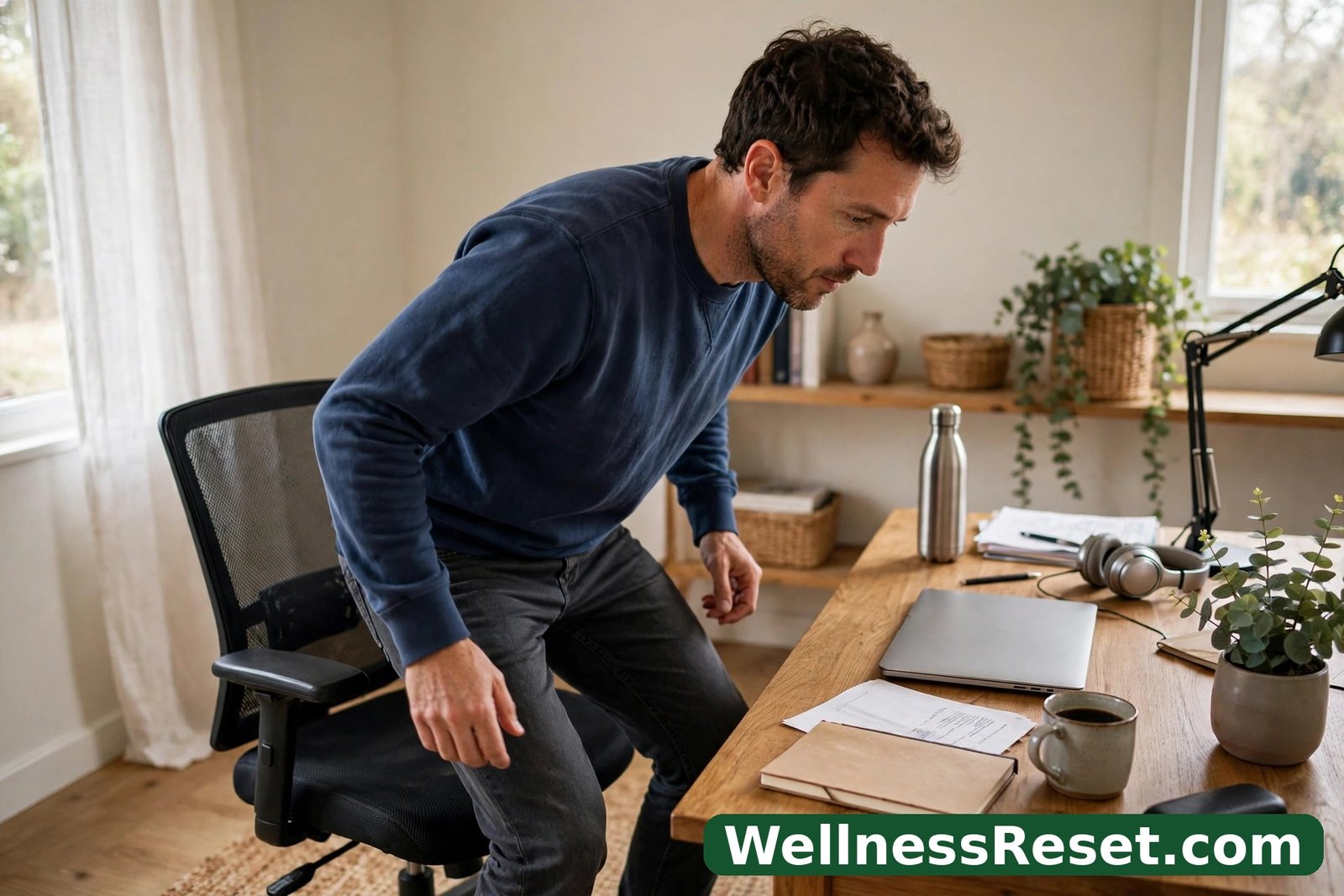
1. Chair stand and sit, 5 times. Stand up slowly without using your hands if you can, sit back down with control, and repeat. It sounds too simple to count. It counts — it is the single most useful movement for legs that have been idle. Best for: the “my legs feel asleep” moment, and anyone who sits for hours at a stretch.
2. Calf raises, 10 times. Stand behind your chair, hold the back lightly for balance, rise onto your toes, hold for 2 seconds, and lower slowly. Slow lowering matters more than going high. Best for: stiff ankles and that heavy-legs feeling late in the afternoon.
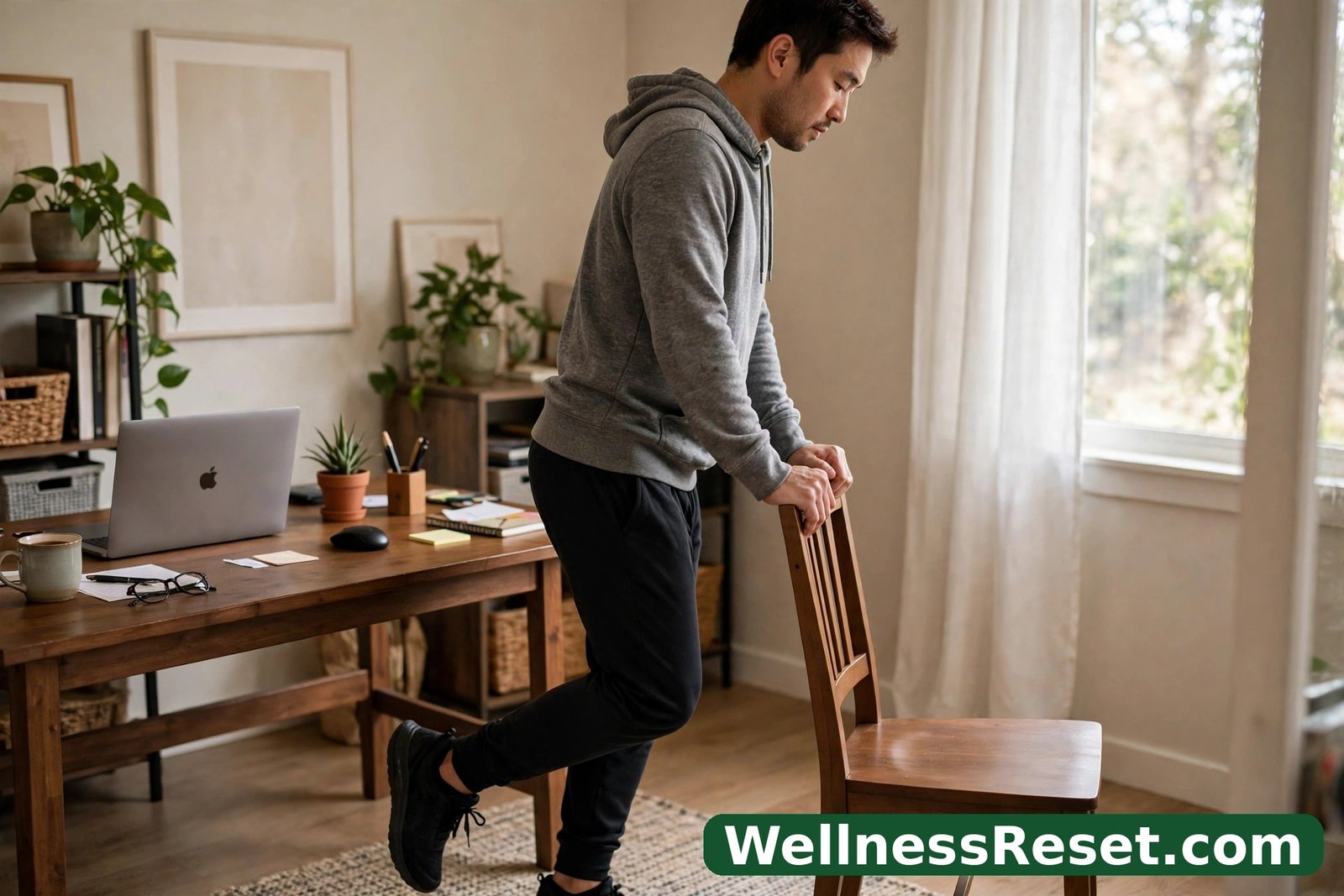
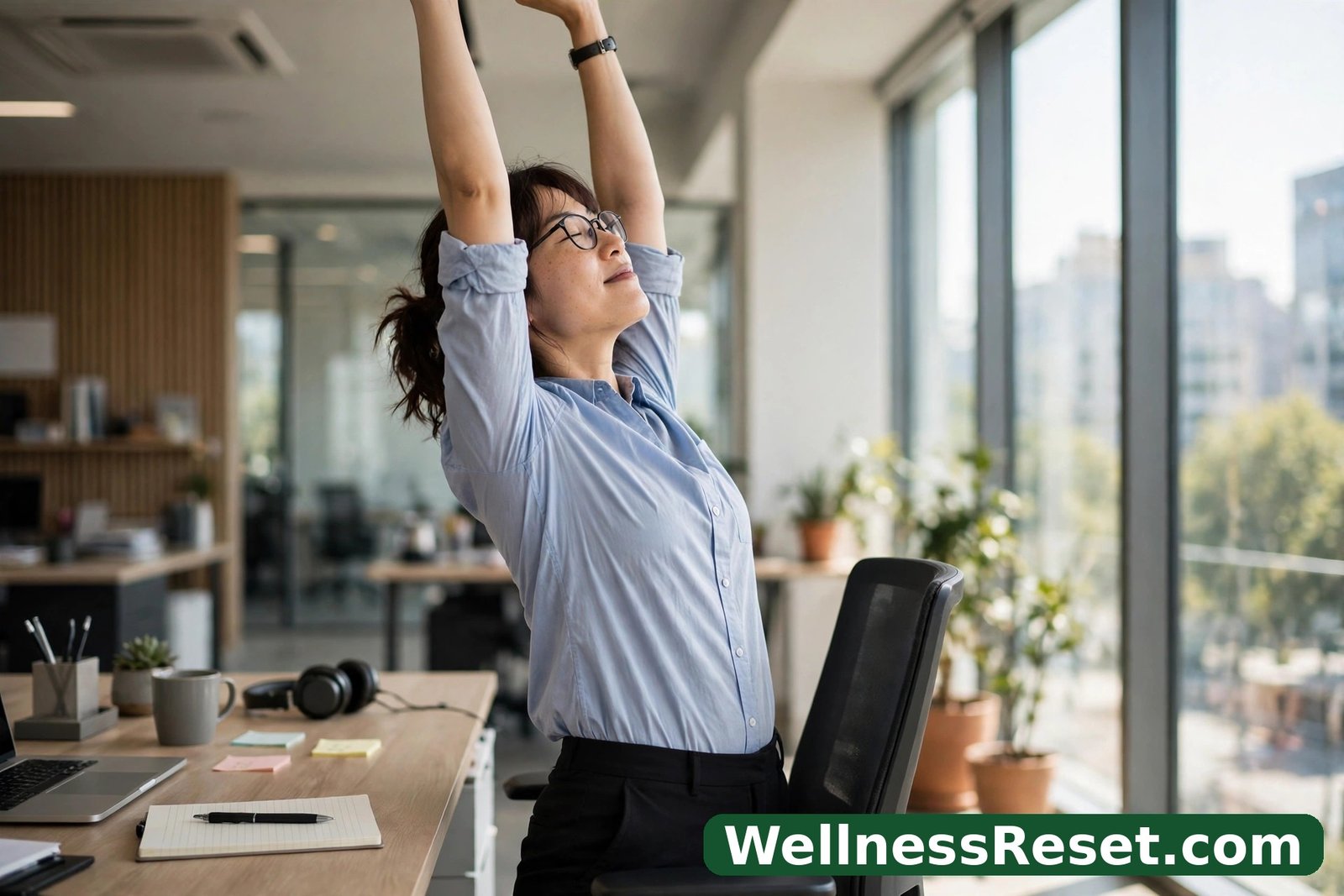
3. Shoulder rolls and a big reach overhead, 30 seconds. Ten rolls, then arms overhead and a long stretch tall, as if you were reaching for something on a high shelf. Best for: resetting your posture before you sit back down, so you do not return to the same slump.
Two minutes, done. Sit back down feeling like you actually moved, not like you just stood up and sat down again.
The 5-Minute Break: The Full Desk Reset
Five minutes buys you the whole reset. This is the break to take mid-morning and mid-afternoon, and it is the one I would pick if I could only pick one.
1. Chair stands, 10 times — slow, controlled, no hands if possible.
2. Seated twist, 30 seconds each side — sit tall, turn gently from your waist, hold the chair back lightly, and breathe. No yanking.
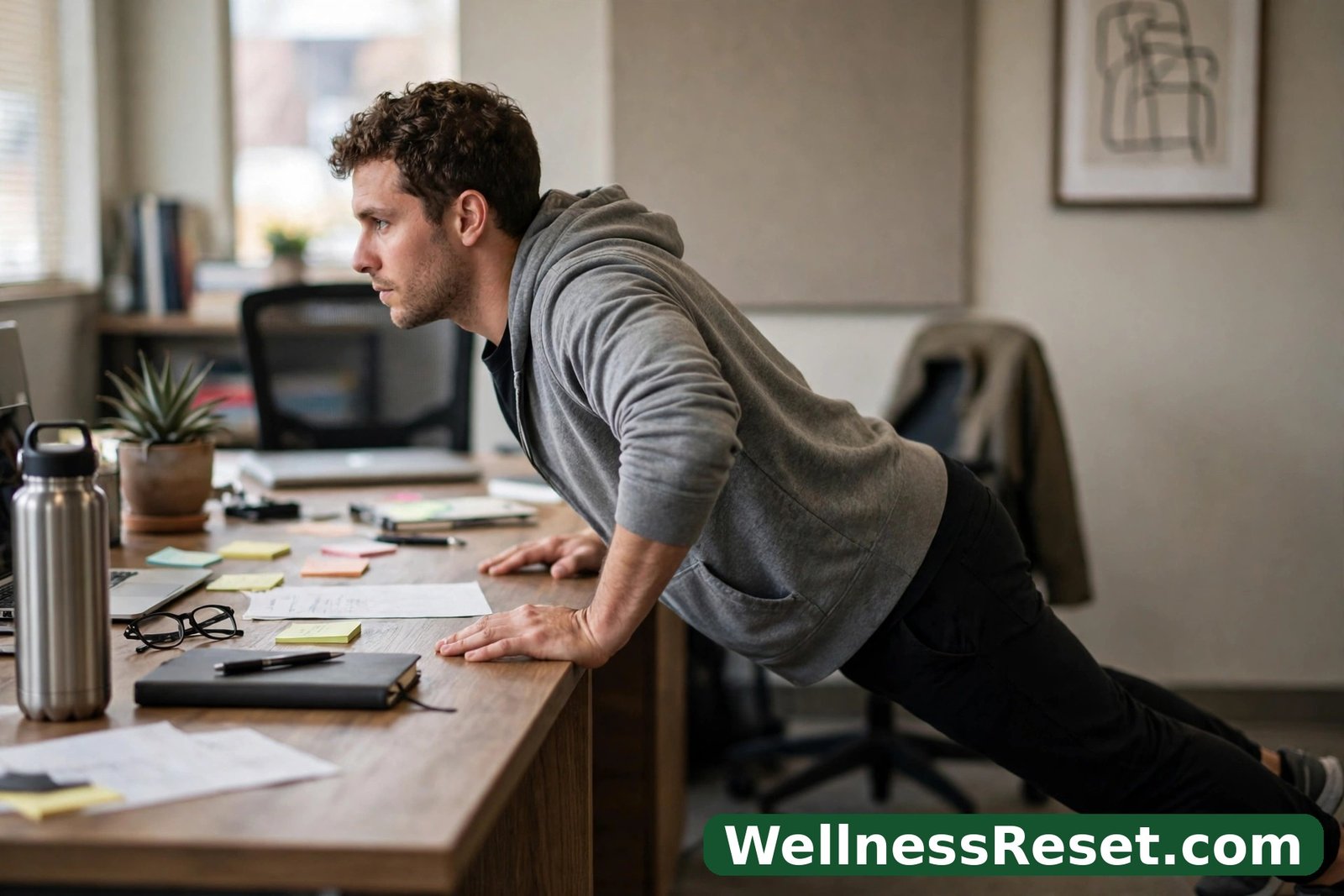
3. Desk push-ups, 10 times — hands on the desk edge, feet stepped back, body in a straight line, lower your chest toward the desk and push back. Easier than floor push-ups, and your shoulders will feel it in a good way.
4. Hip hinge, 10 times — stand, feet hip-width apart, push your hips back like you are closing a car door behind you, then stand tall. This wakes up the back of your legs and your glutes, which sitting switches off.
5. March in place, 60 seconds — knees up, arms swinging gently. Finish with it, because it gets your heart rate up just enough to clear the fog.
Best for: the midday slump, the post-lunch fog, and anyone whose back feels stiff after a morning of meetings.
Do it once, properly, rather than rushing through it twice. Five honest minutes beats ten distracted ones, and untill you feel the difference yourself, that sentence will sound like a platitude. Try it once at 3 pm and see.
A better desk setup makes this reset last longer — see this desk posture routine for the chair, screen, and keyboard positions that stop you sliding straight back into a slump.
The 10-Minute Break: Actually Leave the Desk
Ten minutes is enough to genuinely leave your workspace, and you should. Walk — down the corridor, around the block, up and down the stairs once. Walking is not a fallback exercise; for a desk worker, it is the main one, because it moves everything sitting does not: hips, ankles, arms, and eyes, which finally get to look further than a screen.
Add two things to the walk and it becomes a complete break:
- Stairs, once, slowly. One flight up and down is enough. It loads your legs differently from flat walking, and it is over in a minute.
- A standing stretch at the end. Overhead reach, a gentle side lean each way, and 10 shoulder rolls before you sit back down. Thirty seconds, and you return to your chair in a different shape from the one you left it in.
Best for: long afternoons, days with back-to-back calls, and anyone who notices their mood dropping as steadily as their energy.
If you work from home, walk to the end of the street and back, or do two laps of the house. The distance matters less than actually leaving the room you work in.

Quick Fixes for Common Work-Break Problems
| Problem | Quick fix |
|---|---|
| Only 2 minutes between meetings | Chair stands, calf raises, shoulder rolls — the 2-minute set |
| Post-lunch energy crash | 5-minute desk reset, then a glass of water before sitting down |
| Legs feel heavy or asleep | Calf raises 10 times + march in place 60 seconds |
| Back stiff after a morning of calls | Seated twist each side + hip hinge 10 times |
| No time for a “real” break | Tie the 2-minute set to the kettle or the bathroom trip |
| Breaks keep getting skipped | Put them in the calendar like meetings — 10:30 and 15:30 work well |
Common Mistakes
Treating the break as a phone break. Standing up to scroll on your phone in a different chair is not a break for your body. Leave the phone on the desk for two minutes; it will survive.
Doing one giant break instead of several small ones. One 30-minute walk at lunch does not cancel out four hours of uninterrupted sitting. Frequency beats duration here.
Going too hard, too fast. A work break is not a workout. Sprinting up the stairs on cold legs after three hours sitting is how people pull something. Warm up with the easy moves first.
Skipping breaks on busy days. Busy days are when your body needs them most, and when your focus benefits most from a two-minute reset. The work will still be there when you sit back down — you will just do it better.
Forgetting to actually stand. Half the benefit is simply not sitting. Even standing and shifting your weight for a minute counts, if that is all the break you have.
Making breaks automatic is the real trick — see how to make stretching a daily habit for the trigger-and-routine approach that works better than relying on motivation.
Final Words
Work breaks do not need to be impressive. They need to be frequent, and they need to involve actual movement. Two minutes of chair stands and calf raises, done three times a day, will do more for your body than a gym session you keep postponing.
Pick one trigger today — the kettle, the end of a meeting, 3 pm on the clock — and attach the 2-minute set to it. That is the whole system. Everything else is just extra minutes when you have them.
FAQ
How often should I take a movement break at work? Roughly every 60–90 minutes. A 2-minute break each hour, plus one longer 5–10 minute break mid-morning and mid-afternoon, is a realistic pattern.
What are the best exercises for a 2-minute break? Chair stands, calf raises, and shoulder rolls. They cover legs, ankles, and posture in under two minutes with no equipment.
Can I do these exercises in office clothes? Yes — all of them work in normal office clothes and shoes. Nothing here needs a mat, a change of clothes, or lying on the floor.
Do work-break exercises replace a workout? No. They are a complement, not a replacement — they break up sitting and keep you moving through the day, which a single workout cannot do on its own.
What if I have no space to move at my desk? The 2-minute set needs only the space to stand behind your chair. If even that is tight, do calf raises and shoulder rolls standing in place, and take the 10-minute walk break whenever you can.