The 4-7-8 Breathing Method: Calm Your Mind Before Sleep
Your brain is doing its greatest-hits tour of everything that went wrong today, and it has decided that midnight is the perfect time for an encore. You have tried counting sheep (boring, ineffective), you have tried “just relaxing” (impossible on command), and you are one bad thought away from checking your phone.
Here is something that actually works, and it takes less than two minutes: a breathing pattern called 4-7-8. In for four counts, hold for seven, out for eight. That is the whole technique. No app, no equipment, no subscription.
It sounds too simple to matter. It is not. The long exhale is the key — slow breathing out activates your body’s rest system, the same system that decides whether you are in “danger mode” or “safe mode.” When your exhales are longer than your inhales, your nervous system gets the message: nothing is chasing you, you can power down.
I have used this on restless nights for years, and I will be honest — it does not work like an off switch. It works more like dimming the lights. You go from racing mind to wandering mind to heavy eyelids, usually within three or four rounds.
How to Do 4-7-8 (Takes 90 Seconds to Learn)
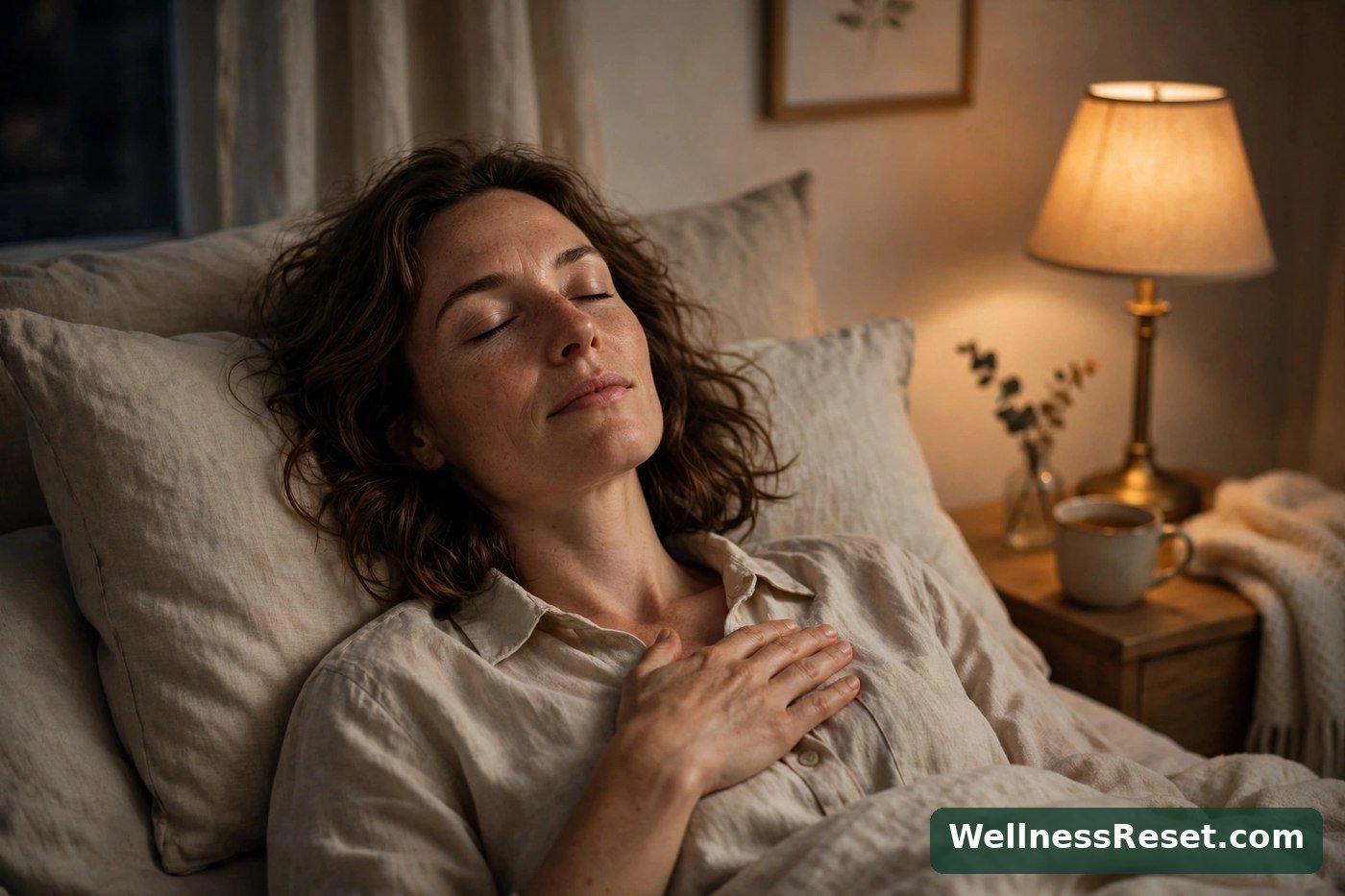
- Get comfortable. Sit upright or lie down. Either is fine — lying down is better if sleep is the goal.
- Breathe in quietly through your nose for a count of 4. Not a gasp — a normal, steady inhale.
- Hold your breath for a count of 7. Keep your body relaxed, especially your shoulders and jaw. The hold should feel slightly challenging but never strained.
- Breathe out slowly through your mouth for a count of 8. Make a soft “whoosh” sound if you like — it helps you pace the exhale.
- That is one cycle. Do 3–4 cycles to start.
Best for: bedtime restlessness, pre-meeting nerves, the tense afternoon when coffee has worn off and anxiety has not.
The counts do not need to be exact seconds — the ratio is what matters. Inhale : hold : exhale at roughly 4 : 7 : 8. If 8-count exhales feel too long at first, shorten everything proportionally (3-5-6 works fine while you build up).
Why the Long Exhale Matters
Your nervous system has two branches that matter here. One speeds things up (heart rate, alertness, the “oh no” feeling). The other slows things down (digestion, calm, the “all clear” feeling). You cannot think your way into the slow branch — but you can breathe your way in, because the breathing muscles are one of the few body systems you control consciously that also talk to the automatic systems.
When you exhale longer than you inhale, your heart rate drops slightly with each cycle. After four cycles, most people feel their shoulders drop an inch without trying. That is not placebo; it is mechanics.
What 4-7-8 will not do: it will not fix chronic insomnia on its own, it will not erase a genuinely stressful life situation, and it is not a substitute for medical help if sleep problems persist. Think of it as a tool for the last stretch of the day, not a life overhaul.

The Two-Week Habit That Makes It Stick
The mistake almost everyone makes: trying 4-7-8 for the first time at 2 AM when they are already wired. Of course it feels impossible then — you are asking a new skill to work under the worst conditions.
Do this instead: practice twice a day for two weeks when you are not desperate. Once in the morning (4 cycles after waking), once in the evening before bed. Two minutes each time. Your body learns the association — this pattern means “we are winding down” — and by the time you actually need it at midnight, the reflex is there.
| Situation | Quick fix |
|---|---|
| The 7-count hold feels panicky | Shorten to 3-5-6 and build up over a week — the ratio matters, not the absolute numbers |
| Mind wanders mid-cycle | Normal. Just return to the count — the redirect is the practice |
| Feel lightheaded | You are breathing too hard. Make each breath gentler; it should feel easy, almost boring |
| Fall asleep during it | That is the point. Success. |
| Partner thinks the whoosh sound is funny | Switch to a silent exhale through the nose — slightly less effective, fully relationship-safe |
Common Mistakes
Going too fast. The most common error is racing through the counts like a chore. Slow each phase down until it feels almost too slow — that is usually the right pace.
Practicing only in crisis. See the two-week habit above. This is a skill, not a button.
Expecting instant silence. Your mind will still throw thoughts at you during the first few cycles. That is fine. You are not trying to empty your mind; you are trying to slow your body down, and the mind usually follows the body, not the other way around.
Final Words
4-7-8 is one of those rare things that is both free and genuinely useful. Ninety seconds to learn, two minutes to practice, and after a couple of weeks it becomes the thing your body reaches for automatically when the night gets loud. Pair it with the phone-outside-the-bedroom rule and you have covered the two biggest levers on bad nights.
If you liked this, the Box Breathing technique is its daytime cousin — same idea, different ratio, better for stress during the day rather than winding down for sleep.

FAQ
How many cycles should I do?
Start with 3–4 cycles (about two minutes). More is not better — overdoing it can make you lightheaded. Consistency beats volume.
Can I do 4-7-8 during the day for anxiety?
Yes, it works for daytime stress too. For daytime use, though, Box Breathing (4-4-4-4) is often easier to fit into a busy moment since the rounds are shorter.
Is it safe? Do not hold your breath if…
If you are pregnant, have a respiratory condition, or feel dizzy, skip the long holds and use gentle 3-5-6 or just slow exhaling. When in doubt, check with your doctor — this is a relaxation technique, not medical treatment.
How long before it starts working?
Most people feel something in the first session — shoulders drop, jaw unclenches. The reliable “falls asleep faster” effect usually shows up after 1–2 weeks of twice-daily practice.






3 Comments