
Best Morning Stretches
The worst mornings in my house do not start with an alarm. They start with the shuffle — feet on the floor, back protesting, neck refusing to turn toward the kettle. For years I treated that shuffle as normal ageing, or bad sleep, or just “how mornings are.” Then I tried something embarrassingly simple: fifteen minutes of stretching before I checked my phone.
Within a week, the shuffle was shorter. Within a month, it was mostly gone. These are the best morning stretches I have settled on after trying far too many routines — the ones that actually earn their place, for a general adult morning, not a seniors-only routine, not an in-bed-only routine, and not a rushed five-minute version. If you only have five minutes, use our shorter routine instead; this one is for days when you can give your morning fifteen honest minutes.
You need no equipment. A rug or a mat helps, a chair helps for balance, and that is it. This is general wellness information only, not medical advice. Stop any stretch that causes sharp pain, and talk to a doctor if stiffness, numbness, or pain keeps coming back.
Why Mornings Feel So Stiff
Overnight, your body barely moves for six to eight hours. Muscles cool, joints sit in one position, and the fluid that cushions your spine redistributes. That is why the first steps feel creaky even after a good night’s sleep — you are not broken, you are just cold-started.
Morning stretching works because it reverses that in order: gentle movement first, then range, then a little strength. Harvard Health’s ideal stretching routine makes the same point about covering the major muscle groups a few times a week, rather than chasing one deep stretch. The mistake most routines make is starting with the deepest stretch, on the coldest muscles, before you have even woken your circulation up. The best morning stretches start small and build. That order is the whole secret, and it is why this routine begins standing, not on the floor.
Before You Start
- Warm up first, stretch second. Walk around the house, make the kettle, do twenty seconds of marching in place. Two minutes of movement beats two minutes of extra stretching on cold muscles.
- Breathe normally through every stretch. If you are holding your breath, back off.
- Mild tension is fine; sharp pain is not. Stretch to the point where you feel it, then ease off a fraction. That fraction is where the benefit lives.
- Do it before screens if you can. Phone first means shoulders forward for ten minutes before you have even started. Stretch first, scroll later.
1. Overhead Reach and Full-Body Wake-Up
Stand tall, feet hip-width apart. Interlace your fingers overhead, palms up, and reach tall for five slow breaths, rising gently onto your toes on the last two breaths if balance allows. Then lean gently to the right for three breaths, back to centre, and left for three breaths.
Best for: the very first move, every single morning. It tells your whole body the day has started.
Do not yank the lean. A few centimetres, with ribs down, is plenty.
2. Neck Release — Slow, No Forcing
Drop your right ear toward your right shoulder until you feel a gentle stretch down the left side of your neck. Hold for five breaths, breathing into the stretch. Come back to centre, then repeat on the left. Finish with two slow neck circles each way — and I mean slow, like a full ten seconds per circle.
Best for: the stiff, “slept wrong” neck that makes turning to reverse the car feel like a negotiation.
Never roll your head backward in a full circle, and never pull your head with your hand. Gravity does enough work here.

3. Standing Cat-Cow and Gentle Back Bend
Feet hip-width apart, hands on your thighs. Breathe in and arch gently — chest forward, shoulders back. Breathe out and round — chin in, belly pulled in, hands pressing into your thighs. Eight rounds, slow. On the last round, stand tall, hands on your lower back, and lean back just a few centimetres for two breaths.
Best for: a lower back that feels compressed after a night on a soft mattress.
The back bend at the end is small on purpose. Morning backs do not like drama.
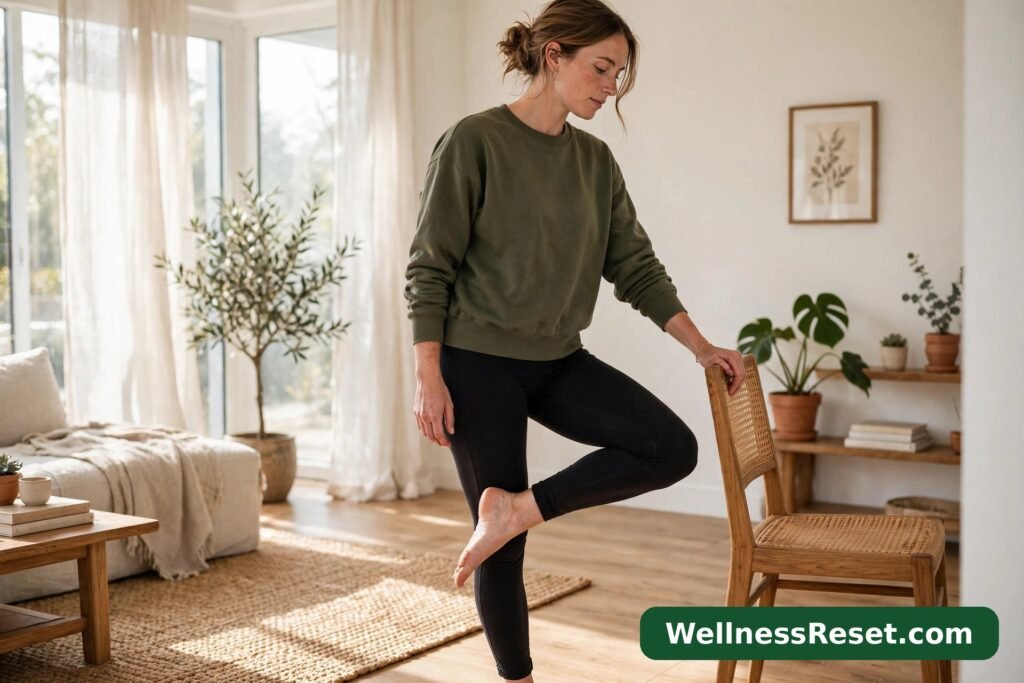
4. Hip Opener: Standing Figure-Four With Chair Support
Stand beside a sturdy chair, one hand lightly on its back. Cross your right ankle over your left knee, flexing the foot, and sit back a few centimetres as if starting to sit down. Hold for five breaths, feeling the stretch deep in the right hip. Stand tall, uncross, and switch sides.
Best for: hips that tighten overnight, and anyone whose first steps feel wobbly until the hips “unlock.”
Keep the standing knee soft, not locked. If balance feels shaky, hold the chair with both hands — support is smart, not weak.
5. Hamstring and Calf Stretch at the Kitchen Counter
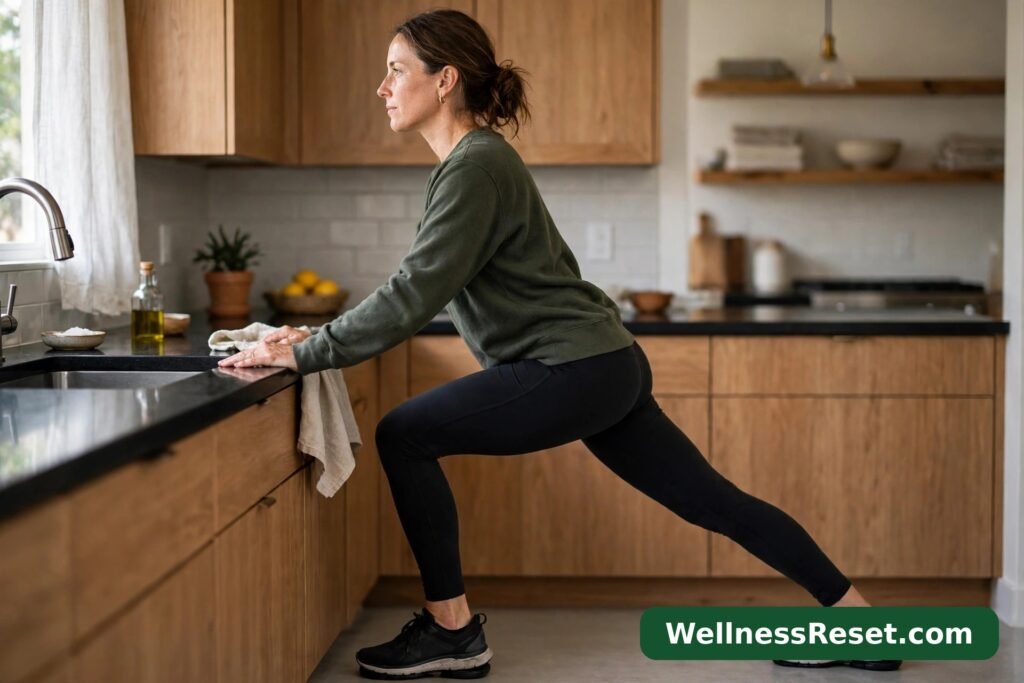
Face the counter, hands resting on it. Step your right foot back about a metre, heel pressed into the floor, left knee bent slightly. You should feel a stretch up the back of the right leg. Hold for five breaths, then bend the back knee slightly to shift the stretch into the lower calf and Achilles area for three more breaths. Switch legs.
Best for: calves that cramp at night and hamstrings that feel short first thing.
Heel on the floor matters more than how far back you step. If the heel lifts, you have stepped too far.
6. Chest Opener and Shoulder Rolls to Finish
Stand tall. Clasp your hands behind your back, straighten your arms gently, and lift them a few centimetres while opening your chest. Hold for five breaths. Release, then roll both shoulders up, back, and down ten times, slow.
Best for: undoing a night curled on one side, and starting the day with shoulders down instead of up around your ears.
This is the move that changes how you carry yourself for the next hour. Do not skip it because it looks too simple.

The 15-Minute Best Morning Stretches Routine, In Order
- Minutes 0–2: Walk, march in place, make the kettle — warm up.
- Minutes 2–4: Overhead reach and side leans.
- Minutes 4–6: Neck release, both sides, plus slow circles.
- Minutes 6–9: Standing cat-cow, eight rounds, plus the small back bend.
- Minutes 9–12: Standing figure-four, five breaths each side.
- Minutes 12–14: Counter hamstring and calf stretch, each leg.
- Minutes 14–15: Chest opener and shoulder rolls.
Fifteen minutes, no floor work, no equipment. Do it daily for two weeks before judging it — mornings change slowly, then all at once.
When to stop: stop if a stretch causes sharp or pinching pain, numbness or tingling down an arm or leg, dizziness, or weakness. Rest, and talk to a doctor if it keeps happening. Mild tension that eases as you hold is normal; pain that gets worse as you hold is not.
Quick Fixes for Common Morning Problems
| Problem | Quick fix |
|---|---|
| Neck will not turn one way | Neck release, five breaths each side — no pulling, no forcing |
| Lower back feels compressed | Standing cat-cow, eight slow rounds, before anything deeper |
| Hips feel locked on first steps | Standing figure-four with chair support, both sides |
| Calves cramp at night | Counter calf stretch, heel down, before bed as well as morning |
| Shoulders up around ears by 9 am | Chest opener + 10 shoulder rolls to finish the routine |
| Only 5 minutes today | Do moves 1, 3, and 6 — or use our dedicated 5-minute routine |
If five minutes really is all you have today, our 5-minute morning stretching routine is built for exactly that — it is better than skipping entirely, and it keeps the habit alive for tomorrow’s full routine.
Common Mistakes
Stretching cold, straight out of bed. Two minutes of walking first changes everything after it. Cold muscles do not like deep stretches.
Forcing the neck. The neck responds to gentle, sustained holds, not to yanking. If you have to pull, you have gone too far.
Holding your breath. Morning stretches should feel like waking up, not like a test. Breathe, or back off.
Only stretching what hurts. The stiff spot is often the victim, not the culprit. Stretch the whole chain — neck, back, hips, calves — even on days when only one area complains.
Judging it after one morning. One session loosens you for an hour. Two weeks of daily sessions is when the shuffle starts disappearing.
Final Words
The best morning stretches are not the most impressive ones. They are the ones you will do tomorrow, and the day after, without a mat, a video, or a pep talk. Fifteen minutes, standing up, before the phone.
Start tomorrow morning — not next Monday, not after you buy anything. Warm up, reach overhead, and notice how the second half of the routine feels easier than the first. That ease is your body waking up properly, for once.
And if mornings are harder for an older relative than they are for you, our morning stretches for seniors adapts this same idea to a slower, seated-friendly pace — worth sharing, not substituting, for today’s general routine.
FAQ
How long should the best morning stretches take?
Fifteen minutes for this full routine. Five minutes is enough on rushed days, but it is a different, shorter routine.
Should I stretch before or after breakfast?
Before is fine, and usually better — stretching on a light stomach is more comfortable. A glass of water first is a good idea.
Can I do these stretches every day?
Yes. Gentle daily stretching is the point. Skip or soften any move that still hurts the next day.
Do I need to warm up before morning stretches?
Yes, briefly — two minutes of walking or marching in place. Never stretch deeply on completely cold muscles.
What if a stretch hurts in the morning?
Stop that stretch. Mild tension is normal; sharp, pinching, or tingling pain is not. Talk to a doctor if pain keeps coming back.