
5 Breathing Exercises for Anxiety You Can Do Anywhere
Two minutes before the meeting, your chest feels two sizes too small. Your breath has gone shallow and quick without asking you, your shoulders are up around your ears, and your heart is doing overtime for a situation that involves a chair and a laptop.
That is anxiety doing what anxiety does — and the breath is where it shows up first. It is also where you can answer it. When you are anxious, you breathe fast and high in the chest, and that pattern itself manufactures more symptoms: lightheadedness, tingling fingers, a feeling that you cannot get a full breath, which the brain reads as more danger. Slow the breath down — especially the exhale — and you cut the loop at its source.
Below are the five breathing exercises that cover almost every anxious situation: the acute spike, the workday worry, the can’t-sleep spiral. They need no app, no equipment, and nobody around you will notice. One important boundary: these are tools for everyday anxiety and stress. They are not a treatment for an anxiety disorder or panic attacks, and if anxiety is regularly running your life, a mental-health professional is the right next step — breathing exercises work alongside that help, not instead of it. And if you ever have chest pain or real difficulty breathing, get medical care first, not breathing techniques.

Why the Exhale Is the Whole Trick
Notice that every exercise below makes your out-breath longer than, or equal to, your in-breath. That is deliberate. Inhaling speeds the heart up slightly; exhaling slows it down. A short, panicky pattern is all inhale and no finish. Lengthen the exhale and you are quite literally pressing the brake pedal of the nervous system with each breath. Keep the breaths small and quiet — you are aiming for calm, not for maximum air. If you ever feel dizzier, you are breathing too big or too fast: stop, breathe normally, and restart smaller.
The 5 Exercises
1. Extended-Exhale Breathing (the foundation)
Breathe in through your nose for a count of 4. Breathe out slowly for a count of 6 — or 8, if that stays comfortable. No holds. Continue for 3–5 minutes. This is the simplest pattern in this article and the one to learn first, because every other exercise is a variation of it. Best for: general anxiety, background worry, winding down.
2. The Physiological Sigh (for a sudden spike)
When anxiety jumps fast — bad news, a near-miss in traffic, a wave out of nowhere — do this: two short sniffs in through the nose (the second one tops up the first), then one long, slow exhale out through the mouth. One to three rounds only. That double inhale fully opens the tiny air sacs in your lungs, and the long exhale dumps the tension. It is the fastest known voluntary reset — your body already does a version of it automatically when you cry or drift off to sleep. Best for: acute spikes, in-the-moment panic feelings.

3. Box Breathing (for focus under pressure)
In for 4, hold for 4, out for 4, hold for 4 — four minutes. The counting gives a racing mind a job, and the holds stop the breath from running away with you. Pilots and soldiers use it before high-pressure moments; it works just as well before presentations and difficult conversations. We have a full step-by-step in our box breathing guide. Best for: work anxiety, interviews, performing under pressure.
4. Belly Breathing (for all-day tension)
One hand on your chest, one on your belly. Breathe so that only the belly hand moves — slow breaths in through the nose, long breaths out. Five minutes, two or three times a day. Anxious people become chest-breathers without noticing, all day long; this retrains the default. It feels awkward for the first sessions and automatic by the end of the week. Best for: chronic low-level anxiety, shallow breathing habit, reset breaks.
5. 4-7-8 Breathing (for anxious nights)
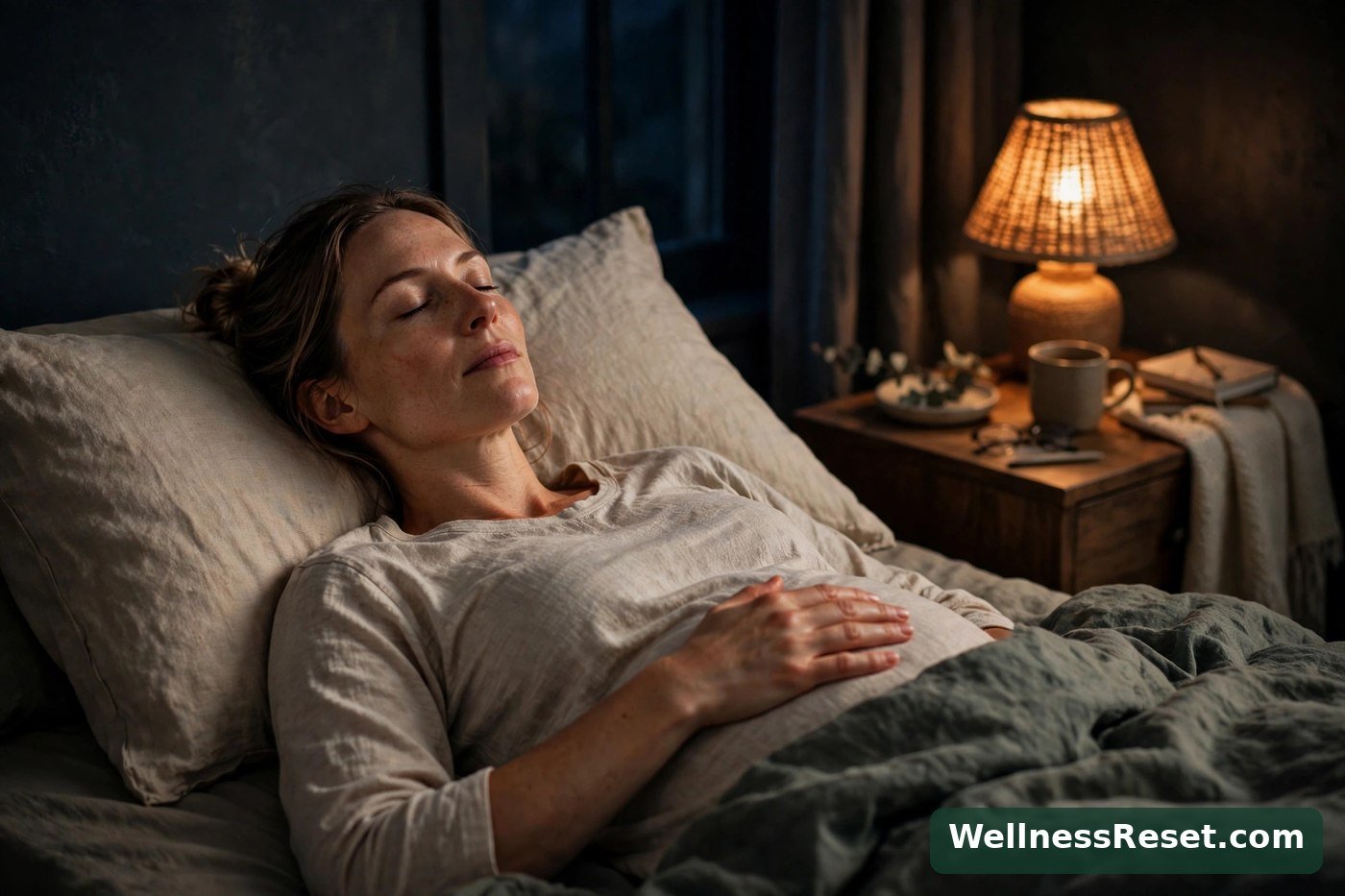
In through the nose for 4, hold for 7, out through the mouth with a soft whoosh for 8. Four rounds to start. The long hold-plus-exhale combination is strongly sedating for most people, which makes this the bedtime member of the family — racing thoughts at midnight are anxiety wearing a nightdress. Best for: anxiety at bedtime, waking anxious at night.
Which One, When?
| Situation | Use this |
|---|---|
| Sudden spike, heart pounding | Physiological sigh (1–3 rounds), then extended exhale |
| Sitting in a meeting, mind racing | Box breathing — invisible, and the counting occupies your thoughts |
| All-day background worry | Belly breathing breaks (5 min, 2–3 times) + extended exhale |
| Anxious and cannot sleep | 4-7-8 in bed, lights off |
| In the car or on a train | Extended exhale only — skip holds and counting tricks that need attention |
Mistakes That Make Breathing Exercises “Not Work”
Taking enormous breaths is the first. People hear “deep breathing” and gulp air like they are about to dive. That over-breathing blows off too much carbon dioxide and produces exactly the dizziness and tingling they are trying to escape. Small, quiet, slow — the person next to you should not hear you.
The second is only ever practising mid-crisis. A technique you meet for the first time at maximum anxiety has no chance; your brain cannot learn a new skill while it is sounding the alarm. Practise belly breathing and the extended exhale when you are already calm — two short sessions a day for a week — and they will be there when you actually need them. Think of it as a fire drill, not the fire.
And the third is judging too fast. The shift usually lands in minute two or three, not second twenty. Give any of these an honest three minutes before deciding it does nothing.

Final Words
Anxiety is loud, but it runs on a loop — fast breath, alarming symptoms, more fear, faster breath. Every exercise in this article breaks that loop at the same weak point: the exhale. Learn the extended exhale first, keep the sigh in your pocket for the sharp moments, and practise on calm days so the skill exists on the hard ones. Small, quiet, regular — that is the entire secret, and it travels anywhere you do.
FAQs
How long do breathing exercises take to work for anxiety?
The physiological sigh can take the edge off within a minute. The others usually land somewhere in minute two or three of steady practice. If nothing shifts after five honest minutes, change position, get some air, and try again later — and note the episode down if it keeps happening.
Can focusing on my breath make anxiety worse?
For some people, at first, yes — attention on the breath can feel uncomfortable when you are very anxious. If that is you, anchor on something external instead: count the exhale only, or name five things you can see while breathing out slowly. The long exhale is the active ingredient; the counting is just a delivery method.
How often should I practise?
Two short sessions a day (3–5 minutes) when calm, plus in-the-moment use whenever anxiety spikes. A week of that builds the skill properly. More is not better — consistency is.
Are these a substitute for therapy or medication?
No. They are regulation tools for everyday anxiety, and many people use them alongside professional help. If anxiety is stopping you working, sleeping, or living normally, please treat that as a health issue and see a professional — that is a strength move, not a last resort.


3 Comments