Stress Relief Exercises
It was a Tuesday, about 4:40 in the afternoon, and I realised I had been holding my shoulders up near my ears for roughly three hours. No reason. No crisis. Just emails, a deadline that kept moving, and my body quietly bracing itself like it was waiting for bad news. My jaw ached. My neck felt like a rusted hinge. And the worst part was I had not noticed any of it until my phone buzzed and I flinched — at a text from my sister about dinner.
That is what stress actually looks like most days. Not a dramatic breakdown. Just a slow tightening, hour after hour, until your body is doing the worrying for you. And the usual advice — “just relax” — is useless, because nobody who is tense has ever relaxed on command.
What works instead is giving your body something small and physical to do. Not a workout. Not a forty-minute yoga class you will never start. Ten minutes of slow, gentle movement that tells your nervous system the emergency is over. That is what these stress relief exercises are: a short routine you can do in your living room, in ordinary clothes, on an ordinary chair, the moment you notice the tension creeping in.
Why Gentle Movement Works When “Relaxing” Does Not
Here is the thing most advice skips. Stress is not only in your head — it lives in your muscles. When your brain senses pressure, it tells your shoulders to rise, your jaw to clench, your breathing to go shallow and fast. It is an old survival reflex, and your body does it whether the threat is a tiger or a difficult phone call.
Sitting still and telling yourself to calm down does not switch that reflex off, because the muscles never got the message. Slow movement does. When you roll your neck, stretch your shoulders, and breathe out longer than you breathe in, you are sending a signal in the other direction: from the body back to the brain. I am safe. Nothing is chasing me. Stand down.
That is also why this routine is not just breathing. Breathing alone helps — and we have a whole guide to it if you want to go deeper: Breathing Exercises for Anxiety. But on a truly wired day, sitting still and focusing on your breath can feel impossible, like being told to sit quietly in a room full of wasps. Moving first makes the breathing easier. The stretches burn off the physical restlessness; then the slow breaths land properly.
One honest note before we start. These stress relief exercises ease everyday tension — the tight shoulders, the wired feeling, the afternoon slump. They will not fix the thing that is stressing you out, and they are not a treatment for anxiety, depression, or any medical condition. If stress is constant, or your sleep and appetite have changed for weeks, talk to your doctor. That is not a disclaimer for the sake of it. It is the truth, and you deserve it straight.
The Ten-Minute Routine
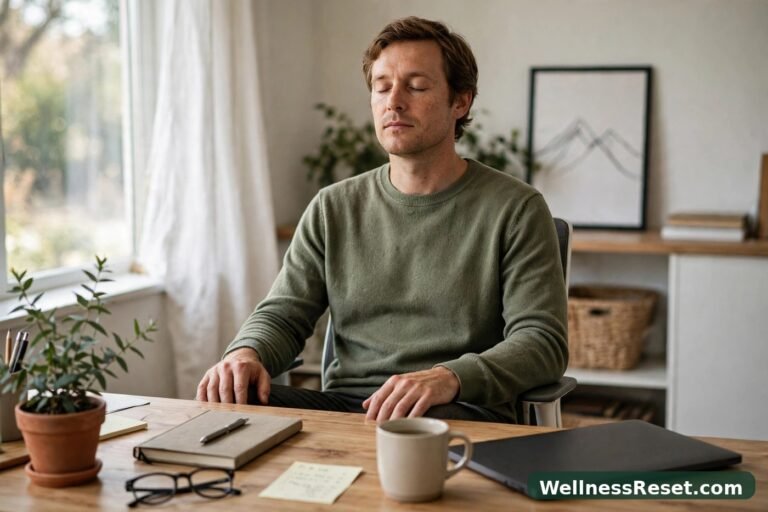
You need a sturdy chair with a flat seat and no wheels, a bit of floor space, and ten minutes. Do it once a day at first — late afternoon works well, when the day’s tension has had time to build. Or do it the moment you catch yourself clenching. There are six moves, and none of them should hurt. Mild stretching is fine. Sharp pain is a stop sign, not a challenge.
1. Slow Neck Rolls
Best for: the stiff, heavy feeling at the base of your skull after hours at a screen.
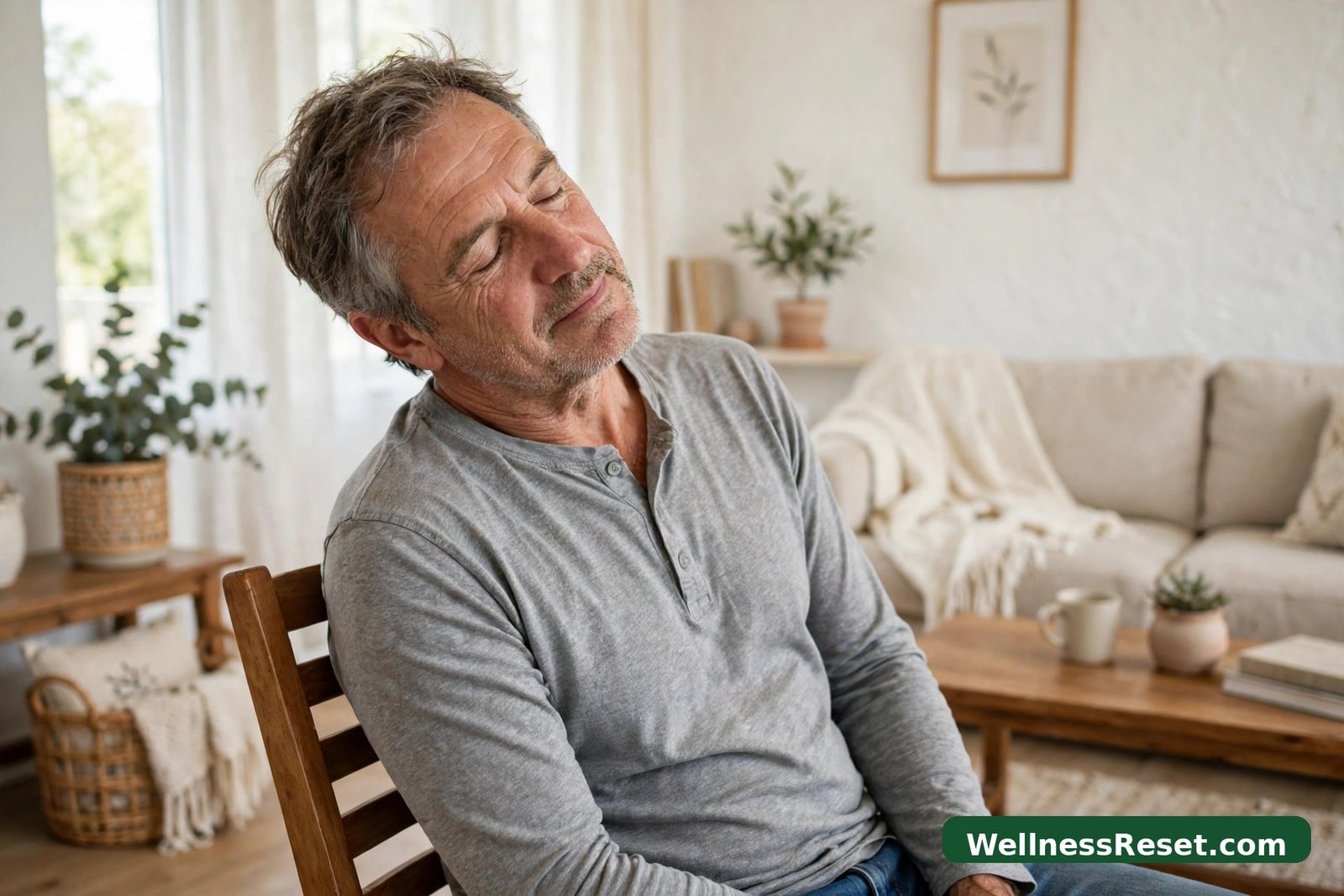
Sit tall, feet flat on the floor, hands resting on your thighs. Drop your chin slowly toward your chest. Then roll your right ear toward your right shoulder, let your head drift back just a little, and keep rolling around to the left ear. Three slow circles one way, three the other. Each full circle should take about ten seconds. That sounds slow. It is supposed to be. Your neck has spent all day locked in one position; yanking it around now only adds to the problem.
2. Shoulder Rolls and Squeezes
Best for: shoulders that have crept up toward your ears without you noticing.
Lift both shoulders toward your ears, hold for three seconds, then let them drop like you are letting go of a heavy bag. Do that three times. Then roll both shoulders backwards in big slow circles, five times. Then forwards, five times. Your shoulder blades should feel like they are sliding down your back. This is the move I do most often, honestly — in the car at red lights, waiting for the kettle, between meetings. It takes thirty seconds and it changes how the next hour feels.
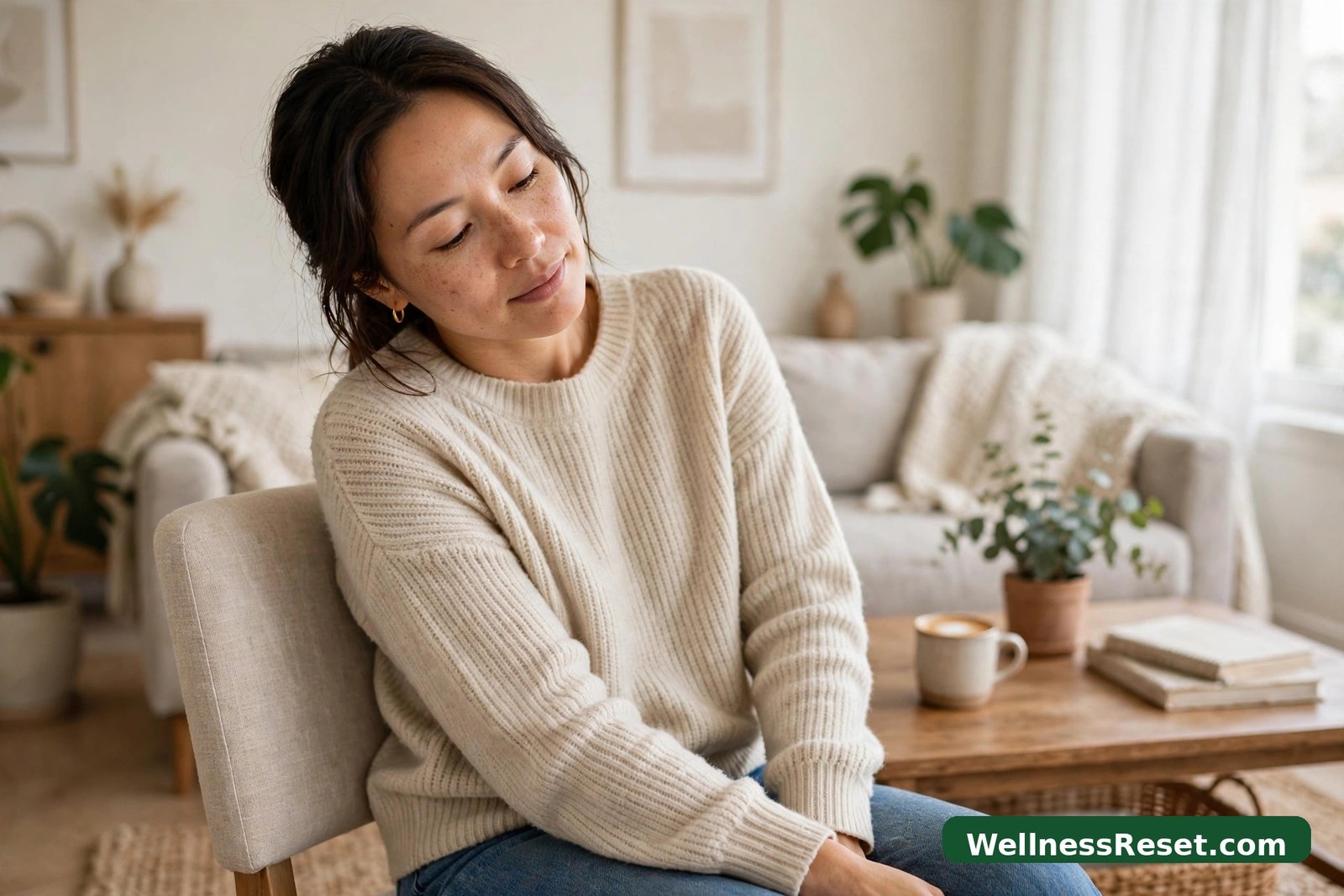
3. Seated Side Stretch
Best for: the tight band along your ribs and waist after sitting folded over a desk all day.
Stay seated. Reach your right arm up overhead and lean gently to the left, like you are reaching for something on a high shelf. Hold for five slow breaths. Come back to centre. Switch sides. Do each side twice. Keep your sitting bones on the chair — the stretch comes from lengthening your side, not from tipping over. If your lower back complains, make the lean smaller. A small stretch you can breathe through beats a big one you have to hold your breath for.
4. Slow Breathing With a Long Exhale
Best for: the wired, buzzy feeling when your heart is beating faster than the situation deserves.
This is the one breathing piece in the routine, and it is deliberately short. Sit back in your chair, one hand on your belly. Breathe in through your nose for four counts. Feel your belly rise — your chest should barely move. Then breathe out slowly through your mouth for six counts, like you are cooling a cup of tea. Six rounds. That is about two minutes. The long exhale is the active ingredient: it is the part that tells your body to slow down. If four counts in feels too long, use three in and five out. The ratio matters more than the numbers. For a fuller breathing practice, our step-by-step belly breathing guide walks through the technique properly: Belly Breathing for Beginners.
For a more structured breathing pattern, try Box Breathing.
5. A Slow Walk, Even Indoors
Best for: restless legs, a foggy head, and the feeling that you need to move but have nowhere to go.
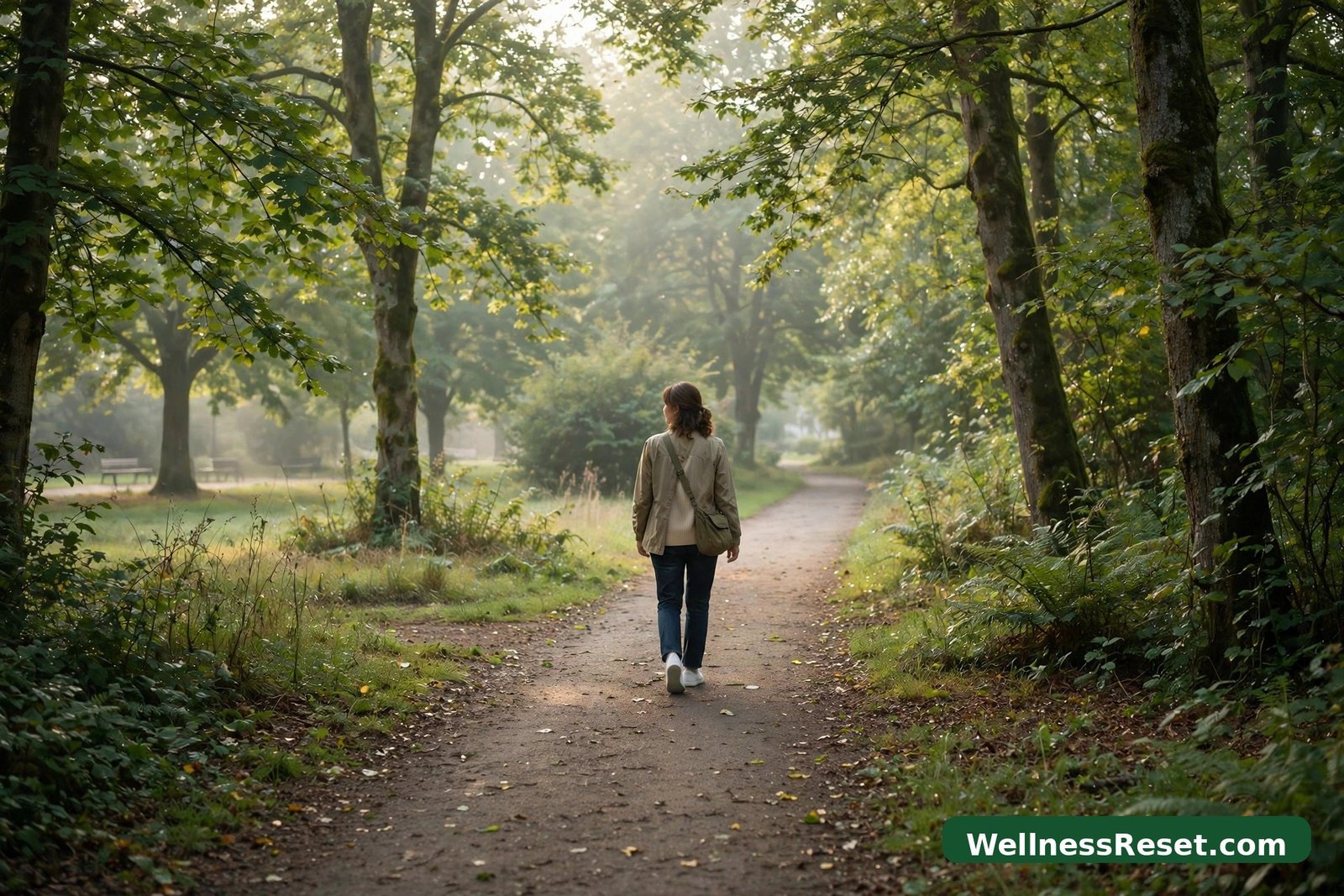
Stand up and walk. Slowly. Not a march, not exercise — a stroll. Around your living room, down the hallway, out to the garden if you have one. Five minutes, at a pace where you could comfortably hold a conversation. Swing your arms loosely. Let your eyes wander instead of staring at the floor. This sounds too simple to count as an exercise, and that is exactly the point. Gentle rhythmic movement is one of the oldest ways humans have calmed themselves down, and it works better than scrolling your phone for five minutes, which is what most of us do instead.
6. The Shake-Out
Best for: the last bit of tension hiding in your hands, arms and legs.
Stand up, feet hip-width apart. Shake your hands loosely, like you are flicking water off your fingers. Ten seconds. Then shake each arm from the shoulder, loose and floppy, ten seconds each. Then lift one knee and shake the lower leg out, ten seconds, and switch. It looks faintly ridiculous. It also works, because tension hides in the small muscles of your hands and feet and shaking them out is the fastest way to remind them they are allowed to let go.
How to Put It Together
Here is the whole thing in order, so you can run it without thinking:
Minutes 1–2: Slow neck rolls. Three circles each way, ten seconds per circle.
Minutes 2–4: Shoulder rolls and squeezes. Three lifts and drops, then five circles back, five forward.
Minutes 4–6: Seated side stretches. Two rounds each side, five breaths per hold.
Minutes 6–8: Slow breathing with a long exhale. Six rounds, four counts in, six counts out.
Minutes 8–10: Slow walk around the house or garden, then the shake-out to finish.
Total: ten minutes. You can do the first four seated and the last two standing, which means the whole routine fits in a lunch break or the gap between the school run and dinner. If ten minutes feels like too much on a bad day, do the shoulder rolls and the breathing only — that is three minutes, and it is genuinely better than nothing. Do not let the perfect version be the enemy of the done version.
Troubleshooting
| Problem | Quick fix |
|---|---|
| You feel silly doing the shake-out | Do it in another room, or skip it and add an extra minute of walking instead |
| Breathing slowly makes you feel more anxious | Shorten the counts — try three in, five out — or drop the breathing and do the stretches only |
| Your neck clicks during the rolls | That is usually harmless, but slow right down and make the circles smaller; pain means stop |
| You keep forgetting to do it | Tie it to something you already do — after lunch, or when the kettle boils |
| Ten minutes feels impossible today | Do just the shoulder rolls and six slow breaths — three minutes still counts |
| The tension comes straight back | That is normal — stress returns because the cause is still there; repeat the routine later, and deal with the cause when you can |
Common Mistakes
Treating it like a workout. If you are sweating or out of breath, you have gone too fast. These are stress relief exercises, not cardio. Slow is the whole mechanism. Speed ruins it.
Holding your breath during the stretches. The moment a stretch gets interesting, people stop breathing. If you catch yourself doing it, ease off the stretch until your breathing is normal again. The breath is the pace-setter.
Doing it once and deciding it does nothing. One round takes the edge off for an hour. A week of daily practice changes how quickly you notice tension building — and noticing earlier is half the battle. Give it seven days before you judge it.
Saving it for the worst days only. This routine works best as maintenance, like brushing your teeth. The days you feel fine are the days it is easiest to do, and they are also the days it builds the habit that carries you through the bad ones.
Ignoring the cause. Movement manages the tension in your body. It does not fix an impossible workload, a difficult relationship, or money worries. Use the ten minutes to feel better — then use the clearer head to deal with the actual problem, or ask for help with it. The NHS has a straightforward guide to stress that is worth reading when you have a quiet moment: NHS Tips to Reduce Stress.
Final Words
Stress will keep arriving. That is not a failure on your part — it is the shape of a normal life with a job, a family, bills, and a phone that never stops buzzing. The question is not how to eliminate it. It is how quickly you can notice it and do something small about it before it settles into your shoulders for the whole evening.
Ten minutes. A chair, a slow neck roll, a long exhale, a walk around the room. That is the whole routine, and it is enough. Try it this afternoon, at the exact moment you catch yourself clenching your jaw. And if you do, pay attention to what happens in the minute afterwards — your shoulders drop, your breathing slows, and the problem that felt enormous at 4:40 feels a little bit smaller at 4:50. It has not gone away. But you have a little more room around it. And room is what you needed all along.
FAQ
How long do stress relief exercises take to work?
Most people feel their shoulders and breathing ease within the first two or three minutes. The effect is real but temporary — like stretching a stiff muscle, it helps for a while and then daily life tightens things up again. The benefit builds with repetition, so doing it daily matters more than doing it perfectly once.
Can I do these exercises at work?
Yes, and that is where they help most. The seated moves — neck rolls, shoulder rolls, side stretches, slow breathing — all work at a desk. The walk and shake-out can wait until you are home, or take them to a corridor or stairwell if your office allows it.
Are stress relief exercises enough for anxiety?
No, not on their own. They ease everyday tension and can be a useful part of managing anxiety, but anxiety that is constant, overwhelming, or stopping you from doing normal things needs proper support — your doctor is the right first step, not a stretching routine.
How often should I do stress relief exercises?
Once a day is a good starting point, ideally at the same time so it becomes a habit. On a hard day, two or three short rounds beat one long one. There is no upper limit — they are gentle enough to repeat whenever you notice tension building.
What if a stretch hurts?
Stop. A gentle pull is normal; sharp, shooting, or pinching pain is not. Make the movement smaller, move more slowly, or skip that move entirely. Pain that keeps coming back, or pain after an injury, needs a doctor or physiotherapist — not a home routine.